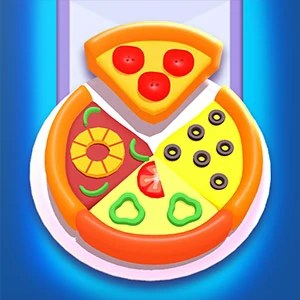
Pizza Puzzle is a browser matching game where identical pieces merge only when adjacent, and the run ends when no space is left. This walkthrough targets the harder stages, covering placement mistakes, board reading, and a practice routine for players who keep losing.
Pizza Puzzle: A Walkthrough for the Stages That Fight Back
Pizza Puzzle gives you one job and one rule. The job is to match the same pieces so they complete the whole. The rule is that pieces come together only when they sit next to the same piece. There is a hard stop, too: the game ends when there is no place left to put pizza. That's the entire brief from the catalogue, and honestly, it's enough to build a walkthrough around. In a game this stripped down, the difficulty doesn't come from hidden systems or surprise twists. It comes from the board filling up faster than you can close matches, and from the small placement decisions that quietly corner you ten moves before you notice.
This walkthrough is for the tougher stages, the ones where you've stopped coasting and started losing. We'll cover what the loop actually asks of you, the specific mistakes that end runs early, why the device you play on changes the feel, and a practice routine you can run without burning your good attempts. One note upfront: the controls weren't captured in our automated check, so we're not going to pretend we know the exact input scheme. Everything below sticks to what the catalogue establishes about how the game works.
The loop, and what you're actually optimizing for
Read the description slowly, because both clauses matter. "Match the same pieces to complete the whole" is the goal. "If you are next to the same piece, the pieces will come together" is the mechanism. The second sentence tells you that adjacency, not distance, is what triggers a merge. Two matching pieces sitting apart on the board are just two pieces. The moment they're touching, they combine.
That changes how you should think about every placement. You're not hunting for pairs in the abstract; you're engineering contact. The board state matters more than the piece in your hand. Before you commit, ask where this piece could touch its twin, and whether placing it there opens the board or seals a corner.
The game-over condition is the other half of the loop, and it's worth restating plainly: the run ends when there is no place to put pizza. You lose to space, not to a timer or a score threshold. Every move should be judged on how much room it leaves behind. A placement that completes a match but wedges the board is worse than a placement that delays the match but keeps three lanes open.
So what are you optimizing for? Not the fastest match. You're optimizing for continuing to have legal moves. Matches are the fuel; open space is the engine. Players who treat matching as the objective rather than the tool tend to burn bright for twenty moves and then stall out with a board full of near-pairs and no room to seat them.
Mistakes that end runs early
These are the failure patterns that show up again and again once stages get tight. None of them require knowing the exact piece set to describe, because they're structural.
- Placing against the wall for no reason. Edge placements feel tidy, but they cut off the number of neighbours a piece can have. A piece in the corner has two possible contacts; a piece in the middle has four. Reserve the edges for pieces that are already adjacent to a match. If you're parking a stray piece on the rim, you're spending board space you'll want back.
- Chasing the match you can see instead of the one you can build. The obvious merge is often the one that eats your last open pocket. When two options exist, take the one that leaves the board more spread out, not the one that clears the most pieces right now.
- Letting a single type flood the board. Because merging requires same-next-to-same, a cluster of one piece type with no partner is dead weight. If you notice three or more of a kind with no route to contact, stop adding to that pile and work the other types.
- Ignoring the last legal space. The game-over trigger is precise: no place to put pizza. That means you can be one placement away from the end without any dramatic warning. Count your open positions every few moves once the board passes the halfway mark. When you're down to a handful, every decision is a survival decision.
- Blind placements to "see what happens." In a spatial matching game, experimentation costs board space, and board space is the resource you lose to. If you want to test a line of play, do it in a fresh run rather than mid-stage.
- Hoarding matches. Some players hold pairs apart to keep options open. That works until it doesn't. Unmerged pairs occupy two spaces each while delivering nothing. If a pair can touch without boxing you in, let it.
There's a subtler error worth naming: treating every stage as a fresh puzzle when the board shape is the real teacher. The stages that give you trouble are telling you which placement habits are failing. If you keep dying with a clogged corner, that's not bad luck across ten runs. That's a habit.
Reading a tight board
When a stage gets hard, the board stops looking like a set of pieces and starts looking like a set of escape routes. Train yourself to scan in this order: open spaces first, existing adjacencies second, your current piece last. If you check the piece first, you'll find the best home for it and miss that it seals the board.
The adjacency rule gives you a useful diagnostic. Any piece with no same-type neighbour is a liability until one appears. Count them. If the liabilities outnumber your open pockets, you're in a squeeze and should prioritise merging over expanding. If you have plenty of room, you can afford to position pieces so future matches have short distances to travel.
Think of each merge as reclaiming space. Two pieces become one, and that's a net gain of room. A board that's merging steadily is a board that's breathing. A board where pieces are multiplying without combining is a board that's suffocating. You can feel the difference within a few moves, and you don't need to see far ahead to act on it.
Desktop, phone, and the patience question
Our automated check loaded the game on desktop with no errors, and the load took just under seven seconds. That's a fact about the test environment, not a verdict on the game everywhere. Seven seconds is long enough that it's worth letting the board settle before you start placing. Don't tap or click into a half-drawn board on instinct; wait for it to be fully there.
We have no verified data on how the game behaves on phones, so treat any phone-specific advice with caution. The one general point that holds regardless of device: spatial matching games reward precision, and precision is easier with a cursor than a fingertip. If you're on desktop, use that. If you're on a phone, slow your placements down and check each one before committing, because a mis-tap costs a board space you can't get back.
The load time also suggests a simple routine: start a run, let it finish loading, then play. Reloading mid-run to "reset" a bad board isn't a strategy, it's a habit that hides the feedback you need.
A practice plan that actually builds the skill
You don't need long sessions. You need deliberate ones. Here's a short routine that targets the specific skills this game rewards.
- Run one: space only. Play a stage without caring about your score. Before every placement, say out loud how many open positions remain. The goal is to finish a run with space still on the board, even if you matched less than usual.
- Run two: adjacency audit. Every few moves, count pieces with no same-type neighbour. Try to keep that number low. This trains you to spot stranded pieces before they pile up.
- Run three: merge discipline. Take every safe merge as soon as it's available. No hoarding. You're learning what a healthy, breathing board feels like.
- Run four: return to the hard stage. Don't grind it. Play it once, note where the board first gets tight, and stop. The note is the lesson.
Do this over a few days rather than in one sitting, and the tougher stages stop feeling like walls. The game is free to play in a browser, which makes short practice runs easy to fit in.
What to take into the next run
Pizza Puzzle isn't complicated. It's exacting. The whole game is that one adjacency rule plus the no-space ending, and every hard stage is a test of whether you're respecting both. Place for contact. Place for room. Count your openings before the board counts them for you. Do that, and the stages that used to end early will start running long enough for your matches to matter.