
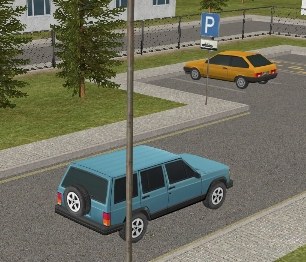
What the First Minute Actually Feels Like You open Parking Slot expecting something brainless, and for about forty seconds it delivers exactly that. A sedan sits at the top of the screen, a rectangular space waits below,
What the First Minute Actually Feels Like
You open Parking Slot expecting something brainless, and for about forty seconds it delivers exactly that. A sedan sits at the top of the screen, a rectangular space waits below, and you drag your finger or click an arrow to guide it in. The car moves slowly, almost politely. The space is wide. You nestle in, a little chime plays, and the next car appears. Easy. You're already thinking this might be too simple to hold your attention.
Then the third or fourth car shows up, and the space isn't quite where you left it. The opening has shifted. Maybe there's a pillar on one side now. Maybe the angle of approach forces you to swing wider than feels natural. And suddenly you're holding your breath over what looked, seconds ago, like a casual parking game. That's the trick Parking Slot pulls. It lulls you into a rhythm and then gently changes the rules mid-sip of your coffee.
I spent my first session hunched over my phone, thumb hovering, doing that thing where you physically lean as if it'll help the car rotate. It doesn't, but I kept doing it anyway. The game doesn't rush you. There's no timer ticking down, no countdown bar pulsing at the edge of your vision. The pressure is entirely self-imposed, which makes the first time you scrape a bumper against a concrete barrier feel surprisingly personal. You did that. You had all the time in the world and you still clipped the wall.
The Loop You're Actually Optimizing For
Parking Slot belongs to that quiet genre of spatial puzzle games where the mechanics are so stripped down that your brain starts inventing its own complexity. Each level gives you a vehicle and a marked parking bay. The car handles with a single input — either a steering wheel that rotates left and right, or forward/backward arrows depending on the version you're playing. The objective is simply to get the car fully inside the rectangle without touching the boundaries or any obstacles scattered around the lot.
What you're really optimizing for isn't speed. There's no star rating for finishing in under ten seconds. The game tracks whether you bump anything, and that's it. A clean park is a successful park. A scrape or a nudge against a pillar means you retry. So the loop becomes about precision, patience, and an almost meditative attention to the car's turning radius.
The satisfaction curve works differently here than in most casual games. Instead of escalating chaos, Parking Slot gives you increasingly awkward geometry. Early levels are straightforward pull-in jobs. Soon you're parallel parking between two tightly spaced cars. Later, you're navigating around shopping cart corrals, light poles, and oddly angled medians. The challenge isn't that things get faster — it's that the margin for error shrinks to something resembling real-world parking anxiety, minus the risk of actual insurance claims.
You'll notice after a few levels that you're not just watching the car. You're watching the space around it. You start mentally mapping the approach before you even touch the controls. That's the quiet genius here. The game trains you to slow down and plan, and the reward is a tiny endorphin hit when the car settles perfectly into the lines and the level completes itself without fanfare.
Where Most Runs Fall Apart
I lost more attempts to overcorrection than anything else. The steering is sensitive in a way that feels fair but punishes jerky movements. You see the back end drifting toward a pylon and you crank the wheel hard in the opposite direction, which sends the front swinging into the other barrier. The car doesn't have forgiving physics. It pivots from its center, and once you're diagonal in a tight space, you're usually doomed.
Another common run-ender is approaching the space at too sharp an angle. It's tempting to try to slide in with one smooth motion, especially when you've been cruising through easier levels. But the game's collision detection is unforgiving. Even a slight overlap with the painted line triggers a failure. I learned the hard way that if you're entering a parallel spot, you need to pull forward farther than you think before cutting the wheel. The visual perspective can trick you into turning early, and by the time you realize the car's trajectory is off, you're already kissing the bumper of the neighbouring vehicle.
There's also a specific mistake that shows up in levels with multiple obstacles. You'll fixate on the one barrier that seems most threatening — say, a concrete planter on the driver's side — and completely lose awareness of the passenger side mirror. The game uses a top-down view, so depth perception isn't really the issue. It's an attention problem. You're so focused on not hitting the obvious danger that you drift into something you forgot was there. I did this three times on a single level before I started consciously scanning the whole parking bay before moving.
The final trap worth mentioning applies mostly to phone players. The on-screen steering wheel sits low on the display, and if you're playing with your thumbs, it's easy to accidentally lift off mid-turn. The car stops rotating instantly, and if you're in the middle of a delicate maneuver, that sudden freeze can throw off your entire positioning. On desktop, this isn't really a concern since you're using arrow keys and they register cleanly. But on a phone, that half-second gap between touches matters more than you'd expect.
Phone Versus Desktop: A Noticeable Divide
I tested Parking Slot on both my phone and a laptop, and the experience splits in ways that affect how you should approach the game. On desktop, the arrow-key controls give you crisp, discrete inputs. Tap right, the wheels turn a fixed amount. Hold right, they keep turning until you release. This makes it easier to develop muscle memory for specific angles. You can count key presses if you're that type of player. After a while, you just know that three taps of the right arrow sets you up for a clean parallel entry on most standard-width spaces.
The phone version uses a virtual steering wheel or left-right buttons, depending on the implementation. The sensitivity feels slightly different — a little floatier, a little less precise at the edges. It's not broken by any stretch, but it demands a lighter touch. I found myself doing better with small, quick adjustments rather than long sweeping turns. Thumb fatigue also becomes a real thing if you're grinding through a dozen levels in one sitting. The game is free and browser-based either way, so you can switch between devices without losing anything. If I'm playing seriously, trying to clear a tough set of levels, I prefer the keyboard. If I'm killing five minutes in a waiting room, the phone works fine as long as I accept that my error rate will be slightly higher.
One small note on the browser experience: the game loads quickly on both platforms, but on older phones, the touch response can lag by a fraction of a second. It's not game-breaking, but it's enough to mess with timing on the tighter spaces. If you notice your inputs feeling sluggish, closing other tabs usually clears it up.
A Practice Plan That Actually Builds Skill
After about twenty minutes of play, I started settling into a groove that felt repeatable. If you want to improve without just bashing your head against the same level, here's a loose structure that worked for me.
First, spend five minutes on the earliest levels without trying to beat them. Instead, experiment with how the car responds to different turn durations. Drive in circles around the lot. Pull into spaces from ridiculous angles just to see where the collision boundaries actually sit. The game doesn't penalize you for time, and failing has no consequence beyond a quick reset. This is your sandbox period. Learn exactly how far the car's nose swings when you hold the turn for a full second versus a half-second.
Second, pick one parallel parking level — usually one of the mid-difficulty ones with two cars bracketing the space — and replay it until you can do it three times in a row without touching the lines. Don't move on after one clean completion. The muscle memory doesn't stick that way. Three consecutive successes forces you to develop a reliable approach rather than a lucky one.
Third, when you hit a level that feels impossible, put the game down for ten minutes. I'm serious. The frustration builds quickly because the game is so quiet. There's no music hyping you up, no flashy effects. Just silence and your own annoyance. Stepping away lets your spatial processing reset. When I came back to the level with the diagonal pillars — the one that killed maybe fifteen of my attempts — I cleared it on the second try simply because I wasn't overthinking the angle anymore.
Finally, if you're on a phone, try switching to a stylus or using your index finger instead of your thumb. The increased precision sounds like a tiny change, but on levels where you need to hold a specific steering angle while inching forward, it makes a genuine difference. On desktop, consider turning off any mouse acceleration settings if you're using the on-screen controls rather than the keyboard. The game reads raw input, and any software smoothing can introduce slight unpredictability.
Parking Slot doesn't demand a huge time commitment. It's the kind of game you can play for ten minutes during a break and feel oddly settled afterward. The absence of timers, scores, or competitive elements strips away the usual casual-game anxiety. What's left is a small, focused puzzle about spatial awareness and patience. I didn't expect to care as much as I did about whether a pixelated sedan was perfectly centered between two painted lines, but here we are. It's a free browser game that knows exactly what it wants to be, and that restraint is what keeps me coming back to it when I need something calm to do with my hands.