
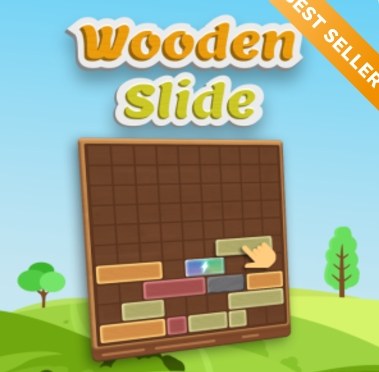
Wooden Slide is a browser puzzle where you slide blocks to fill and clear rows before the tower hits the ceiling. It suits players who enjoy fast, combo-driven score chasing with instant same-level retries.
What Wooden Slide Actually Asks You to Do
The catalogue entry for Wooden Slide is short, and it is worth reading closely before you touch anything. Here is the whole of it: quickly slide your blocks to fill up the rows to remove blocks from play. Keep sliding as fast as possible as you attempt to keep the blocks from reaching the top. Once the tower reaches the top it is game over. Play again and start at the same level.
That is the entire brief. There is no story, no character, no upgrade tree mentioned. What you get instead is a compact statement of a loop and a loss condition, and those two things tell you most of what you need to know about how to play well. This is a puzzle game about clearing rows under time pressure, and the pressure is spatial: the tower grows from below or from within, and the ceiling is the clock.
The phrase "fill up the rows" is doing a lot of work. It tells you that a row is not cleared by matching colours, pairing symbols, or connecting lines. It is cleared by being completely filled. That single rule changes how you should think about every move you make, and it is the foundation for everything below.
The Loop, and What You Are Actually Optimising
Strip the game down and the loop is this: blocks are present, you slide them, filled rows disappear, and the tower's height is the resource you are spending. Every row you clear buys you vertical space. Every moment you spend not clearing rows costs you that same space.
So what are you optimising for? Not speed alone, and not tidiness alone. You are optimising for the rate at which you convert loose blocks into cleared rows, while never letting the top of the tower reach the ceiling. Those two goals pull against each other. The fastest possible clearing rate comes from taking the first decent row you can complete. The longest possible survival comes from building structures that let you complete several rows in quick succession. Good play lives somewhere in the middle, and where exactly depends on how much headroom you have at that moment.
There is a second thing the description establishes that matters more than it first appears: play again and start at the same level. That means a failed run is not a step backwards. The level you reached is the level you return to. Whatever difficulty that level represents, it is now your floor. You are not grinding back through easier territory to reach the part that beat you. You are dropped straight back into it.
Practically, that changes how you should treat a loss. It is a free retry on the exact configuration that killed you. The information you gained in the failed attempt — which rows were filling, where the space was, which slide you fumbled — is still valid on the next attempt. Use it.
Combos: Why Consecutive Clears Beat Single Clears
The editorial angle here is combos, and the game's own rules explain why they matter without needing any extra lore. Row clearing in a fill-the-row game is inherently chainable. When you complete one row, the blocks in that row leave play. Removing them changes the shape of everything around them. Gaps that were blocked a second ago may now be reachable. Blocks that had nowhere to go may now have somewhere to go.
That is the mechanical basis for a combo: a clear that opens up the next clear. A single row removed in isolation is just one row of breathing room. Two or three rows removed in a connected sequence is a much larger swing, because the removals feed each other rather than each one being paid for separately.
What does this look like in practice? It usually means keeping a near-complete row in reserve rather than firing it the instant it becomes available. If a row is one slide away from filling, and you have a second row that is two slides away, the order in which you finish them decides whether you get a chain or two unrelated events. Finishing the two-slide row first, then the one-slide row, can let the second clear inherit the space the first one created.
The tension is obvious. Holding a completed row means holding a row's worth of blocks on the board, which means the tower is taller than it needs to be. If the top of the tower is close to the ceiling, holding is a bad trade. If you have room, holding is often the better play. Reading that correctly — am I rich in space or poor in it right now — is the core skill of the game.
High-Value Moves and How to Spot Them
Not every slide is worth the same. A few categories of move tend to pay better than the alternatives, and they all follow from the fill-the-row rule.
- The setup slide. A move that does not clear anything but places a block where it makes two rows simultaneously completable. It costs you one turn and returns two clears. This is the highest-value move type in most fill-the-row games, and it is easy to miss when you are reacting rather than planning.
- The cascade starter. A slide that clears a row in a position where the removal opens the path for a block that was previously stuck. You are not just clearing a row; you are unlocking a region of the board.
- The space recovery. When the tower is climbing, the correct move is often the ugliest one available — the clear that drops the height fastest, regardless of what it does to your layout. Survival moves and efficiency moves are different tools.
- The same-level restart. Because a loss returns you to the same level, the first few moves of a retry are effectively a rehearsal. If you know the opening configuration, you can plan an opening sequence rather than improvising it.
Notice that none of these require knowing anything about the game beyond the description. They are consequences of the rules as stated. That is the useful thing about a simple ruleset: the strategy is legible even when the specifics of a given board are not.
Mistakes That End Runs Early
Most failed runs in a game like this fail for a small number of repeated reasons. Here are the ones the rules most directly imply.
Clearing the first available row, always. This is the default behaviour and it is often correct, but doing it every single time means you never build a combo. You are paying full price for every row instead of letting some clears subsidise others. If you never hold a row, you never chain.
Ignoring the tower height until it is urgent. The loss condition is the tower reaching the top. That is a slow-moving number most of the time and a very fast-moving one at the end. If your first thought about height happens when you are already near the ceiling, you have left it too late to take a survival move.
Sliding without a destination. "Quickly slide your blocks" is an instruction about pace, not an instruction to move constantly. A slide that does not improve a row, unlock a block, or reduce height is a turn spent for nothing, and turns are the currency here.
Filling rows you cannot clear. A row that is nearly full is a liability if the last block needed to complete it is buried. Partial progress in the wrong place just adds height. Watch for rows that are close but unreachable and stop feeding them.
Treating a retry as a fresh start. The game puts you back at the same level. If you lost at a specific point, you already know something about that point. Playing the retry identically and hoping for a different result wastes the one advantage the restart rule gives you.
Panicking at the top. When the tower is high, the temptation is to make fast, small, reactive moves. Those are exactly the moves that do not reduce height. A single well-chosen clear that removes a full row does more for you than five hurried nudges.
Phone, Desktop, and How You Play
The catalogue does not specify platform requirements, controls, or whether the game is tuned differently on touchscreens versus a mouse or trackpad. So the honest answer is that the description does not say, and anything specific about input would be guesswork.
What can be said is general and follows from the pace the game asks for. Wooden Slide wants fast sliding, and fast sliding is easier on whichever device lets you make precise, repeatable movements without your hand covering the board. If you are on a phone, that usually means a grip that keeps your thumb clear of the rows you are reading. If you are on a desktop, it usually means keeping your pointer near the region where your next few moves are likely to happen rather than dragging it back and forth across the whole screen.
It also runs in a browser, which means there is nothing to install and no commitment to a session. That suits a game structured around short runs and immediate restarts. You can take one attempt, lose, and take another without any setup in between — which is precisely the rhythm the same-level restart rule is built for.
A Short Practice Plan
If you want to get better at this rather than just play it, try structuring a handful of runs deliberately. Ten or fifteen minutes is plenty.
Run one: clear everything immediately. Take every row the moment it is available. Do not hold anything. This establishes your baseline rate and shows you where the tower gets ahead of you. Note the point where you first feel the ceiling becoming a problem.
Run two: hold one row at a time. Same rules, but you are allowed to keep a single completable row in reserve until a second row is also close. Try to convert them together. Compare how much space you had at the same point in run one.
Run three: look for setup slides only. Ignore immediate clears unless you have no choice. Spend the run hunting for the single slide that makes two rows completable. You will probably lose earlier. That is fine — you are training a specific habit, not chasing a score.
Run four onwards: play normally, but after each loss, name one thing. Not a vague feeling. One concrete thing: a row you fed that you should have left alone, a combo you broke by clearing too early, a moment you stopped watching the height. Because the restart puts you back at the same level, you get to test that specific correction on the very next attempt.
That is the whole game as the catalogue describes it: slide blocks, fill rows, remove them, keep the tower down, and when it reaches the top, go again from where you left off. The strategy is all in how you spend the space you have.