What Hits You in the First Minute You open Rope Color Sort 3d and it's deceptively calm. A handful of glass vials sit on a plain background, each one holding a stack of colored discs threaded onto a central rope. The fir
What Hits You in the First Minute
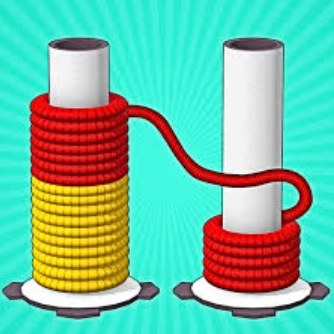
You open Rope Color Sort 3d and it's deceptively calm. A handful of glass vials sit on a plain background, each one holding a stack of colored discs threaded onto a central rope. The first thing I did was tap a vial, then tap another, and watched a single red disc lift off the rope and plop onto the new rope. The physics have a tiny bounce to them, just enough weight that the action feels satisfying. No timer starts ticking. No dramatic music swells. The game gives you space to figure things out, which is rare in the sort-puzzle genre where urgency usually gets pushed on you from the jump.
I spent the first couple of levels absentmindedly transferring colors around, thinking I'd cracked the code. Then around level five, I trapped a green disc under three blues and stared at the screen for a solid minute, realizing I'd made a mess I couldn't undo. That quiet panic is the heart of the game. It lulls you into thinking it's a casual color-matching toy, then quietly reveals itself as a spatial sequencing puzzle that punishes sloppy moves.
The Core Loop and What You're Actually Optimizing For
Each level gives you a set of vials, some empty and some filled with a stack of colored discs. The discs are threaded onto ropes, so you can only access the topmost color on any given rope. To move a disc, you tap the source vial, then tap a target vial. The move only works if the target vial is either empty or already has the same color sitting at the top of its rope. That's the single constraint that drives every decision.
Your goal is to get each rope holding only one color, end to end. You're not racing a clock. You're not being scored on speed. The optimization is purely about move efficiency and avoiding dead ends. The fewer unnecessary transfers you make, the cleaner your solve. But the real optimization, the thing I started chasing after about ten minutes, is foresight. You start mentally mapping three or four moves ahead, imagining which colors need to be temporarily parked in empty vials, which ones can stack safely, and which sequence will collapse the puzzle without stranding a key disc at the bottom of a rope.
One subtlety I didn't appreciate at first: empty vials are a resource. Early levels give you exactly as many empties as you need. Later levels start getting stingier, forcing you to create your own empty vials by fully clearing a rope. That moment when you finally empty a vial and get a new staging area feels like unlocking a tool. You start treating empties like inventory slots in a resource-management game, not just places to dump unwanted colors.
Mistakes That Will Wreck Your Run Early
The most common mistake I made in my first session was treating the game like a simple match-and-clear. I'd see two red discs on different ropes and immediately move one onto the other, without checking what was underneath. If the receiving rope had a blue disc buried two spots down, that red disc was now trapped there until I cleared the blue, which might not be possible yet. The game has no undo button that I could find, and restarting a level from scratch is your only bailout. That friction is intentional, I think. It forces you to slow down.
Another trap: filling your empty vials with "temporary" colors that you can't easily extract later. I'd park a yellow disc in an empty vial, then realize I needed that vial to stage a green, but the yellow was blocking access. Now I'm stuck searching for another yellow to pair it with, burning moves I didn't plan for. The fix is to be stingy with empties. Only commit a color to an empty vial if you know exactly how you'll free it up again.
A subtler error is ignoring the bottom disc of a nearly complete rope. You might have a rope with four blue discs on top and one green at the very bottom. It's tempting to keep stacking blues there, but until you figure out how to excavate that green, that rope is a dead end for blue completion. I started scanning the bottom disc of every rope before making any major moves, because that hidden color dictates the true availability of the rope.
Here's a specific pattern that burned me twice: I had two ropes both topped with the same color, and both had that same color as the bottom disc. I merged them, creating a long stack, only to realize I'd now buried the very color I needed to clear in order to access other discs. When you see identical top and bottom colors on a rope, pause. That's a warning sign to check whether merging will actually help or just deepen a grave.
How the Difficulty Ramps and What Changes
The early levels feel like tutorial territory, even though there's no explicit hand-holding. You get plenty of empty vials, rope stacks are short, and the color palette is limited to maybe three or four distinct hues. By level 20 or so, they start introducing longer ropes, meaning more discs per vial, and the color variety expands. Suddenly you're juggling six or seven colors across a dozen vials, and the mental stack gets heavier.
Around that point, the game also starts playing with what I'd call "color adjacency traps." You'll have two colors that look similar under certain lighting—a teal and a light blue, or a coral and an orange—and in the heat of planning, you'll misidentify one. I made a move confidently once, thinking I was stacking matching pinks, only to realize one was actually a lavender. That mistake cost me four moves to unwind. The 3D perspective, which is mostly cosmetic, does slightly shift how colors read depending on the angle, so I started rotating the view with a quick drag before committing to color-sensitive moves.
What doesn't change: the game never adds timers, power-ups, or move counters. The purity holds. The challenge comes entirely from increased combinatorial complexity. That's a design choice I respect. It means the difficulty is genuine puzzle difficulty, not artificial pressure. But it also means if you hit a wall, there's no hint system to nudge you, which can be frustrating if you're stuck for five minutes on a single configuration.
Playing on Phone vs Desktop
I tested this on both a mid-range Android phone and a desktop browser, and the experience diverges more than I expected for a simple sort game. On phone, the vials are large enough to tap accurately with a thumb, and the vertical orientation feels natural—you're looking down at a row of bottles, which maps well to the portrait screen. The drag-to-rotate gesture is responsive, though I occasionally accidentally rotated when I meant to tap a vial at the edge of the screen. That's a minor annoyance that fades with muscle memory.
On desktop, the mouse click precision is obviously superior, but the game feels oddly small in a browser window. The vials sit centered with generous empty space around them, and I found myself wanting a fullscreen mode that didn't exist. The rotation is handled by click-dragging, which works fine but lacks the tactile immediacy of the touch version. One oddity: on desktop, I sometimes misclicked when two vials were positioned close together at certain angles, sending a disc to the wrong destination. That's a precision issue that never happened on phone.
If you're planning to play seriously, I'd lean toward the mobile version. The touch interface suits the casual-but-focused nature of the puzzles. It's easy to pick up for three minutes while waiting for something, which is really the ideal session length for this kind of game. On desktop, it feels like it's filling space rather than commanding attention.
A Practical Practice Plan for Getting Good
If you want to build competence without constantly restarting levels, here's a loose plan that worked for me after about 15 minutes of flailing. First, spend two or three levels doing nothing but observation before your first move. Scan every rope from top to bottom, noting which colors appear as both top and bottom discs. Those are your priority targets, because freeing them unlocks options. Identify which colors are "stranded"—appearing only once across all ropes—and which ones have multiple accessible copies. The stranded ones are your blockers; plan around them.
Second, practice the "empty vial discipline" I mentioned. For the next five levels, make a rule: never fill your last empty vial unless you can see the exact sequence of moves that will empty it again within three steps. This forces you to treat empties as scarce, which they actually are in harder levels. It's a training-wheels constraint that builds good instincts.
Third, when you get stuck, don't restart immediately. Instead, try to articulate exactly which color is the bottleneck and why. Is a red disc trapped at the bottom of a rope that's topped with greens? Is there a chain of dependencies that needs to be unwound in a specific order? Verbalizing the problem, even just in your head, often reveals a path you overlooked. The puzzles are deterministic; there's always a solution. The bottleneck is usually a single disc you're ignoring because it's buried deep.
Finally, play in short sessions. This isn't a game that rewards marathon grinding. The mental fatigue of tracking multiple colors across multiple ropes sets in fast, and your solve quality drops. I found 15-20 minute sessions to be the sweet spot. After that, I'd start making lazy moves and digging holes I couldn't climb out of. The game runs fine in a free browser tab, no download needed, so it's easy to dip in and out.
What the Game Doesn't Tell You
A few unspoken mechanics emerged over time. First, the disc transfer animation isn't just cosmetic. There's a brief delay between when you tap a target vial and when the disc settles, and you can't queue another move during that window. It's a tiny cooldown that prevents rapid-fire experimentation. On harder levels, I found myself impatiently tapping during that window and getting no response, which initially felt like a bug. It's not. The game forces a rhythm on you.
Second, the 3D aspect is mostly aesthetic, but it does have one functional quirk: at certain rotation angles, you can see slightly down into a vial and get a hint of the color beneath the top disc. It's not explicit, but with practice, you can learn to spot the edge of the next disc's hue. I'm not sure if this is intentional or a rendering artifact, but it's there. It's subtle enough that it doesn't trivialize the puzzle, but observant players can use it to peek one move ahead.
Third, there's no level skip or hint system. If you're truly stuck, your only options are to restart or to close the tab and come back later. I respect the purity of that choice, but it also means this game isn't for everyone. If you need progression at all costs, the friction will grate. If you enjoy sitting with a single puzzle until it cracks, the design is oddly meditative.
Who This Game Is For and Who Should Skip It
Rope Color Sort 3d appeals most to players who enjoy methodical, consequence-heavy puzzle solving. It's closer to a solitaire variant or a Towers of Hanoi derivative than to a frantic match-three. The lack of timers, scores, or flashy feedback means you have to be intrinsically motivated. The reward is the quiet click of a solved puzzle, not a fireworks display. If you find satisfaction in organizing physical objects—sorting a messy drawer, arranging books by color—this scratches a similar itch.
Skip it if you need variety in your puzzle diet. The core mechanic doesn't evolve dramatically. Levels get harder through complexity, not through new mechanics. By level 30, you've seen everything the game will throw at you, just in denser configurations. That's not a criticism; it's a design choice. But if you're someone who gets bored once you've mastered a single system, the game's long tail might feel repetitive rather than rewarding.
For a free browser game you can fire up with no account, no download, and no ad interruptions that I encountered, it's a solid little brain teaser. It won't change your life, but it might change how you spend 15 minutes of a slow afternoon.