
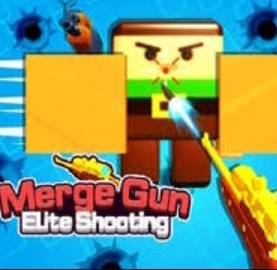
Your First 60 Seconds in Merge Gun Elite Shooting I opened this game expecting a standard idle merger, and I was half right. The first thing that hit me was the gun barrel in the bottom-center of the screen — it's alread
Your First 60 Seconds in Merge Gun Elite Shooting
I opened this game expecting a standard idle merger, and I was half right. The first thing that hit me was the gun barrel in the bottom-center of the screen — it's already firing. You don't press a shoot button. Bullets stream out automatically at a base fire rate that feels painfully slow, like a garden hose with a kink in it. Enemies drift down from the top in neat little rows, each one carrying a small white number above its head. That number is its health. Your gun has a damage number floating right on it. If your damage is 5 and the enemy shows 12, you're going to be sitting there for a while, watching three bullets plink away while that enemy inches closer to your position. That's the core tension: everything is a race between your damage output and the enemy's advance.
Within seconds, a "Merge" arrow starts pulsing over two identical pistols sitting in your bottom tray. You drag one onto the other. The resulting gun has a higher number. You slot it into the active weapon position, and suddenly those 12-health enemies pop in one shot instead of three. You feel a small rush. Then the next wave spawns enemies with 45 health, and you're back to scrambling. This is the rhythm for the entire game — brief moments of dominance interrupted by new thresholds that demand another merge cycle. The first minute tells you everything you need to know about whether you'll stick with it.
The Loop Isn't What You Think
Most merge games let you build up a board of items, combine them at your leisure, and then deploy the result. Merge Gun Elite Shooting collapses that timeline. The gun you're holding is firing right now, during the merge process. There's no pause screen where you calmly arrange your arsenal while enemies wait politely. If you spend three seconds dragging pistols around to find a match, those three seconds are filled with bullets doing potentially inadequate damage to enemies that are still moving toward you. This turns the merge mechanic into something closer to a real-time inventory management panic.
You're optimizing for two things simultaneously: the damage number on your active gun, and the speed at which you can produce the next meaningful upgrade. The board space is limited — you get a row of slots at the bottom, and guns spawn into them at intervals. New guns drop at a level roughly matching your current progression, but they're random. You'll get duplicates. You'll get guns that are one tier below what you need. Managing that grid of half-built weapons while your main gun is actively losing effectiveness against the current wave becomes the actual skill. It's less about "what merges with what" and more about "can I complete this merge before the big enemy reaches the bottom third of the screen."
The game rewards a specific type of multi-tasking. Your eyes need to flick between three zones: the enemy field (assessing threats), your active gun's damage number (comparing it to enemy health), and the merge tray (spotting pairs you can combine quickly). Players who fixate on one zone for too long will lose runs that a more distributed attention pattern would survive. I found this genuinely demanding in a way that surprised me for a browser game.
Where Most Runs Actually Die
After about 15 minutes of play, I started noticing the same failure patterns. The most common mistake isn't slow merging — it's merging the wrong thing at the wrong time. When you combine two guns, the new weapon goes into an empty slot or replaces one of the ingredients. If your active gun is currently the highest damage dealer you have, and you accidentally drag it onto a duplicate thinking you'll upgrade it, you briefly remove your best weapon from the firing position. For a split second, the active slot might default to a lower-level gun. In that gap, enemies that were being held at bay suddenly gain ground. I lost three runs before I realized what I was doing.
The second major error is hoarding. The tray fills up. You think, "I'll just wait until I have three of the same gun and make a bigger chain merge." While you're waiting, your active gun falls behind the enemy health curve. By the time you execute that satisfying triple-merge, enemies have closed the distance and your newly upgraded weapon doesn't have time to clear the backlog. Merge Gun Elite Shooting punishes delayed gratification. The optimal strategy is to merge as soon as you have a pair, even if it means you're only going up one tier, because maintaining parity with enemy health is more important than building a massive stockpile.
The third mistake is harder to spot: ignoring the spawn timing. New guns appear in your tray on a cooldown. If you merge too aggressively and empty your tray down to one or two guns, you might find yourself in a dead zone where no new guns have spawned yet, your active weapon is still weak, and enemies are bearing down. There's a rhythm to keeping at least three or four guns in reserve so you always have merge candidates when the cooldown refreshes. Emptying your tray for a big upgrade feels good but creates risk windows that compound fast.
Phone vs Desktop: The Input Gap Matters
I tested this on both a desktop browser with a mouse and on a mid-range Android phone using Chrome. The difference is significant enough to mention. On desktop, dragging guns with a mouse is precise and fast. You can execute a merge in under half a second, and the larger screen lets you keep peripheral vision on the enemy field. The game feels almost like it was designed for this input method.
On mobile, the merge tray sits at the bottom of the screen, and your thumb has to travel between guns. The hitboxes are generous — I rarely missed a drag — but the physical distance your thumb covers adds roughly 0.3 to 0.5 seconds per merge compared to mouse input. Over a run, that accumulates. I found myself playing more conservatively on mobile, merging earlier and keeping a larger buffer of upgraded guns, because I knew my input speed was slower. If you're struggling on phone, the issue might not be your strategy but simply the input lag inherent to touch dragging. You can compensate by prioritizing merges that require the shortest drag distance — look for adjacent guns in the tray rather than guns on opposite ends.
One desktop-specific advantage: you can use keyboard shortcuts for some actions, though the game doesn't advertise them. Tab cycles between available guns in the merge tray, and number keys slot weapons into the active position. I discovered this accidentally when I fat-fingered the 2 key. It cuts merge time roughly in half once you build the muscle memory. Mobile has no equivalent shortcut layer, so phone players are working with a harder baseline difficulty.
Enemy Patterns You Can Exploit
The enemies aren't just health sponges with different numbers. After several runs, I noticed subtle differences in movement speed and formation. The small, low-health enemies move faster than the chunky high-health ones. This creates a priority problem: your gun automatically targets the nearest enemy, which is often a fast little 10-health pest, while a 200-health behemoth is steadily advancing right behind it. You can't manually aim. The only way to shift targeting priority is to clear the front line fast enough that the big enemy becomes the nearest target.
This means your damage threshold isn't just "can I kill enemies before they reach me" — it's "can I kill the small fast enemies quickly enough to have time left over for the slow tanky ones." If your gun does 50 damage and the small enemies have 40 health, you're two-shotting them. That extra shot per small enemy adds up across a wave and leaves less time for the heavy units. The real breakpoints are when your damage one-shots the fast enemies, freeing up your gun's full attention for the real threats. I started checking enemy health against my damage number at the start of each wave and calculating whether I was at a one-shot threshold. If I wasn't, I prioritized merges even harder.
Waves also tend to cluster enemies in columns. Three enemies with identical health will drop in a vertical line. Your gun chews through the front one, then the middle, then the back. If you're slightly underpowered, the back enemy will reach your position just as you finish the front two. Learning to recognize when a column is going to cause trouble — and merging preemptively before that column forms — separates decent runs from long ones.
The Upgrade Hierarchy Nobody Talks About
Merge Gun Elite Shooting doesn't have a tech tree or skill points in the traditional sense. But there's an implicit hierarchy in how you spend your limited merge actions. Every merge consumes two guns to produce one. That's a net loss of one gun from your tray. You're constantly trading quantity for quality. The question is which quality to pursue.
Gun damage is the obvious number everyone watches, but fire rate matters just as much and the game doesn't display it prominently. Some guns shoot faster than others even at the same damage tier. I noticed this with the SMG-style weapons versus the rifle-style ones — the SMG has a lower damage number but puts out more bullets per second, which can be better against waves with lots of small enemies. The rifle has higher single-shot damage but fires slower, making it better against tanky enemies where you need each bullet to count. You can't choose which gun type you get from a merge; it's determined by the ingredients. But you can influence your odds by which guns you choose to merge and which you leave sitting in the tray. If you have two SMGs and two rifles, merging the SMGs gives you a higher-tier SMG. Merging one SMG and one rifle might give you something in between. The merge system has a hidden preference for same-type combinations that I only started to notice after a dozen runs.
There's also a subtle economy around "wasted" merges. If you merge two guns and the result is only marginally better than what you already have slotted, you've spent two guns for a tiny upgrade. Sometimes it's better to hold that pair and wait for a third copy, which lets you do a double-merge that jumps two tiers instead of one. But this circles back to the hoarding problem. The skill is in judging whether the current wave pressure allows you to wait for a bigger payoff or forces you to take the small upgrade now.
A 20-Minute Practice Plan That Actually Works
If you want to push past the early-game plateau without grinding mindlessly, I'd suggest a focused 20-minute session with specific goals rather than just playing runs on autopilot. Here's what I did and why it helped.
First five minutes: play a run where you do not allow yourself to have more than four guns in the tray at any time. The moment you hit five, you must merge something, even if it's not the optimal pair. This forces you to break the hoarding habit and teaches you what the game feels like when you're constantly cycling your inventory. You'll probably lose this run early. That's fine. The point is to feel the rhythm of frequent merging.
Next five minutes: play a run where you only merge same-type guns. If you have two pistols, merge them. If you have a pistol and an SMG, leave them alone. This forces you to learn the type hierarchy and see how different gun families perform at higher tiers. Pay attention to which types clear waves faster relative to their damage number.
Minutes 10 through 15: play normally, but every time an enemy reaches the bottom half of the screen, say out loud what your current damage number is and what the enemy's health is. This verbal check builds the habit of actively comparing those numbers rather than just staring at the screen hoping things work out. It feels silly but it works.
Last five minutes: one full run where you try to apply everything. No hoarding, same-type merges when possible, constant damage-vs-health awareness. See how far you get compared to your earlier runs. I improved my average wave count by about 30% after a single session of this structured approach.
The game is free in your browser, which makes this kind of deliberate practice easy to justify — you're not burning limited lives or energy timers. You can reset as often as you want and experiment with different merge pacing without penalty. That low-stakes environment is perfect for building the specific awareness the game demands.