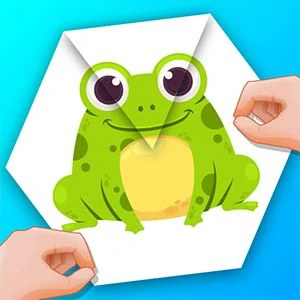
Paper Fold is a browser puzzle game where you click paper corners to fold them, and the right order creates patterns. It suits players who like origami games and easy controls, with unlockable backgrounds and patterns plus hints.
Paper Fold is a browser game built around a simple action: click a corner of the paper, and that corner folds. The catalogue lists it as a kids' adventure title playable on smartphones and tablets, including iPhone, iPad, Samsung, and other Apple and Android devices. It also describes interesting gameplay, easy controls, and a target audience of players who like origami games. Folding the paper in the right order produces patterns. You can unlock more backgrounds and patterns as you go, and hints are there for when you get stuck.
That's the whole factual foundation. There's no published list of levels, no scoring formula, no move limit. So this guide sticks to what the description establishes and treats everything else as habits worth building in a click-to-fold puzzle. Where the catalogue is silent, I'll say so rather than guess.
What the loop actually asks of you
Read the description closely and a clear loop falls out. You click corners. Order matters. Correct order makes patterns. Patterns and backgrounds unlock. Hints exist as a fallback.
So the thing you're optimizing isn't speed and it isn't reflexes. It's sequence. A fold that looks harmless on its own can be wrong because of when you made it, not because of what it did. The description's phrase "in the right order" is doing all the work here. That single line tells you the puzzle is about ordering, which means your main job is to think about what a fold does to everything after it.
There's a second thing to notice. The catalogue says hints are there if you get stuck, not that hints are free or unlimited. It doesn't say either way. Don't assume a hint is a permanent safety net. Treat it as a tool for a specific kind of stuck.
Advanced habits once you know the basics
These are habits, not secret moves. Nothing below contradicts the catalogue, and nothing below invents levels, timers, or scoring that the description doesn't mention.
- Plan two folds before you click one. If order is the mechanic, the cheap mistake is clicking as you go. Before the first click of a session, decide which corner you'll fold second. If your plan for fold two falls apart after fold one, you've learned something about the puzzle for free, without a wasted sequence.
- Read the target pattern before touching the paper. The description says the right order makes patterns. That implies a pattern exists to aim at. Look at what you're trying to produce and work backward to which corners must move. Players who click first and read the goal second are working in the wrong direction.
- Treat the first fold as the most expensive one. Early folds narrow your options the most, because everything after them is built on top. Save your most confident fold for the start and your least certain one for the end, when you have more information and less left to lose.
- Change one thing at a time. If a sequence fails, don't rebuild it from scratch. Reorder one fold. Working from a single change tells you whether that fold was the problem. Wholesale resets hide the cause.
- Use hints as confirmation, not as answers. The description offers hints for getting stuck. An advanced habit is reaching for one when you've already formed a theory, to check it, rather than the moment something feels hard. Confirming a good theory teaches you more than being handed a move.
- Notice what unlocks and why. Backgrounds and patterns unlock through play, per the catalogue. Pay attention to which successes open new content. If a particular kind of pattern seems to trigger unlocks, that's a direction to push rather than a one-off to admire.
Mistakes that end runs early
A few patterns of failure show up in any click-to-fold game, and the catalogue's emphasis on order makes them especially costly here.
Clicking corners you don't intend to fold. The controls are corner clicks. A stray click is a fold you didn't plan, and in an order-based puzzle an unplanned fold is a wrong fold. Slow your hand down. On a tablet, be honest about where your finger lands before you lift it.
Ignoring the pattern. The description promises patterns from correct sequences. If you're folding without looking at what you're trying to build, you're playing a guessing game. The pattern is the objective, so keep it in view.
Resetting too fast. When a sequence goes wrong, the temptation is to start over immediately. But you've just made a fold in context and you may not get that context back easily. Before resetting, name what went wrong. Even a one-word note ("corner too early") makes the next attempt smarter.
Leaning on hints too soon. The catalogue clearly offers hints. That doesn't mean the first hard moment is the moment to use one. If hints are limited and the description doesn't say they aren't, spending them on puzzles you could solve with a minute of thought is a waste of a resource you might need later.
Playing past the point of attention. Nothing in the description says Paper Fold demands long sessions. Order puzzles reward clear thinking, and clear thinking fades. If folds start feeling random, that's a signal to stop, not to push.
Phone, tablet, or desktop
The catalogue says the game is playable on all smartphones and tablets, naming iPhone, iPad, Samsung, and other Apple and Android systems. It doesn't mention desktop. A verified load check on a desktop browser did complete, with a load time of roughly ten seconds, but that is a load result, not a statement that desktop is a supported platform. Treat phones and tablets as the confirmed home for this game.
What follows from that? The control is a corner click, and on a touchscreen a click is a tap. That makes precision a physical skill as much as a mental one. A few practical points:
- Use a device that suits your hands. The catalogue lists both phones and tablets. If corners feel cramped on a small screen, a larger one gives your finger more room to land where you mean.
- Check your aim before committing. Because a stray tap is a fold, glance at the corner under your finger before you press. This matters more on a phone than a tablet.
- Be patient with loading. The desktop check took about ten seconds to load. Mobile loads vary, so if the game hasn't appeared, wait rather than tapping around the page.
A short practice plan
You don't need a long regimen, but a deliberate one beats random clicking.
Session one: learn the vocabulary. Spend a short session folding corners and watching what each one does. Don't aim for wins. Aim for understanding what a single fold changes. This is the groundwork the catalogue assumes when it calls the controls easy.
Session two: one pattern, slowly. Pick a target pattern and try to reach it by planning your first two folds before clicking. If you fail, change one fold only. Repeat until the sequence works or you've genuinely exhausted your ideas. This builds the plan-ahead habit.
Session three: hints under control. Play as normal, but set a rule: only use a hint after you've formed a theory and tested it once. Notice whether the hint confirms your thinking or corrects it. Both are useful, but they tell you different things about how you're reading the puzzle.
Ongoing: track unlocks. The catalogue says more backgrounds and patterns unlock through play. Keep a loose note of which patterns you completed and what changed afterward. Over time, that record tells you which habits are actually paying off.
Between sessions: stop while sharp. End on a solved puzzle rather than a frustrated streak. Order puzzles are easier to pick up again when your last memory is a clean sequence.
Where the description leaves you to experiment
Paper Fold's catalogue entry is short. It confirms corner-click folding, order-based patterns, unlockable backgrounds and patterns, hint availability, and mobile play. It doesn't tell you how many levels there are, whether moves are limited, or what the scoring looks like, if there is any. That's fine. The habits above don't depend on those details. They depend on the one thing the description states plainly: the right order makes the pattern. Plan your folds, read your target, and use hints with intent. Free browser play keeps the barrier low, so you can practise a little at a time.