
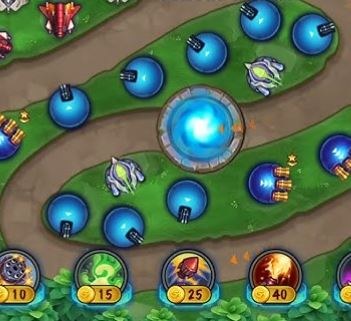
First Minute: Cold Drop Into a Familiar Formula You load up Tower Defense Galaxy and the first thing that hits you is the cleanness. No cinematic intro, no lore dump about galactic empires crumbling. Just a grid, a windi
First Minute: Cold Drop Into a Familiar Formula
You load up Tower Defense Galaxy and the first thing that hits you is the cleanness. No cinematic intro, no lore dump about galactic empires crumbling. Just a grid, a winding path, and a handful of basic turret icons glowing at the bottom of the screen. You place a machine gun tower near the first bend, hit start, and watch little geometric enemy shapes shuffle down the lane. The first wave pops satisfyingly. You earn a few credits, upgrade the tower once, and immediately feel that tiny dopamine nudge. So far, so standard.
But within about 90 seconds you notice something that separates this from the hundreds of other free tower defense games floating around browser game sites. The map isn't just a flat left-to-right snake. The paths branch, loop back, and sometimes run parallel to each other in ways that make you second-guess every tower placement. I dropped a sniper tower on what I thought was a perfect choke point, only to realize three waves later that the creeps were taking an alternate route that completely bypassed my kill zone. That's the moment I sat up a little straighter.
The Loop Isn't Just About DPS
Most tower defense games train you to chase the biggest damage numbers. Tower Defense Galaxy nudges you toward something messier and more interesting: path manipulation. Some maps let you place barrier towers that redirect enemy movement. I didn't figure this out until my fourth or fifth attempt on a map called something like "Spiral Arm," where the default path is so short you barely have time to whittle down the tankier waves. Once I started blocking off shortcuts and forcing enemies into a longer, zigzagging death corridor packed with freeze and area-of-effect towers, the whole flow changed.
The core loop works like this: you start with a modest pool of credits and a limited selection of towers unlocked. Each wave cleared gives you more credits and occasionally a special ability charge. Between waves you're upgrading existing towers, plopping down new ones, and — crucially — selling towers that are no longer well-positioned. The sell-back rate is generous enough that you're not punished for early experimentation, which I appreciated because my first few setups were genuinely embarrassing.
What you're really optimizing for isn't raw kill count. It's coverage overlap. You want a mix of towers that can hit enemies at different points along their route, with special attention to the last third of the path. That's where the heavily damaged survivors from your front line stagger through, and if you haven't built a cleanup crew of fast-firing towers near the exit, you'll leak lives constantly. I learned that lesson the hard way.
There's also a subtle resource tension between upgrading a single tower to tier three versus spreading credits across three tier-one towers. The tier-three machine gun absolutely shreds early and mid-game waves, but it can't be everywhere at once. On maps with split paths, three tier-ones covering separate lanes often outperform one super-tower that only watches one corridor. The game doesn't tutorialize this tradeoff. You just fail a few times and then it clicks.
Mistakes That End Runs Early
I want to save you some frustration because I made every single one of these mistakes during my first hour of play. The most common run-ender is ignoring tower range indicators. The game shows you a faint circle when you select a tower, but it's easy to overlook when you're scrambling between waves. I placed a missile launcher that technically overlapped the path, but only on the very outer edge of its range. Enemies zipped through that thin sliver in less than half a second and the tower barely fired. By the time I realized what was happening, I was down three lives and my economy was too gutted to recover.
Another trap: over-investing in a single damage type too early. Certain enemy types have resistance shields that glow a specific color. If you've gone all-in on energy weapons and a wave of energy-resistant orbs rolls through, you're toast. The game doesn't broadcast this weakness loudly. You'll just watch your supposedly powerful towers tickle the enemies while they waltz past. I started keeping at least one kinetic tower and one elemental tower active by wave 10 as a safety net, even if they weren't my primary damage dealers.
Selling too aggressively is also a quiet run-killer. Yes, the refund is decent, but you still lose some credits on each sale. I got into a bad habit of selling my early-game towers the moment mid-game options unlocked, then realizing I didn't have enough cash to fully replace them. There's an awkward gap around waves 15 to 20 where you need your starter towers still pulling weight while you slowly phase in the heavier hitters. If you scrap everything at once, you'll face a wave with half your lanes uncovered.
Finally, special ability timing. You get a screen-clearing orbital strike or a slow-motion field on a cooldown, and I kept blowing them on waves that looked scary but were actually manageable. Then a genuinely brutal wave with fast, small hitbox enemies would appear and my panic button was still ticking down. Learning to read the wave composition preview — which the game does show you before each round — is what turned my runs from "dying at wave 22" to "actually finishing maps."
What the Progression Actually Feels Like
Tower Defense Galaxy doesn't have a story mode in the traditional sense. What it has is a series of maps that unlock as you beat previous ones, and each new map introduces a wrinkle that forces you to rethink your comfortable strategies. One map has teleporter pads that randomly shunt enemies to different lanes. Another has environmental hazards you can trigger by placing towers on specific nodes. The variety kept me engaged longer than I expected, because just when I thought I'd "solved" the game with a particular tower composition, the next map would make that build completely nonviable.
There's also a light upgrade tree that persists between runs. You earn some kind of currency — the game calls it star credits or something similar — based on how many waves you cleared and whether you finished the map. You spend these on permanent upgrades: slightly cheaper tower costs, a bit more starting cash, faster ability cooldowns. It's not a grind-heavy system, which I respect. After about 20 minutes of play I had enough creds to unlock the first two or three upgrades, and they made a noticeable but not overpowering difference. This isn't one of those games where you need to grind for hours just to have a fair shot at later maps.
The tower unlock order feels intentional. You start with the basic machine gun, a sniper tower, and a freeze tower. The sniper is high damage but painfully slow fire rate, so it's terrible against swarms. The freeze tower does almost no damage but creates choke points when paired with anything else. Later you get missile launchers with splash damage, tesla coils that chain lightning between nearby enemies, and a buff tower that boosts adjacent towers' range and fire rate. That buff tower became the lynchpin of almost every successful run I had once I unlocked it. Placing it in a central hub where it touches four or five other towers completely changes the math on what's possible.
Device Notes: Phone vs Desktop
I tested this on both a laptop browser and an Android phone, and the experience is surprisingly different. On desktop, you have the precision of a mouse for placing towers exactly where you want them, and the larger screen makes it easier to scan the whole map between waves. Hotkeys for starting waves and upgrading towers are present but not particularly well-advertised. I discovered the spacebar starts the next wave by accident when I leaned on my keyboard.
On mobile, the tap targets are generous enough that I rarely mis-placed a tower, but the upgrade menu is a little fiddly. You have to tap a tower, then tap the upgrade button at the bottom of the screen, and the button is small enough that I fat-fingered it a couple times and accidentally sold a tower instead. The game does ask for confirmation on sales, which saved me, but the flow is slightly clunky. I also found that on longer maps, scrolling around to check all your lanes is a bit of a chore on a phone screen. It's absolutely playable — I finished several maps entirely on mobile — but if you have the choice, desktop feels like the intended experience.
Battery drain is minimal. This isn't a graphically intensive game. The visuals are clean geometric shapes with some particle effects when towers fire, and my phone didn't heat up even after 45 minutes of continuous play. The browser version runs fine even on a spotty connection once the initial load finishes, and there's no always-online requirement that I could detect.
A Short Practice Plan If You're Struggling
If you're hitting a wall around the mid-teens waves, here's the approach that got me over the hump. I'm not saying this is the optimal meta strategy — I'm not deep enough to know — but it worked consistently across three different mid-game maps.
First, spend your first three waves building nothing but the cheapest towers near the back half of the map. Let the front half stay empty. This feels wrong, but it means your damage dealers are positioned where enemies are funneled into narrower corridors later. Place two machine guns covering the last two bends before the exit, and one freeze tower where their ranges overlap.
Second, don't upgrade anything until you have at least four towers on the field. The early waves are forgiving enough that basic tier-one towers handle them fine. Save those credits. Once you have a base of four or five towers spread across the map's key intersections, then start upgrading the ones that cover the most path distance.
Third, when the first branching path appears — usually around wave 8 or 9 — resist the urge to split your defenses evenly. Pick one lane as your kill zone and use barrier towers or clever placement to route as many enemies as possible through it. The off-lane only needs a token defender, maybe one sniper tower to pick off stragglers.
Fourth, save your special ability for waves that include fast-moving, low-health enemies. Those swarms are what leak through even well-built defenses because your towers can't retarget fast enough. The orbital strike or slow field catches them all at once and buys you breathing room.
Finally, by wave 18 or so, you should be transitioning from early-game towers to your endgame composition. Sell one starter tower at a time, not all at once, and immediately replace it with a missile launcher or tesla coil. If you have the buff tower unlocked, this is when you build your central hub around it.
Should You Actually Try It?
Look, Tower Defense Galaxy isn't reinventing the genre. If you've played Bloons TD or Kingdom Rush, the broad strokes will feel immediately familiar. What it does well is maps that demand spatial thinking rather than just number-chasing, and a difficulty curve that ramps up without feeling unfair. The fact that it's free and runs in a browser with no download, no account, and no ad bombardment every 30 seconds made me more patient with its rough edges than I would be with a paid game.
The rough edges are real, by the way. The UI on mobile could use another pass. There's no undo button for tower placement, which stings when you drop an expensive tower one grid square off from where you meant to. And some of the later maps feel like they were balanced for players who've already unlocked most of the permanent upgrades, which means your first attempt might feel impossible until you've grinded a few earlier maps for credits.
But I kept coming back to it. The moment-to-moment feedback of watching your carefully constructed kill zone absolutely melt a wave that gave you trouble two attempts ago — that's the core pleasure of the genre, and Tower Defense Galaxy delivers it cleanly. I'd say give it 15 minutes. If the first map doesn't hook you, the game probably isn't for you. If you find yourself replaying it to shave off one more leaked life, well, you'll know you're in for a few hours.