
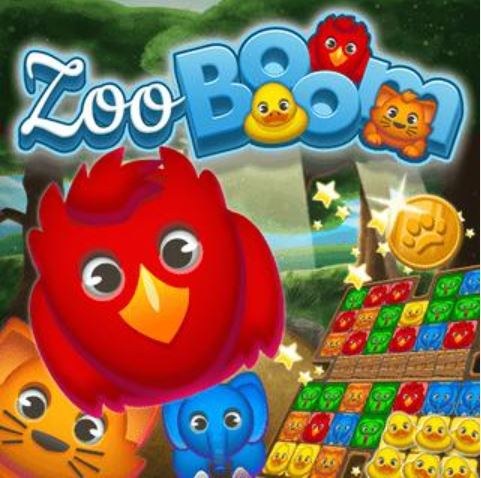
I fired up Zoo Boom expecting a cute match-and-pop, maybe something with animals making noises. What I got instead was a surprisingly tense bomb-blast grid that had me locked in within the first minute. The screen fills
I fired up Zoo Boom expecting a cute match-and-pop, maybe something with animals making noises. What I got instead was a surprisingly tense bomb-blast grid that had me locked in within the first minute. The screen fills with colorful animal tiles, sure, but they're packed tight above a fuse line that feels way closer than you want it to be. My first real click chain felt like pure luck. The second one I tried to plan, and I immediately understood why the game keeps showing you that restart button so cheerfully.
That First Sixty Seconds
You click a group of two or more matching animal tiles. They pop. Everything above shifts down. New rows slide in from the top. That's the whole core, and it's dead simple. But within about forty seconds, I'd already blown myself up twice because I was clicking the biggest cluster I could find without thinking about what it would leave behind. The early grid looks generous, lots of obvious four- and five-tile groups, and the bomb meter fills slowly enough that you feel safe. That safety is a trap. The game wants you to get comfortable, then punishes you when the board fragments into nothing but isolated singles and awkward pairs.
What I noticed right away is how the timer isn't really a clock. It's a fuse that burns down as new rows enter from the bottom. Pop enough tiles fast and you keep the screen from filling. Stall for even three or four seconds hunting for a perfect move, and suddenly you've got a column of mismatched penguins and monkeys stacking toward the top with no clean way to clear them. The sound design reinforces this. It's not frantic, but there's a low-pressure pulse that made me click faster than I meant to, which of course led to worse decisions.
What You're Actually Optimizing For
Zoo Boom isn't about high scores in the traditional sense. There's no leaderboard staring at you, and the points pop up in a font that feels almost decorative. The real thing you're chasing is smooth board states. Every time you clear a group, you want the resulting tile layout to give you another obvious group immediately. If you have to hunt, you're losing. The game rewards flow more than precision. This clicked for me around my seventh or eighth attempt when I stopped trying to maximize every single pop and started thinking two moves ahead.
The bomb meter on the side fills as you clear tiles, and when it's full you can tap to wipe a chunk of the board. I kept saving it for emergencies, which is exactly wrong. You want to use it early, when the board is still manageable, to prevent emergencies from forming in the first place. Letting the meter sit full is just wasting charge. I started hitting it the moment I saw two columns getting dangerously tall, even if the rest of the screen looked fine. That single habit change stretched my average run from about ninety seconds to over four minutes. The bomb isn't a panic button. It's a pressure valve you should be pulling regularly.
The chain system is where things get interesting. Clear a group, and if the falling tiles create another match automatically, you get a chain bonus. The game doesn't explain this in detail, but chained clears fill your bomb meter faster. I spent a few rounds deliberately setting up columns where I knew a single pop would cascade into two or three follow-up clears. This means ignoring the obvious big group sometimes in favor of a smaller one that's positioned better. That's counterintuitive, and it took me a while to override my instinct to always grab the largest cluster.
The Mistakes That Ended My Runs Early
I want to be specific here because these aren't the generic "plan ahead" tips you see everywhere. These are the exact ways I kept dying until I figured out what was happening.
First, I kept clearing the bottom rows. It feels natural, like you're digging out the foundation. But clearing low pops the tiles above and often leaves you with a scattered mess in the middle of the screen. The new rows enter from the top anyway, so you haven't actually bought yourself space. What worked better was clearing from the top down, or at least targeting the middle section where clusters tend to form after a few shifts. This keeps the board's weight distributed and prevents those single-column death towers.
Second, I was allergic to using the bomb on anything less than a full-screen crisis. By the time I triggered it, the board was already in a state where one bomb clear wasn't enough to save me. The bomb clears a radius around where you tap, not the whole screen. If you wait until every column is at the danger line, you'll clear maybe three columns and the other three will still end you. I learned to bomb when two adjacent columns looked bad, not when everything was collapsing.
Third, I ignored the single tiles. A lone zebra or lion sitting between two big groups seems harmless, but it breaks potential chains. If you've got a column with three monkeys, a single zebra, then three more monkeys, popping either monkey group won't chain because the zebra blocks the fall. I started looking specifically for these blockers and either clearing them first if they had a match somewhere, or positioning my bombs to erase them. Cleaning up singletons isn't glamorous, but it keeps the board connected.
Fourth, I played too fast when the fuse line started flashing. The game adds a visual warning when rows get near the top, and my lizard brain interpreted that as "click anything immediately." This led to desperate single-pair clears that just shuffled the problem around. The warning is actually generous. You've got more time than it feels like. Two or three calm, well-placed clears will push the line back down more effectively than six panicked clicks.
Phone vs Desktop: It Matters Here
I played Zoo Boom on both my phone and my laptop, and the experience is different enough that it's worth mentioning. On a phone, the tiles are larger relative to your thumb, which makes tapping groups of two or three feel natural. But I misclicked constantly on edge tiles, especially near the top of the screen where my thumb had to stretch. That's a real problem when one wrong tap can pop a pair you were saving for a chain. I ended up holding my phone with two hands and using my index finger, which felt silly but cut my mis-tap rate way down.
On desktop with a mouse, precision is obviously higher. You can hover and plan without committing. The downside is that the game feels slightly slower because you're dragging a cursor instead of tapping directly. I found desktop better for learning the chain mechanics and board-reading, but phone felt more satisfying once I knew what I was doing. If you're struggling with consistency, try switching devices. The muscle memory transfers, but the change in input method can break you out of bad tapping habits.
One odd thing on mobile: the game didn't seem to mind if I switched tabs or locked my phone briefly. It paused cleanly. That's not always true for browser games, and it meant I could play in short bursts without losing progress. On desktop, resizing the browser window scaled the game fine, though going too narrow made the tiles cramped. I'd recommend fullscreen or at least a wide window so you aren't squinting at tiny animal icons.
Zoom level affected my play more than I expected. At default zoom, I could see the whole board without moving my eyes much, which let me spot chains faster. Zoomed in, I tunnel-visioned on one section and missed danger building on the opposite side. If you're dying to columns you didn't notice, check your browser zoom. Backing out to see the full grid at once made a measurable difference in my run lengths.
What The Game Doesn't Tell You
Since there's no official description to lean on, I'm working from what I observed across a couple dozen plays. Zoo Boom appears to be a pure arcade bomb-blast with no meta-progression. I didn't unlock new animal types or power-ups over time. What you see in your first round is the full toolset. That's actually refreshing. It means improvement comes entirely from you getting better at reading the board, not from grinding for upgrades. But it also means the difficulty curve is just you hitting your own skill ceiling.
The scoring system prioritizes speed and chain size. You get more points for clearing groups of five or more, and the chain multiplier seems tied to how many automatic cascades you trigger. I couldn't pin down the exact formula, but I consistently scored higher when I focused on creating falling matches rather than just clicking every available group. The game seems to reward efficiency over volume, which aligns with the smooth play angle. A messy run that barely survives will net you a fraction of the points of a clean run that ends earlier.
I also noticed that the game gets subtly harder as you go, not through faster new-row entry but through tile distribution. Early boards have an even spread of four or five animal types. Later, you'll see more of the same animals clustered in ways that look helpful but actually make the board brittle. A screen full of mostly lions and monkeys means fewer match opportunities overall, and when those big same-type clusters pop, they leave behind scattered singles of other types that are hard to clear.
A Practice Plan That Doesn't Feel Like Homework
I'm not going to suggest drills or timed sessions because that kills the fun. What worked for me was playing with a single intention per session, and I'd recommend three short phases if you want to push past the early plateau.
Phase one: play five rounds where you only care about not letting any column reach the top. Ignore score entirely. Ignore chains. Your only job is survival. This teaches you to read the board's vertical pressure and use the bomb defensively. You'll probably die a lot at first, but by round four or five you'll start seeing the warning signs earlier. The goal here is to make the fuse line feel less scary, not to get a high score.
Phase two: play five rounds where you only pop groups of three or more if they're in the top half of the board. This forces you to stop clearing from the bottom and retrains your eye to scan upward. It'll feel wrong. You'll leave obvious matches untouched. But it builds the habit of managing the board from the top down, which pays off in longer runs later.
Phase three: play normally, but set a rule that you must use the bomb the moment it's full, no saving it. Hit a dense cluster near the middle, or target a column that's getting tall. The point is to make proactive bombing automatic. After ten or fifteen rounds with this rule, you'll develop a feel for when the bomb is most useful, and you'll stop treating it like a precious resource.
Each phase takes maybe ten minutes. I ran through them over a few lunch breaks, and by the end I was consistently hitting run lengths I didn't think I'd reach when I started. The game doesn't change. You do. That's the whole appeal.
Why It Kept Me Playing
Zoo Boom doesn't have a story or characters or progression hooks. What it has is a loop that feels satisfying when you're in the zone. The animal art is charming without being distracting. The sound effects land somewhere between a puzzle game and a slot machine, all soft pops and rising tones. It's the kind of game you can play in a browser tab for free during a break and actually feel like you got a little mental reset.
The tension between speed and planning is what stuck with me. Too fast and you scatter the board. Too slow and the rows pile up. Finding that middle pace where you're clicking deliberately but not hesitating is genuinely engaging. I caught myself holding my breath during long chain sequences, which is either a sign of good design or a reminder to relax my shoulders.
If you're coming from match-three games where you can take your time, Zoo Boom will feel aggressive at first. Give it fifteen minutes. Let yourself lose a bunch. The reset is instant and there's no penalty for failure, so the cost of experimentation is basically zero. Once you internalize that the bomb is a tool not a treasure, and that top-down clearing keeps the board alive, the game opens up into something that feels more like juggling than puzzle-solving.