
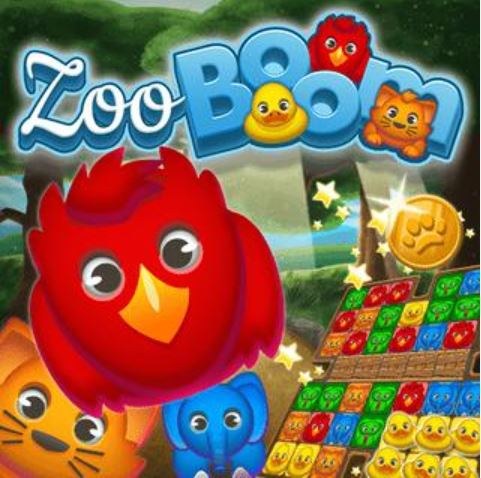
First Minute, First Detonation I opened Zoo Boom expecting something cheerful, maybe a bit of animal-themed chaos. What I got was a board full of sad-eyed creatures trapped in cages and a fuse already hissing. The first
First Minute, First Detonation
I opened Zoo Boom expecting something cheerful, maybe a bit of animal-themed chaos. What I got was a board full of sad-eyed creatures trapped in cages and a fuse already hissing. The first thirty seconds are disorienting in the best way. You’re not eased in with a tutorial that holds your hand—you’re handed a bomb and told, implicitly, to figure it out before everything goes wrong. I tapped a cage, saw a blast radius flare out, and watched a chain reaction take out half the screen. A lion cub blinked back at me from the rubble, clearly unimpressed. The game wastes zero time teaching you that placement matters more than speed, even though the ticking audio makes you want to rush. By the minute mark my board was a mess of half-rescued animals and missed combos, and I was already restarting.
What You’re Actually Optimizing For
Zoo Boom belongs to the bomb blast puzzle family, which means the surface loop is tap-to-explode, clear obstacles, save animals. But after a dozen runs I realized the real resource isn’t moves or lives—it’s chain potential. Every cage you detonate sends out a shockwave that can trigger adjacent explosives, and those can trigger more. The score system rewards cascades far more than individual pops. A single well-placed tap that ripples across sixty percent of the board will give you a higher star rating than methodically cleaning up every last cage in isolation. This isn’t a game about clearing the board completely. It’s about reading the layout in the first five seconds and finding the ignition point that will do the most work for you.
You’re also managing a soft timer. There’s no countdown clock, but the levels have a move limit that feels tight on purpose. You can’t afford to experiment once you’re past the early stages. If you’re three moves in and still haven’t found a cascade anchor, you’re probably already losing. I started treating each level like a puzzle where the first tap is the only one that truly matters, and everything after that is damage control.
Mistakes That End Runs Before They Start
I burned through a lot of runs making the same three errors, and I suspect most players will fall into these traps within the first hour.
Edge fixation. There’s a natural instinct to start at the corners or edges of the board because they feel safe or contained. Zoo Boom punishes this hard. Explosions on the perimeter lose half their shockwave potential because there’s nothing beyond the border to catch. I lost count of how many times I tapped a cage in the top-left corner, watched a satisfying burst, and then realized the chain stopped dead because the blast had nowhere else to travel. Middle-of-the-board ignitions almost always outperform edge starts, even if they look less dramatic initially.
Ignoring cage types. Not all cages are equal. Some contain animals that don’t contribute to chain reactions; others have reinforced bars that require two adjacent blasts to break. Early on, I treated every cage as interchangeable and tapped whatever was closest to my thumb. That habit cost me entire boards. Reinforced cages act like circuit breakers—they stop cascades cold if you don’t soften them up first. I learned to scan for the dark-colored cages before making any move and either avoid them as ignition points or plan a secondary blast nearby to crack them open in the same turn.
Rescue tunnel vision. This one sounds counterintuitive because saving animals is the stated goal. But obsessing over a single stranded panda in the corner while ignoring a cluster of five cages in the center is a fast way to run out of moves. The game doesn’t reward completionism with bonus points; it rewards efficiency. If a cage is isolated and would take two moves to free, I leave it. The star thresholds are calibrated around cascades, not perfect clear rates. I had to unlearn the completionist muscle memory from other puzzle games.
Device Feel: Phone vs Desktop
I tested Zoo Boom on both a mid-range Android phone and a laptop with a trackpad, and the difference is significant enough to mention. On a phone, the tap precision feels natural. Your thumb naturally gravitates toward the center of the screen, which happens to align with optimal ignition placement. The haptic feedback—if your device supports it—gives a subtle thump on successful chains that I found genuinely helpful for timing my next move. On desktop with a mouse, the cursor precision is higher but the physical feedback is absent, and I caught myself clicking too fast because the audio cues alone weren’t grounding me. Trackpad play is a distant third; I wouldn’t recommend it unless you have no other option. The drag-and-release motion occasionally misread as a swipe, which once detonated a cage I was only trying to inspect.
Load times are negligible on both platforms, which matters because you’ll be restarting levels frequently. There’s no appreciable performance drop when the board gets crowded with particle effects, though on an older phone I noticed a slight frame hitch during particularly large chain reactions. Not game-breaking, just enough to break the flow for a split second.
A Practice Plan That Won’t Make You Hate the Game
After banging my head against the mid-game difficulty spike for an afternoon, I stepped back and built a small practice routine that actually improved my consistency without turning the game into a grind. This isn’t a speedrun strat or a leaderboard optimization—it’s just a way to stop losing to the same board layouts repeatedly.
First, spend ten minutes in the earliest levels with the sound on and your eyes on the shockwave animations, not the score. Watch how the blast propagates. Notice which cage placements create branching paths versus linear chains. The visual language of Zoo Boom is consistent once you learn to read it, but the game never explicitly teaches you that certain cage colors signal blast-resistant properties or that animals positioned diagonally from each other chain differently than orthogonally adjacent ones. You have to observe it.
Second, do five runs where you intentionally hold your first tap for a full ten-count after the level loads. Force yourself to trace at least two potential cascade paths with your eyes before touching anything. This feels agonizing at first because the bomb fuse audio is designed to make you anxious, but the timer doesn’t actually start until your first move. The psychological pressure is a design trick. Once I started treating the pre-tap phase as a planning window rather than a countdown, my first-move accuracy jumped noticeably.
Third, when you hit a level that stumps you three times in a row, do not keep bashing it. Drop back five levels and replay one you’ve already three-starred. This isn’t about cooling off—it’s about rebuilding the pattern recognition that frustration erodes. I found that my failed attempts on a hard level were making me progressively worse at easier ones because I was carrying over bad habits like edge-tapping and single-cage rescues. A clean run on a familiar board resets those instincts.
Finally, if you’re playing on a phone, try switching hands. I’m right-handed and almost always play with my right thumb, but Zoo Boom boards sometimes cluster the optimal ignition point on the left side. My right-thumb reach was pulling me toward suboptimal right-side taps simply because they were more comfortable. Using my left thumb for a few sessions felt clumsy at first but expanded the board areas I naturally considered as starting points.
What the Game Doesn’t Tell You
There’s no in-game encyclopedia or help screen beyond a bare-bones tutorial that covers maybe sixty percent of the mechanics. A few things I pieced together through trial and error: animals rescued in chains of five or more produce a temporary score multiplier that carries into your next move if you act quickly enough. The multiplier indicator is easy to miss—it’s a small paw print icon that fades fast. Also, some levels have hidden secondary objectives tied to specific animal types, but the game only reveals these if you fail them once. I stumbled onto a “save all elephants” condition purely because I happened to clear a board inefficiently and got a post-level popup telling me what I missed. On my winning run, the objective had never been displayed.
These hidden layers are what keep Zoo Boom interesting past the first few hours. The game respects your ability to discover mechanics organically, but it also means you will lose levels to information you didn’t have. I’m mostly fine with that tradeoff, though I can see it frustrating players who prefer explicit rulesets.
Sticking With It
Zoo Boom settles into a rhythm after you internalize the cascade logic. The mid-game levels start introducing board shapes that deliberately break up chain potential—narrow corridors, isolated islands of cages, obstacles that absorb blasts without propagating them. These feel unfair until you realize they’re teaching you to value setup taps over immediate payoffs. A move that clears only two cages but positions a reinforced cage next to a cluster for your next turn is often the correct play, even though it feels unsatisfying in the moment.
The game runs free in any modern browser, no download or account needed, which makes it easy to dip into for fifteen-minute sessions. That’s honestly the ideal play length for me—long enough to clear a handful of levels or grind out a tricky one, short enough that the move-limit tension doesn’t curdle into frustration. I wouldn’t marathon this game, but I keep a tab open for it now, and that says more than any star rating.