
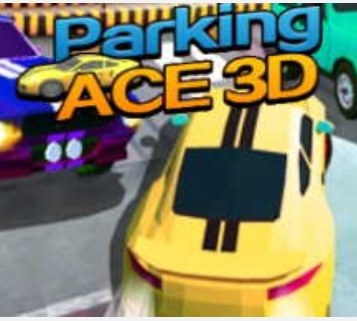
First Moments Behind the Wheel I tapped the play button expecting a casual little time-waster, and within about 90 seconds I'd already wedged a sedan halfway onto a curb. The camera swung around in that slightly floaty t
First Moments Behind the Wheel
I tapped the play button expecting a casual little time-waster, and within about 90 seconds I'd already wedged a sedan halfway onto a curb. The camera swung around in that slightly floaty third-person view, and I immediately realized this wasn't going to be one of those games where the hitboxes look the other way. The first car you get handles like a grocery cart with a bad wheel — not broken, just heavy enough that you can't whip it into a space and call it a day. The asphalt has this clean, almost toy-like sheen to it, and the parking spots are marked with glowing yellow borders that feel oddly satisfying to line up with. You'll notice pretty quickly that the game doesn't hold your hand. No ghost arrows appearing after ten seconds of hesitation, no "almost there!" encouragement. Just you, the car, and a row of concrete pillars waiting to ruin your afternoon.
Who This Game Actually Clicks For
Parking Ace 3D sits in a strange little pocket of the gaming world. It's listed under Kids, but I wouldn't call it strictly a children's game. A six-year-old could absolutely play the practice mode and have fun scooting cars around, but the later challenges require a patience level that most grown-ups I know don't possess. This is for people who find something meditative in precision. If you're the type who straightens a picture frame twice even though it looked fine the first time, the loop here will hook you. It's also a surprisingly solid pick for anyone who genuinely needs to work on spatial awareness — new drivers, people who've always been nervous about parallel parking, or just folks who want to understand how a car pivots around its rear axle. The game doesn't teach you real-world driving physics, but it does drill something transferable: the relationship between steering input and how the back end of a vehicle swings around. I found myself thinking about pivot points I hadn't considered since driver's ed.
The Loop That Keeps You In or Spits You Out
Each level gives you a car, a parking spot, and a field of obstacles. Your job sounds simple: get from point A to the glowing rectangle without hitting anything. What you're actually optimizing for isn't just completion — it's clean completion. The game tracks collisions, and while a light tap against a barrier won't instantly fail you, it gnaws at the back of your mind. There's no visible star rating flashing at the end, but you'll know. You'll feel the difference between a run where you nudged a cone and one where you glided in like you'd been valeting cars for a decade. The reward loop is entirely internal. No loot boxes, no coin drops, no upgrade trees. You finish a tough level and the game just quietly serves up the next one. For some players, that'll feel refreshingly pure. For others, it'll feel like a missing heartbeat.
The practice mode is worth mentioning because it's not just a tutorial — it's a genuinely pressure-free sandbox. You can reset instantly, and the obstacles are arranged in a way that lets you experiment with approach angles without punishment. I spent a solid ten minutes just reversing into the same spot from different starting positions to understand how the game's physics model handles momentum. The cars don't have weight shift or body roll in any realistic sense, but they do have a turning radius that feels distinct from vehicle to vehicle. The compact cars pivot tighter. The SUVs feel like piloting a small boat. You'll develop preferences fast.
Concrete Mistakes That End Your Run Early
I failed more times than I'd like to admit before I started noticing patterns. The first killer is overcorrecting. You'll come in at a slightly wrong angle, panic, crank the wheel hard in the opposite direction, and suddenly your front bumper is kissing a barrier. The steering sensitivity doesn't punish you for being slow — it punishes you for being twitchy. Smooth, gradual inputs work far better than sharp flicks. I learned to steer in smaller increments and let the car's arc play out before adjusting.
The second mistake is fixation on the front of the car. New players tend to stare at the hood, willing it to clear obstacles. That's backwards thinking for most parking scenarios. The rear wheels are your pivot point, and the back end swings wider than you expect. I started watching the rear quarter panel more than the front, and my success rate jumped noticeably. The game doesn't explain this. You either figure it out through repetition or you keep scraping the same wall and wondering why.
The third run-ender is impatience with the camera. You can swipe to rotate the view, and I ignored that feature for my first dozen attempts, stubbornly trying to park from one fixed angle. Swinging the camera around to a top-down view or a side profile completely changes your depth perception. Some levels practically require a camera adjustment to judge the gap between your fender and a pillar. If you're not regularly shifting your perspective, you're playing with one eye closed.
Phone vs Desktop: A Noticeable Divide
I tested this on both an iPhone and a desktop browser, and the experience splits in interesting ways. On a phone, the tilt controls or on-screen steering wheel give you a more granular sense of input. There's a tactile pleasure in tilting your device slightly to ease a car into a tight spot, and the smaller screen makes the parking spaces feel proportionally larger in your field of view. The trade-off is precision. My thumbs occasionally obscured part of the screen, and on one memorable attempt, I accidentally brushed the reset button while trying to adjust the camera. On desktop, the keyboard controls (arrow keys or WASD) feel more binary — you're either turning or you're not — but the larger screen lets you spot obstacle gaps more clearly. I preferred desktop for the later, tighter levels where I needed to see exactly how much space existed between my mirror and a concrete column. Your mileage will vary based on how you process spatial information, but if you're struggling on one platform, switching to the other might unstick you.
A Few Levels That Stood Out
Not every parking scenario is a rectangular lot with generous margins. The game starts throwing curveballs around the time you get comfortable. There's a level with diagonal parking spots crammed between two rows of pillars where the approach angle is everything — come in too shallow and you'll clip the pillar on the passenger side, too steep and you'll never straighten out. Another level places the parking spot on a narrow strip with a drop-off on one side, and while there's no actual fall damage, the psychological weight of that edge messed with my steering more than any physical obstacle. The variety keeps the core loop from feeling like a monotonous drill, even though mechanically you're doing the same thing each time.
A Short Practice Plan That Actually Worked For Me
After banging my head against a few levels, I settled into a routine that made the game click. I'd start each session with five minutes in practice mode, deliberately parking badly on purpose — overshooting, undershooting, coming in at terrible angles — just to watch how the car responded. Then I'd pick one level from the early set and try to complete it three times in a row without a single collision. Not just passing, but clean. If I touched anything, I'd reset and start the count over. That self-imposed constraint forced me to slow down and actually plan my approach instead of reacting in the moment. After that, I'd tackle a new level and usually clear it within a few attempts. The whole warm-up took maybe ten minutes and saved me a lot of frustration. If you're the type who likes structure, that rhythm works. If you'd rather just dive in and learn through failure, the game won't punish you for it — there's no life system or timer ticking down.
What It Doesn't Try To Be
Parking Ace 3D is not a driving game. There's no speed, no open roads, no traffic to weave through. It's not a career sim with progression unlocks or a garage full of aspirational cars. You won't earn currency or customize rims. The car models are generic and unbadged. If you come in expecting even a hint of arcade racing energy, you'll bounce off it within minutes. The game knows exactly what it is — a parking puzzle box — and it doesn't pretend otherwise. That narrow focus is either its greatest strength or its dealbreaker, depending on what you're looking for. I found it oddly honest. No bloated menus, no daily login bonuses, no pop-up asking me to rate it. Just a grid of levels and a car waiting to be parked.
One thing I kept wishing for was a replay of my successful park. Some of my clean runs felt so smooth that I wanted to watch them back from an external camera angle, just to admire the arc. The game doesn't offer that, and it doesn't need to. But that desire to rewatch speaks to how satisfying the core mechanic becomes once you stop fighting the steering and start flowing with it.
If you've got fifteen minutes and want something that demands focus without demanding your credit card, this fits that slot neatly. It loads fast in a browser, no download required, and the free browser play means you can jump in on a break without committing to anything. Just don't be surprised when a "quick attempt" turns into forty minutes of muttering at your screen while trying to parallel park a digital SUV without tapping the car behind you.