What It Feels Like Right Off the Bat I tapped the first tube and watched a little rainbow stack of balls pop up, then tapped another tube and saw it plop into place. That sound is weirdly satisfying—it’s a soft, almost h
What It Feels Like Right Off the Bat
I tapped the first tube and watched a little rainbow stack of balls pop up, then tapped another tube and saw it plop into place. That sound is weirdly satisfying—it’s a soft, almost hollow click that makes you want to do it again immediately. Within about forty seconds I had five half-sorted tubes and a creeping sense that I’d already boxed myself in. The game doesn’t give you a tutorial beyond “here’s a finger, tap this,” so you learn by failing, and you fail fast. The art is clean, almost aggressively minimal: solid color balls with a slight sheen, transparent tubes, a pastel background that fades into nothing. No timer, no score counter, no animated mascot cheering you on. Just the puzzle and whatever your brain can hold.
How the Loop Actually Works
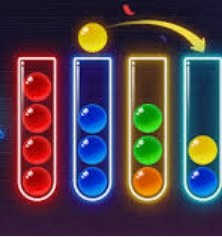
Ball Sort Master gives you a row of glass tubes, some filled with mixed-up colored balls, some empty. You can only move a ball onto another ball of the same color, or into an empty tube. A tube holds four balls max. Once four matching balls settle into a tube together, that tube is “solved” and usually locks or grays out. The goal is to get every color separated into its own tube. That’s it.
What you’re really optimizing for isn’t speed—it’s empty tube access. Every move either opens up a space or uses one up, and the empty tubes are your only breathing room. Without at least two empties at most stages, you’re dead in the water. The game starts you with two empties on the early puzzles, then slowly tightens the screw. By the time you hit levels in the 40s and 50s, you’ll often have just one empty tube and a whole mess of partial stacks. That’s when the real thinking starts.
I noticed after a dozen or so levels that the layouts aren’t random in the way you’d expect. Colors tend to cluster in certain tubes, and if you can spot which ones have “pure” single-color bottoms early, you can plan your stacking around them. The game rewards you for looking three moves ahead, not one.
Mistakes That End Runs Early
I killed at least eight runs in my first fifteen minutes, and they all fell into a few buckets. The biggest one: moving a ball onto a color you hope to match soon, but don’t have an immediate path to. You see a green ball sitting on top of a red stack, and you move another green onto it, thinking “I’ll dig that green out later.” You won’t. That bottom green is now buried under two or three reds, and you’ve just handcuffed yourself.
Another classic is filling your last empty tube with a single ball just because you panicked. If you drop a blue ball into your only empty tube and you have no blue matches anywhere else exposed, congratulations—you just turned that empty tube into a permanent blue monument. Now every other color has one fewer place to go, and the puzzle is probably unsolvable without the undo button.
The third mistake is tunnel vision on one color. I’d get excited that I had three yellows together and spend five moves trying to free the fourth, ignoring the fact that my reds and purples were getting tangled into a knot I couldn’t untie later. You have to keep scanning the whole board, not just the tube you’re currently obsessed with. Beginners tend to play vertically—one tube at a time—when the game is really a horizontal balancing act.
Stuck Spots and How I Got Unstuck
Level 37 stopped me cold. I stared at the screen for a solid four minutes, undid five moves in a row, and seriously considered just closing the tab. What I eventually realized was that I had two tubes with the exact same top color (pink) and I needed to treat them as a single unit. Instead of trying to clear one completely, I stacked pinks from both tubes onto a third tube that had pink at the bottom. That freed up one tube enough to expose the green I actually needed.
When you hit a wall, the first thing to try is emptying a tube you’ve already partially solved. It feels wrong to break up a set of three matching balls, but if those three are blocking access to four or five other moves, it’s worth it. I also started using the undo button more aggressively—not just to fix mistakes, but to scout. Make a move, see how the board reacts, undo it, try a different branch. The game doesn’t penalize undos at all, so you can treat it like a rewind-based exploration tool.
There’s a trick I leaned on in the 60s and 70s that I haven’t seen mentioned much: if you have two empty tubes, only ever fill one of them halfway. Keep the second one truly empty as long as possible. Once both are filled, your maneuverability drops off a cliff. I’d rather make four awkward interim moves than give up that last empty slot.
Phone vs Desktop: They’re Not the Same Game
I played on both my phone and my laptop, and the experience is noticeably different. On desktop with a mouse, misclicks are rare—you point, click, click, and the ball lands exactly where you want. On a phone, the tubes are narrower, and I accidentally dropped balls into the wrong tube more times than I’d like to admit, especially when my thumb was covering the destination. The touch targets are generous enough, but when you’re moving fast, the margin for error shrinks.
Phone play also makes it harder to see the whole board at once. On desktop, I could glance across all the tubes in one eye sweep. On a phone screen, I had to actively scroll my focus left to right, and that slight cognitive lag led to me missing obvious matches. I’d recommend desktop if you’re stuck on a tough puzzle and need to think clearly. Phone is fine for casual early levels or when you’re just killing time, but for the later stages where one wrong move ruins ten minutes of progress, the bigger screen and precise cursor make a real difference. That said, the game loads instantly in a browser with no install, so you can jump between devices easily—no account or sync needed, just open the tab and go.
A Short Practice Plan That Actually Helped
After flailing for a while, I settled into a routine that made me more consistent. I’d spend the first ten seconds just looking—no moves, no tapping. I’d count which colors had all four balls visible somewhere on the board. If a color had all four visible, I’d prioritize it immediately because it meant I could clear a tube without needing to dig. If a color only had two or three showing, I knew it was a trap to chase it early.
Then I’d spend about five minutes actively playing, but with a rule: never leave a tube with a single ball of a color on top if that color isn’t actively being built somewhere else. Singles are poison. They block the tube and don’t help you progress. I’d either combine them with another single of the same color or leave them alone entirely until I had a clear landing spot.
Finally, I’d give myself permission to restart the level after two minutes of no progress. Not undo—full restart. There’s a psychological hurdle to hitting that restart button because it feels like admitting defeat, but some seed layouts just put you in a bad position from move one, and no amount of clever undos will fix it. A fresh shuffle takes ten seconds to re-deal and often gives you a more forgiving starting arrangement. I started clearing levels about 30% faster once I stopped treating restarts as a last resort and started using them as a strategic reset.
When the Game Gets Sneaky
Around level 80, I started noticing that the game introduces what I can only call “decoy moves.” These are moves that look good right now—like matching two balls of the same color on a nearly empty tube—but actually push you toward a dead end three moves later. The only way to spot them is to pause before any move that feels too obvious. If a move jumps out at you instantly, ask yourself: what does this block? What color am I covering up? What tube am I filling that might need to stay empty? Half the time I caught myself just before making a move that would’ve ruined the run.
Another pattern I saw: the game sometimes gives you two tubes with identical color sequences on top. It’s bait. You’ll want to merge them, but doing so often leaves you with one completely full tube of mixed colors underneath and no way to dig them out. Instead, treat those twin tubes as temporary storage. Use one to offload balls from other tubes, and only merge when you’ve cleared enough space elsewhere to handle the fallout.
What I Wish I Knew from the Start
You can play Ball Sort Master entirely free in your browser—no download, no paywall, no energy system. That’s worth mentioning because a lot of sorting games hide extra tubes or undos behind ads or coins, but here the tools are just there. The undo button is unlimited. The restart is instant. You get a clean puzzle and whatever your brain can do with it. That simplicity is the whole appeal.
Also: the game doesn’t tell you this, but you don’t have to solve every tube in order. I used to compulsively finish one color before starting the next, and that’s a great way to get stuck. The smarter approach is to work on two or three colors simultaneously, keeping their partial stacks balanced so no single tube becomes a dead weight. Think of it like juggling—you want all the balls in the air, not one caught and three on the ground.
If you’re stuck right now on a specific level, try this: find the color that appears least often on the board. That’s usually the one buried deepest. Ignore it completely. Focus on clearing the colors that are most exposed, even if they’re not the ones you want to solve. Clearing space often unsticks the color you actually care about without you having to touch it directly. It’s counterintuitive, but it’s pulled me out of more dead-ends than any other single tactic.