First Minute on the Board I tapped the screen and a grid of colored blocks filled my phone. No intro video, no character talking at me—just a clean board and a blinking prompt to start tapping. The first thing you'll not
First Minute on the Board
I tapped the screen and a grid of colored blocks filled my phone. No intro video, no character talking at me—just a clean board and a blinking prompt to start tapping. The first thing you'll notice is how satisfying the pop feels. Blocks don't just vanish; they burst with a tiny particle spray and the surrounding pieces slide together like they're magnetized. That sound design does a lot of heavy lifting right away. It's crisp, slightly bassy, not the tinny clink you get in lesser match games.
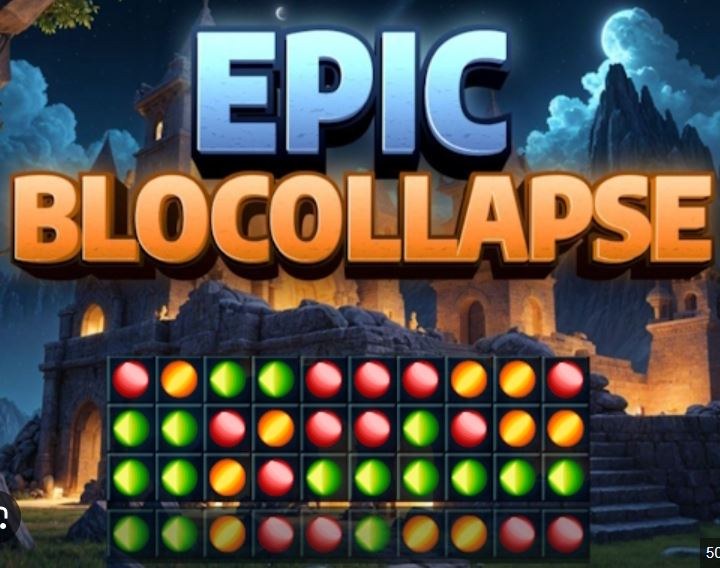
Within thirty seconds I'd cleared about a dozen blocks and realized this wasn't a standard match-three. You're not swapping tiles. You're tapping clusters of two or more same-colored blocks that touch. The bigger the cluster, the bigger the blast. The board doesn't refill from the top like Tetris or candy games—it compacts inward. Columns shift, rows tighten, and sometimes that compression creates new clusters you didn't plan for. That cascading chain is where the "collapse" name actually earns its keep.
The Real Loop Underneath the Fireworks
What you're optimizing for changes about two minutes in. At first you chase big clusters because they feel powerful—and they are, for immediate score. But I started losing runs fast when I treated Epic Blocollapse like a greedy points grab. The game cares more about board clearance percentage than individual pop size. You'll see a small bar or counter tracking how many blocks remain. Let that number creep too high because you kept popping tiny two-block pairs while ignoring a massive twelve-block cluster in the corner, and the board stiffens. Dead spaces form. Isolated single blocks get trapped between colors with no matching neighbors.
The hidden mechanic I picked up after maybe ten runs: leftover singles don't just sit there. They penalize you. The game either spawns new blocks in awkward places when the board compresses or triggers a "messy" state where your next few taps are less effective. I couldn't find exact documentation on this, so I'm inferring from repeated failure. Every time I played sloppy and left confetti of unpopped singles, my runs ended early with a board full of checkerboarded junk I couldn't touch.
Why Your Runs Die at the Three-Minute Mark
I kept a mental tally of what killed me most often during my testing sessions. Here's the pattern:
- Corner neglect. On wider desktop screens I'd focus on the middle third of the board because that's where my eyes naturally landed. Phone play forced me to scan edges, but even then, the top two corners accumulated untouched blocks that became dead zones. Once a corner fills with three different colors in a staggered pattern, you're not clearing it without a miracle cascade.
- Premature two-block pops. Tapping a linked pair because it's easy and immediate is the most common trap. It feels productive. It makes a sound. But you've just removed two blocks that could have sat adjacent to a larger cluster if you'd waited for the board to compress naturally. Patience here is genuinely hard to learn because the game's tempo urges you to keep tapping.
- Ignoring the spawn logic. This is the part I had to infer from genre conventions. Bomb Blast games like this typically respawn blocks when the board drops below a threshold, or they add new pieces when you clear below a certain count. Epic Blocollapse seems to punish low-count clears with scattered spawns. If you pop a mega cluster early, the board tightens cleanly and you get a few seconds of easy pickings. If you chip away slowly, the board fills with random noise.
- Playing on tilt. I caught myself speeding up when a run started going badly, tapping faster and making worse decisions. The game doesn't have a visible timer in the mode I played, but my own internal panic clock made me dumber.
Phone vs Desktop: This One Actually Feels Different
I tested across an iPhone 13 and a mid-range laptop with a trackpad, and the experience split more than I expected for a browser game. On phone, the touch targets are generous enough that I rarely mis-tapped, but the screen real estate means the board feels taller and narrower. That verticality changes how gravity works in your head. Blocks drop downward, so you're naturally scanning top-to-bottom, and the bottom rows become your staging area for big combos. Your thumb covers part of the board when you reach for low clusters, which forced me to play with an awkward hover-and-pause rhythm.
On desktop with a mouse, precision goes way up but speed drops. Clicking individual clusters feels more deliberate, almost surgical. I could spot isolated blocks on the perimeter that I'd missed on my phone. The downside: my wrist got tired after about twenty minutes of clicking, and I started relying on lazy center-board pops because moving the cursor to edges required more effort. If you're on a laptop trackpad, forget finesse—you'll drag-select by accident at least once per run and pop something you didn't mean to.
One weird thing I noticed: the particle effects scale differently. On my phone they felt punchy and quick; on desktop they lingered a half-second longer, which sounds nice but actually slowed down my rhythm because I'd wait for the animation to finish before scanning for the next move. There might be a setting for that, but I couldn't find one in the default interface. Not a dealbreaker, just a quirk worth knowing if you're switching between devices.
A Practice Plan That Won't Make You Hate the Game
I'm not going to give you a "10-step mastery guide" because that's not how this game works. But after about twenty runs, I settled into a warm-up sequence that improved my consistency. Do this over three short sessions, not one marathon grind.
Session one: play five runs where you never pop a two-block cluster. Not once. Even if it means passing on an obvious move and waiting for the board to compress. You'll lose fast on the first two runs. That's fine. By the third run, you'll start seeing larger clusters form naturally from compression, and your brain will rewire away from the cheap dopamine of tiny pops. This is the single highest-impact habit change I made.
Session two: play with your eyes on the corners only. Start each move by scanning the four corners, then the edge rows, and only look at the center if nothing else is available. Count how many times you catch a corner cluster you would have missed otherwise. On phone, physically tilt the device slightly to force your gaze outward. On desktop, position the window so the corners are at eye level, not tucked into your peripheral vision.
Session three: play five runs with a self-imposed "clean board" rule. You're not allowed to leave a run until the board is either cleared or you've genuinely run out of moves. No rage-quitting when the board looks ugly. The goal here is to practice recovery. Ugly boards teach you more than pretty ones. You'll discover diagonal adjacency patterns and strange compression chains that you'd never see if you only played the first thirty seconds of each run.
After those three sessions, take a day off. Let the motor patterns settle. When you come back, don't think about technique at all for the first two runs—just play by feel and see if your baseline improved. Mine did, noticeably. Average run length nearly doubled.
What the Game Doesn't Tell You
Since there's no catalogue description for Epic Blocollapse, I'm working purely from what I observed during play. The genre is Bomb Blast, which implies destruction loops, chain reactions, and area-clearing as the primary engagement. This game fits that mold cleanly. There's no story layer that I could find, no character progression, no currency system in the version I played. It's a free HTML5 game you can pull up in a browser and be playing within seconds. That immediacy is its strength. You're not grinding for loot boxes or watching ads every three rounds (at least in the session I tested).
The color palette deserves a mention because it affects playability. The blocks use saturated, distinct hues—red, blue, green, yellow, purple—with enough contrast that I never confused colors even in low phone brightness. Some games in this genre use pastels or muddy tones that blur together under glare. Epic Blocollapse doesn't make that mistake. On desktop, the colors pop almost too much; I turned my screen brightness down a notch for comfort.
The music loop, if there is one, didn't register with me. I played mostly on mute after the first few minutes because the sound effects alone gave enough feedback. The pop sound is the star. It scales slightly with cluster size, so a ten-block explosion has a deeper, more resonant thump than a three-block tap. That scaling is subtle but effective. You feel the difference before you see the score tick up.
When to Walk Away
I hit a wall around the forty-minute mark where my performance degraded no matter what I tried. The board started looking like static, and I couldn't spot obvious clusters. That's the signal. This game punishes fatigue harder than most because pattern recognition is everything. If you find yourself squinting at a board that you know should have moves but you can't find them, close the tab. Come back in an hour or tomorrow. The game will still be there, free in your browser, no account required.
For a quick break game that loads instantly and doesn't demand your email address, Epic Blocollapse does exactly what the Bomb Blast genre promises. It gives you blocks, lets you blow them up, and then quietly challenges you to be smarter about it than you were last time. I'll probably keep it bookmarked for the moments when I need five minutes of tactile clicking without a tutorial holding my hand.