
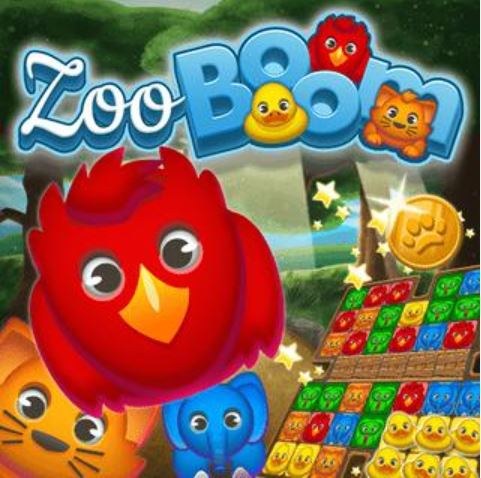
I fired up Zoo Boom expecting another cutesy match game where fuzzy animals wink at you while you clear colored blocks. What I got instead was a surprisingly tense bomb-defusal puzzle that just happens to have zoo decora
I fired up Zoo Boom expecting another cutesy match game where fuzzy animals wink at you while you clear colored blocks. What I got instead was a surprisingly tense bomb-defusal puzzle that just happens to have zoo decorations plastered on it. The first sixty seconds feel like someone handed you a live circuit board and said “snip the right wires, no pressure.” You're staring at a grid of animal tiles, a timer ticking down, and a bomb icon that pulses ominously in the corner. There's no tutorial rabbit holding your paw. You either figure out the tap logic fast or you watch the whole board detonate in a shower of pixels.
The core loop is deceptively simple, and that's what kept me coming back for “one more try” until I'd burned through a solid twenty minutes without noticing. You're presented with a board full of animal faces—monkeys, lions, hippos, the usual zoo suspects. Each one has a tiny bomb meter underneath it. Tap a tile, and its meter fills a notch while adjacent tiles of the same animal also tick up. The goal is to fill every bomb meter on the board exactly to its max without overshooting. Overshoot even one, and the chain reaction starts. The whole board goes up and you're back to square one.
What you're really optimizing for is sequencing. The puzzle isn't just about which animals you tap; it's about the order you tap them in, because each tap affects clusters in ways that can cascade into dead ends three moves later. I lost my fifth run because I got greedy with a lion cluster in the top-left corner. I'd already nudged the adjacent hippos to their limit, and that final lion tap pushed them over. I watched the explosion ripple outward like dominoes. It stung, but I also immediately saw what I'd done wrong, which is the mark of a well-tuned puzzle.
The Tension Curve That Sneaks Up on You
Early boards lull you into a false sense of security. The first few levels have small grids, maybe four or five animal types, and meters that only need two or three taps to fill. You'll breeze through them thinking you're some kind of bomb-squad prodigy. Then the game starts layering complications. Boards get larger. Meters require more taps. Animal types start appearing in awkward L-shaped clusters where tapping one corner fills half the group but leaves the other half dangerously close to overloading. Around level ten, I found myself squinting at the screen, mentally tracing tap sequences three moves ahead like a chess player who just realized their opponent isn't a toddler anymore.
There's no move counter, by the way. The game doesn't penalize you for taking extra taps, as long as you don't overshoot anything. This creates an interesting psychological effect. In most puzzle games, efficiency is the goal—fewer moves, higher score. Here, the only failure state is detonation. So you can theoretically tap around the board in circles, carefully inching meters up one notch at a time. But the absence of a move limit doesn't make it less stressful. If anything, knowing you have unlimited moves makes the overshoot failure feel more personal. You can't blame a turn limit. You just screwed up.
Who's Going to Click With This (and Who Should Back Away Slowly)
Zoo Boom suits a specific kind of player, and I want to be upfront about that because the cute animal veneer might trick the wrong audience into trying it. This is not a casual match-three you play while half-watching TV. It demands your full attention. If you enjoy puzzles where the solution space is wide open but the margin for error is razor-thin, you'll sink into this comfortably. Think of it as a gentler cousin to those bomb-defusal video games where you're reading a manual and cutting wires, except here the manual is your own spatial reasoning and the wires are cartoon hippopotamuses.
People who thrive on planning ahead will find their groove. The game rewards you for scanning the entire board before your first tap. I developed a habit of identifying the “bottleneck” animal first—the one that appears in the tightest clusters with the most neighbors—because that's usually the one that'll trip you up if you ignore it until the end. If you're the type who enjoys Sudoku or nonogram puzzles where you pencil in possibilities before committing, Zoo Boom scratches that same itch.
On the flip side, if you're looking for a relaxing idle game or something you can play in thirty-second bursts while waiting for coffee, this probably isn't your match. The reset-on-failure mechanic means one moment of distraction can undo five minutes of careful tapping. I had a run end because my cat jumped on my desk and I reflexively tapped the screen. That's not the game's fault, but it reveals how unforgiving the design is. There's no undo button. No second chances. One wrong tap and you're staring at a “Level Failed” screen with a surprisingly cheerful explosion animation.
Completionists might find the structure satisfying or maddening, depending on temperament. Levels are sequential, and you can't skip ahead. If you're stuck on level seventeen, you're staying there until you solve it. There's no hint system, no power-ups to bail you out. Just you and the grid. I respect that purity, but I also recognize it'll frustrate players accustomed to modern puzzle games that offer skip tokens or ad-watch bailouts. Zoo Boom is old-school in its refusal to hold your hand.
Mistakes That Will Blow Up in Your Face (Literally)
After a dozen or so failed runs, I started cataloguing the dumb ways I was dying. The most common mistake by far is what I call the “corner trap.” You've got an animal type clustered in a corner with two or three neighbors. You tap it once, everything's fine. You tap it again, still fine. But that third tap also hits the neighbors, and one of those neighbors was already one notch from full because you'd been working on a different cluster earlier and forgot about the overlap. Boom. The fix is boring but effective: before every tap, glance at every adjacent tile's meter, even the ones you aren't actively working on.
The second mistake is treating all animal types equally. They're not. Some animals appear in large, spread-out groups that are forgiving to tap. Others appear in tight knots where three taps will max out the whole cluster simultaneously. Learn to spot the difference early. I started mentally labeling each animal type as “safe” or “volatile” within the first five seconds of a new board. Volatile types get handled last, when I have a clearer picture of the board state. Safe types I can chip away at earlier to build momentum.
The third mistake, and this one is more subtle, is failing to recognize when a board is already lost. Sometimes you'll make a tap that doesn't immediately detonate anything, but it creates a situation where no sequence of future taps can solve the board. One animal will inevitably overshoot no matter what you do. Learning to spot these dead-man-walking scenarios early saves time. I don't have a perfect heuristic for it yet, but I've gotten better at sensing when I've painted myself into a corner. When that happens, I just tap rapidly and trigger the explosion on purpose to reset. It's faster than agonizing.
Phone vs Desktop: This One Actually Matters
I played Zoo Boom on both my phone and my laptop, and the experience differs enough that it's worth mentioning. On a phone, the tiles are thumb-sized and satisfying to tap. The haptic feedback—if your device supports it—adds a tiny physical click that makes each tap feel deliberate. The downside is that on smaller screens, the meters under each animal are harder to read at a glance. I caught myself leaning in to check whether a hippo was at two pips or three. That extra half-second of squinting broke my flow a few times.
On desktop, you're using a mouse or trackpad, which feels less tactile but gives you much better board visibility. The larger screen means you can take in the whole grid without scrolling or zooming. I found my desktop runs were consistently more successful, not because the puzzles were easier but because I could plan further ahead without losing track of meter states. If you're struggling on mobile, try switching to a bigger screen. It won't make the puzzles easier, but it removes a layer of interface friction that you might not even realize is there.
One quirk I noticed: the tap targeting on mobile can be slightly unforgiving if you have large fingers. More than once I meant to tap a monkey and accidentally hit the zebra next to it because the tiles are packed tight. On desktop, the cursor is precise. No misclicks. If you're prone to fat-finger errors, that alone might push you toward playing on a computer. The game doesn't seem to have been designed exclusively for one platform or the other; it just happens that the precision demands favor a mouse.
A Practice Plan That Won't Make You Miserable
If you want to get better at Zoo Boom without banging your head against the same level for an hour, here's the approach I settled into after some trial and error. I'm not a puzzle genius, just someone who figured out how to stop blowing up quite so often.
First, spend your first five minutes on any new level just observing. Don't tap anything. Trace the clusters with your eyes. Identify which animals touch which others. Count how many taps each cluster needs to max out. This sounds tedious, but it takes less time than replaying the level three times because you rushed in blind. I timed myself: the observation phase on a medium-sized board takes about ninety seconds. That's shorter than a single failed run.
Second, start each board by tapping the animal that appears in the fewest clusters. Usually this is some poor isolated penguin or giraffe sitting by itself in a corner. Clearing the loners first removes variables. Once they're maxed out, you can forget about them entirely and focus on the interconnected mess in the center of the board. This is the opposite of what my instincts told me to do—I wanted to tackle the big scary clusters first—but saving them for later gives you more information about how the board behaves.
Third, if you're stuck on a specific level for more than ten attempts, walk away. I mean physically stand up and do something else for five minutes. Zoo Boom is the kind of puzzle where frustration makes you worse. You start tapping faster, skipping the observation phase, blaming the game for your own sloppiness. A short reset does wonders. I solved level fourteen on my first try after coming back from making a cup of tea, having failed it eight times in a row before the break.
Finally, embrace the explosions. They're going to happen. The game's failure animation is quick—no lengthy death sequence, no ad break, just a brief boom and a restart button. The low friction of failure is deliberate design. The developers clearly expect you to fail often and retry immediately. Once I stopped treating detonations as personal failures and started seeing them as data points, my progress sped up. Every explosion teaches you something about adjacency or meter thresholds. Pay attention to what blew up and why, and you'll internalize the board logic faster than any tutorial could teach you.
The Animal Coating: Does It Help or Hurt?
I want to circle back to the zoo theme because it's an odd choice for this kind of puzzle and I'm still not sure if it works. The animals are cute, sure. Bright colors, big eyes, little ears that wiggle when you tap them. But the cheerful aesthetic is at odds with the gameplay tension. You're defusing bombs, not feeding penguins. I found the disconnect slightly jarring at first, then oddly charming, like someone wrapped a stress ball in gift paper. It lowers the stakes visually even though the mechanical stakes are unchanged.
Your mileage will vary. Some players might find the animal theme infantilizing, especially given how punishing the actual puzzles are. Others might appreciate the contrast—it's easier to stay calm when a smiling cartoon zebra is the thing about to explode rather than a realistic explosive device. I landed in the latter camp after a while. The goofy animal noises when you tap tiles became a weird comfort. That little monkey squeak meant I was making progress, even if I was also inching closer to disaster.
Is This Worth Your Lunch Break?
Zoo Boom isn't going to be everyone's favorite game, and that's fine. It's a focused, unflashy puzzle with a single mechanic explored thoroughly across escalating difficulty. No loot boxes, no daily login bonuses, no metagame progression system to pad out engagement. Just a series of bomb grids and your own growing ability to read them. I respect the restraint. In a browser game landscape cluttered with feature-stuffed titles that try to be everything at once, there's something refreshing about a game that does one thing and trusts you to meet it on its own terms.
If the description I've laid out sounds appealing—careful planning, spatial reasoning, the satisfaction of solving a board that looked impossible two minutes ago—then you'll probably enjoy the free browser version enough to lose an afternoon to it. If you're already feeling stressed just reading about timed bomb puzzles, maybe go play something with more forgiving failure states. The zoo animals will still be there if you change your mind.