
First Moments Behind the Wheel You’ll load into Bus Parking King and immediately feel the weight of the thing. The bus doesn’t glide — it lurches a little when you tap the gas, and the turning radius is wider than your b
First Moments Behind the Wheel
You’ll load into Bus Parking King and immediately feel the weight of the thing. The bus doesn’t glide — it lurches a little when you tap the gas, and the turning radius is wider than your brain expects. My first attempt lasted maybe twelve seconds before I clipped a concrete barrier and watched the level reset. No dramatic crash animation, just a soft fade and a “try again” prompt that felt surprisingly gentle.
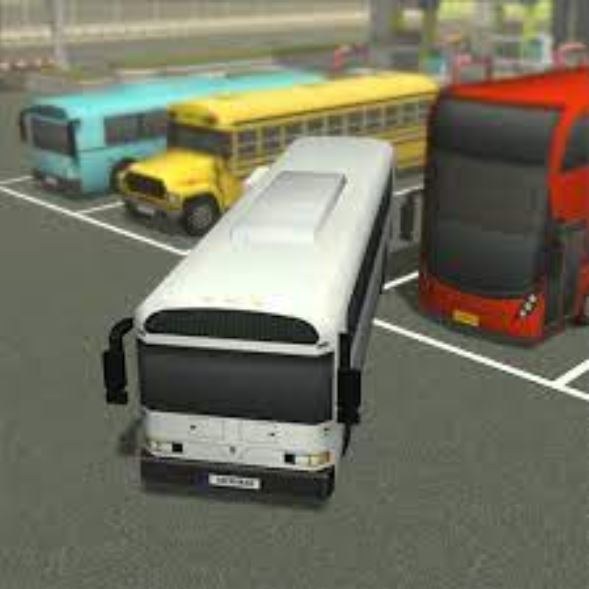
The camera sits at a fixed overhead angle, slightly tilted so you can see the parking lines and the obstacles in one glance. There’s no minimap, no distance markers, just you, the bus, and a painted rectangle waiting somewhere in a lot filled with shipping containers, lampposts, and other parked vehicles that definitely weren’t placed to make your life easier. The steering wheel controls appear on screen if you’re on mobile — a virtual wheel on the left, gas and brake pedals on the right. On desktop, it’s arrow keys or WASD, and I’ll get into why that matters later.
That first minute feels calibrating. You’re not just learning the controls; you’re learning how much bus hangs behind the rear wheels, how early you need to start your turn to avoid swinging the tail into something expensive-looking. The game doesn’t tutorialize much beyond a single arrow pointing toward your spot. The rest is trial, error, and eventually a kind of muscle memory you didn’t know you needed for pixel buses.
What You’re Actually Optimizing For
Bus Parking King isn’t just about fitting into the rectangle. The game tracks something more interesting: how cleanly you chain movements together without stopping, reversing unnecessarily, or tapping obstacles. Think of it as a combo system dressed up in reflective vest orange.
Each level gives you a target parking position, but the scoring layer rewards continuous motion. When you pull forward, arc smoothly into a turn, and back in without pausing, the game registers a “flow” multiplier that ticks upward. Hesitate mid-maneuver or tap the brake too long, and that multiplier resets. Hit something — even a traffic cone that someone definitely left too close to the lot entrance — and you lose the chain entirely.
The loop works like this: you start a level, scan the obstacles, plan your approach in the first three seconds, then commit. The best runs feel almost choreographed. You’re threading a long vehicle through gaps that look impossibly tight, and when the multiplier hits 5x or 6x, the score counter starts climbing fast enough to make you nervous. That nervousness is the real game. It pushes you to take slightly riskier angles, to carry a little more speed through a turn, and that’s exactly when the back bumper finds a light pole.
There’s also a time element, but it’s gentler than you’d think. You get a time bonus at the end, but chasing seconds usually breaks your combo. The high-score players on any given level tend to prioritize smooth chains over raw speed. I learned that the hard way after watching my score flatline on a level I’d finished ten seconds faster than my previous attempt. Clean counts more than quick here.
Mistakes That Send You Back to the Menu
After about twenty minutes with Bus Parking King, I started recognizing the patterns that end runs prematurely. Some are obvious — hitting a wall at full speed is going to reset you every time. But the subtle ones are what separate a frustrating session from a satisfying one.
Overcorrecting during reverse. This is the big one. The bus responds to steering inputs differently in reverse than your brain predicts. When you’re backing toward a spot and realize your angle is slightly off, the instinct is to crank the wheel hard in the opposite direction. That sends the front end swinging wide, and suddenly you’ve clipped a barrier with a part of the vehicle you forgot existed. Small adjustments only. If you need to turn more than a quarter-wheel in reverse, you’ve probably already lost the line and should pull forward to reset your position. Yes, that breaks your combo, but it’s better than a full restart.
Entering the lot too fast. The first stretch of most levels is a straight approach to the parking area. It’s tempting to hold the gas down and build some speed, especially when you’re replaying a level for the fifth time and feeling impatient. The problem is that braking distance in this game is not generous. If you’re still carrying momentum when you reach the first turn, you’ll understeer wide or have to brake so hard the game registers it as a hesitation. Both kill your chain. Coast in. Let the bus slow naturally before you start your setup turn.
Ignoring the pivot point. Buses pivot around the rear axle, not the center of the vehicle. This sounds obvious if you’ve ever driven anything larger than a sedan, but in the overhead view it’s easy to forget. When you’re making a tight right turn around a container, watch your left rear corner. That’s the part that will catch. I lost at least four runs to the same shipping container before I started mentally tracking where my rear wheels were, not just where the front bumper was pointing.
Getting greedy with the combo multiplier. Once you see 4x or 5x on screen, the temptation to push for one more clean maneuver is intense. But some parking spots are positioned in ways that require a deliberate pause — maybe you need to straighten out after a cramped approach, or wait for a moving obstacle to clear on levels that include them. The game doesn’t penalize you for taking a breath. It penalizes you for tapping the brake in the middle of a motion you already committed to. The distinction matters. If you need to stop completely and reassess, do it. You’ll lose the current multiplier but keep the run alive. I’ve salvaged plenty of levels by accepting a reset multiplier rather than forcing a motion that would have clipped something.
Phone vs Desktop: What Actually Changes
I played Bus Parking King on both a mid-range Android phone and a laptop browser, and the experience shifts in ways worth knowing about before you commit to a platform.
On mobile, the virtual steering wheel is serviceable but imprecise. Your thumb covers part of the screen, and making fine adjustments while also managing the gas pedal with your other thumb takes coordination that the first few levels don’t require but later ones absolutely do. The advantage is that you can play anywhere, and the touch controls are responsive enough that I never felt like input lag was the reason I crashed. It was always my thumbs.
On desktop with a keyboard, the steering feels more granular. Tapping an arrow key gives you a discrete amount of turn angle, and holding it ramps up smoothly. This makes small corrections easier, especially in reverse. The downside is that keyboard gas and brake are binary — on or off — whereas mobile pedals have a bit of analog range if you slide your thumb rather than tap. For levels where you need to creep forward at half speed, mobile actually has an edge. I found myself switching to desktop for precision parking levels and back to mobile for levels where controlled acceleration mattered more.
One quirk: on some mobile browsers, the ad break between levels shifts the screen layout slightly, and I once tapped the wrong spot because a banner ad loaded in and moved the restart button down a few pixels. Not a dealbreaker, but worth knowing if you’re on a slower connection.
A Practice Plan That Won’t Waste Your Time
If you want to get genuinely better at Bus Parking King without burning out on the same three levels, here’s how I’d structure a session based on what worked for me. This isn’t a speedrunner’s regimen — it’s for people who want to see their scores climb without spending hours grinding.
First five minutes: calibration runs. Pick a level you’ve already cleared and run it three times without caring about score. Focus entirely on how the bus moves at low speed. Notice where the rear end swings during slow turns. Practice stopping exactly on a painted line. These runs aren’t about completion — they’re about building a mental model of the vehicle’s dimensions. You’ll feel silly doing it, but the next time you thread a gap without thinking, you’ll know why it worked.
Next ten minutes: combo-chaining on easier levels. Go back to the earliest levels where the parking spots are generous and the obstacles are minimal. Try to chain the entire approach, turn, and park sequence without letting the multiplier drop. If it drops, finish the level anyway to see where you hesitated, then restart and try again. The goal here is to internalize what continuous motion feels like so that on harder levels, you recognize the rhythm even when the geometry gets tighter.
Final five minutes: one hard level, no restarts. Pick a level that’s currently giving you trouble. Commit to finishing it three times no matter how bad your score is. Don’t restart mid-run. The point is to practice recovery — what do you do after you’ve already broken your combo and the perfect run is off the table? How do you still park cleanly from a bad position? These skills transfer to earlier levels when you’re chasing high scores and make a mistake late in a run. Knowing you can salvage a finish even with a reset multiplier keeps you from rage-quitting.
If you only have five minutes total, just do the calibration runs. They pay off more than you’d expect.
Why the Combo System Sticks With You
What makes Bus Parking King more interesting than other parking games floating around free browser sites is that the scoring system changes how you read the environment. After fifteen minutes, I stopped seeing a parking lot and started seeing lines of motion — arcs I could trace, pivot points I needed to hit, moments where I could carry momentum through a tight spot without tapping the brake. The game doesn’t explain any of this. You just start noticing it.
The levels themselves are static, at least in the ones I played. Obstacles don’t move unless a level specifically includes a timed gate or a crossing vehicle, and those appear sparingly enough that they feel like a change of pace rather than a gimmick. The variety comes from the layouts — some lots are wide open with angled spots, others are cramped industrial yards where the parking space is wedged between two dumpsters and a concrete pillar. The difficulty curve isn’t perfectly smooth. Level five felt harder than level seven to me, and your mileage may vary depending on whether you’re better at parallel parking or backing into perpendicular spots.
The visual style is clean and functional. Buses are brightly colored, obstacles are distinct, and the parking target glows just enough to be visible without looking like a neon sign. There’s no music that I can recall, just engine hum and a subtle chime when your multiplier increases. It’s the kind of audio design that fades into the background until you realize you’ve been playing for half an hour.
Bus Parking King won’t reinvent the parking game genre, but the combo mechanic gives it a layer that most free browser parking games skip. You’re not just trying to fit into a rectangle — you’re trying to do it in one smooth, unbroken motion, and the scoring system notices when you pull it off. That’s enough to keep me coming back to shave a few more points onto my best levels, and if you’re the type who finds satisfaction in cleaning up messy lines and chasing flow state, it’ll probably do the same for you.