
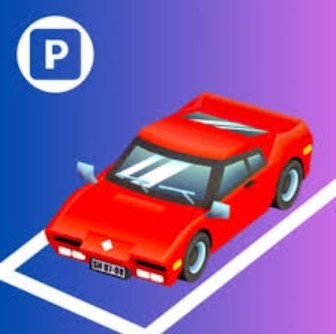
The first time Parkmania loads, you’re presented with a car that looks vaguely European and a parking lot that seems deceptively roomy. You press the arrow key, the car lurches forward, and within three seconds you’ve cl
The first time Parkmania loads, you’re presented with a car that looks vaguely European and a parking lot that seems deceptively roomy. You press the arrow key, the car lurches forward, and within three seconds you’ve clipped a concrete planter. No explosion, no dramatic failure screen — just a subtle red flash on your bumper and the quiet understanding that this is going to be harder than it looks. That’s the whole first minute: a gentle humbling. The camera sits at a fixed three-quarter angle, which means you’re constantly fighting your own depth perception, and the car’s turning radius feels about as nimble as a shopping cart with a locked wheel.
I’ve now put roughly twenty hours into various parking games in this genre, and Parkmania sits comfortably in the “deceptively punishing” subcategory. It’s not a physics sandbox where you can bounce off walls and giggle. It’s the kind of game where a three-point turn becomes a seven-point turn because you misjudged the rear overhang by what feels like a pixel. If you’ve played Parking Fury or any of the mobile parking sims that dominated browser game portals a few years back, you know the drill. Parkmania doesn’t reinvent the formula; it refines the friction points until they become the whole point.
The Loop That Hooks You
Parkmania operates on a level-by-level structure. Each stage gives you a designated parking spot marked by a glowing rectangle and some cones. You start somewhere on the map — sometimes facing the wrong direction, sometimes wedged between a delivery truck and a decorative hedge — and your only job is to get the car into that rectangle without hitting anything. Hitting objects isn’t an instant fail, but it racks up damage. Too much damage and the level restarts. There’s also a timer running, though in my experience it’s generous enough that you’ll rarely lose to the clock unless you’re genuinely stuck in a loop of bad corrections.
What you’re optimizing for is clean execution. The game tracks your damage count visibly, and something about seeing that “0” at the end of a level feels disproportionately satisfying. You’re not just parking; you’re trying to park perfectly. The levels escalate by adding tighter spaces, more obstacles, and occasionally moving elements — pedestrians who wander across your path, other cars that pull out unexpectedly. These moving hazards are where Parkmania distinguishes itself from the pack. They’re not random chaos; they follow predictable patterns that you can learn. A man pushing a stroller will cross from left to right every twelve seconds. A white sedan will reverse out of its spot when your nose gets within a certain distance. Learning these triggers turns each level into a small memorization puzzle.
The controls are straightforward: arrow keys or WASD for movement. No gear shifting, no clutch, no manual camera rotation. You get forward, reverse, and steering. That’s it. This simplicity means your failures feel entirely like your own fault, which is both the game’s greatest strength and its most frustrating quality. There’s no handbrake turn mechanic, no boost button, no way to cheat the geometry. If you’re stuck, you inch forward, cut the wheel, inch backward, cut again, and repeat until you’ve either cleared the obstacle or wedged yourself so thoroughly that restarting is the only dignified option.
When the Wheels Come Off
Let me tell you about the mistakes that will end your run early, because I made all of them multiple times. The most common is what I’ve started calling “the optimistic angle.” You approach the parking spot at roughly 45 degrees, convinced you can swing the nose in with one smooth motion. You cannot. The car’s pivot point sits farther back than your brain expects, so the front corner clips the adjacent vehicle every single time. I lost count of how many runs I tanked because I refused to accept that the geometry demanded a straighter initial approach.
Second mistake: forgetting about the rear. The camera angle does a decent job of showing you what’s ahead, but the rear bumper exists in a perpetual blind spot. You’ll be so focused on lining up the front wheels that you’ll swing the tail into a bollard you forgot was there. There’s no rearview mirror, no picture-in-picture backup camera, no audible proximity warning. You have to hold a mental map of what’s behind you, which gets genuinely difficult when you’re on your eighth correction attempt and your spatial awareness has degraded into frustrated guesswork.
The third run-ender is impatience with pedestrians. The moving NPCs follow set paths, but their hitboxes are unforgiving. You don’t have to hit them squarely; a gentle nudge at half a mile per hour counts as contact. I developed a habit of waiting a full two seconds after a pedestrian cleared my path before moving, because the animation can be slightly misleading about when the collision zone deactivates. One level in the mid-game has a crossing guard who walks a loop around a school zone, and I restarted that stage eight times before I internalized his rhythm.
There’s also a subtler failure mode: overcorrecting. You’ll be centimeters from the perfect spot, angled slightly wrong, and instead of accepting a minor imperfection you’ll try one more adjustment. That adjustment becomes two. Then three. Suddenly you’ve drifted farther from the target than when you started, and the timer’s ticking down, and you’re making the kind of jerky, frustrated inputs that guarantee a collision. Walking away for thirty seconds fixes this more reliably than any technique I could describe.
Who This Game Actually Suits
Parkmania is not for everyone. Let’s be honest about that. If you’re looking for a relaxing experience where you can zone out and listen to a podcast, this isn’t it. The game demands focused attention. Every level is a small concentration exercise. You will be annoyed. You will restart levels that you were seconds from completing. The question is whether that annoyance feels motivating or demoralizing to you.
People who enjoy optimization puzzles will click with Parkmania immediately. It scratches the same itch as untangling headphone cords or organizing a drawer that’s been chaotic for months. The satisfaction comes from imposing order on a small, stubborn space. If you’re the type of person who straightens pictures on restaurant walls without thinking about it, you’ll understand the appeal within the first three levels.
I think the game also suits players who have limited time but high focus. A single level takes anywhere from forty seconds to maybe four minutes, depending on complexity and your stubbornness. You can play three levels on a coffee break and feel like you accomplished something tangible. There’s no narrative to track, no upgrade tree to manage, no inventory to sort. Just a car and a rectangle and the increasingly personal battle between them.
On the flip side, if you struggle with spatial reasoning or get easily frustrated by repeated failure, Parkmania might feel more punishing than rewarding. The game doesn’t offer much in the way of scaffolding. There’s no hint system, no optional guide lines, no “easy mode” that widens the parking spots. The difficulty curve is steady but unyielding. Level 7 expects significantly more precision than Level 3, and Level 12 introduces moving obstacles without any warning or tutorial. You learn by failing, which I personally respect but which won’t suit every temperament.
Phone vs Desktop: A Practical Divide
Since Parkmania runs in your browser for free, you can theoretically play on whatever device you have handy. In practice, the experience differs enough between phone and desktop that it’s worth spelling out. On a desktop with a physical keyboard, the controls feel tight and responsive. The arrow keys give you granular control over speed and steering angle. You can tap forward in tiny increments, which is essential for the tighter parking spots later in the game. I found myself resting my fingers on the arrow keys and making micro-adjustments that felt almost surgical.
On a phone, the game overlays virtual directional buttons on the screen. They work fine in a technical sense, but the lack of tactile feedback makes precision significantly harder. Your thumb will slip off the “forward” button at least once per session, and you’ll accidentally steer while trying to reverse because the on-screen controls sit close together. I found the mobile version playable but noticeably more frustrating, especially on levels with moving obstacles where you need quick, precise stops. If you have the option, play on a laptop or desktop with a keyboard. Your blood pressure will thank you.
One oddity I noticed: the game’s performance varies by browser. On Chrome, everything ran smoothly at a consistent frame rate. On Firefox, I experienced occasional micro-stutters, particularly when pedestrians entered the screen. These stutters lasted maybe a quarter-second, but when you’re mid-turn with centimeters of clearance, a quarter-second freeze is enough to cause a collision. If you’re struggling with timing-based levels and using Firefox, try switching browsers before you blame your reflexes.
Building Your Parking Muscles: A Practice Plan
I’m going to outline a short practice routine that helped me improve faster than just grinding levels sequentially. This isn’t official advice from the developer; it’s just what worked for me after noticing my own patterns of failure.
First, spend your initial session purely on the first three levels. Don’t try to progress. Just replay them until you can consistently achieve zero-damage completions. The early levels exist to teach you the car’s dimensions and turning behavior. You need that knowledge to become automatic before the spaces tighten. I replayed Level 2 specifically about fifteen times, approaching the parking spot from different angles each time, just to internalize where the car’s corners actually are relative to what the camera shows.
Second, practice reversing in straight lines. It sounds absurdly basic, but reversing is where most of my damage occurred. Find a level with a long, open stretch — Level 4 has a decent straightaway near the starting position — and just drive backward in a straight line for thirty seconds. Then try reversing around a gentle curve. The reversed steering takes time to internalize, and practicing in a low-stakes environment builds the muscle memory without the pressure of a ticking clock.
Third, when you encounter a level that introduces moving obstacles, spend your first attempt not even trying to park. Just sit and watch. Note the timing of each pedestrian, each moving car. Count the seconds between their appearances. On the school zone level I mentioned earlier, mapping the crossing guard’s loop made the difference between eight failures and a clean completion on the next try.
Fourth, adopt a personal rule: never adjust more than twice once you’re within what looks like the final positioning. If you’re in the rough vicinity of the parking rectangle and your angle is slightly off, accept it. A two-damage completion is better than a restart because you chased perfection into a concrete barrier. This rule alone cut my average completion time by roughly thirty percent.
Finally, take actual breaks. Parkmania fatigue is real. Your spatial judgment degrades after about twenty minutes of concentrated play. You’ll start making mistakes you weren’t making at the start of the session, and you’ll blame the game when it’s actually your tired brain cutting corners on distance estimation. I set a timer for twenty-five minutes and walked away when it buzzed, regardless of what level I was on. My progress rate improved noticeably.
The Quiet Appeal
What keeps me coming back to Parkmania isn’t flashy. There are no leaderboards that I can see, no achievements to unlock beyond the internal satisfaction of clearing levels, no progression system beyond the next tighter parking spot. The game trusts that its core loop is engaging enough without external validation. For the right player, that trust is well-placed.
There’s something meditative about the repetition once you settle into its rhythm. The low-poly environments are uncluttered and calm. The sound design is minimal — a soft engine hum, a subtle bump when you make contact, no music that I can recall. It’s just you and the geometry. Every level is a small problem with a clear solution, and solving it feels like straightening a crooked frame in a world that could use more straight frames.
If you have fifteen minutes, a keyboard, and a tolerance for being humbled by a virtual parking space, Parkmania delivers exactly what it promises. No more, no less. And honestly, that restraint is rarer than it should be in free browser games.