
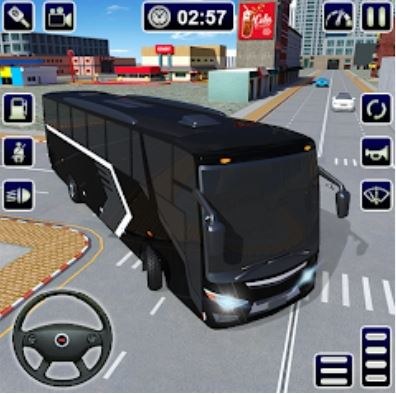
I loaded up Bus Driving expecting something simple—maybe a top-down city loop with a timer. Instead, the first thirty seconds felt oddly tense. You're sitting behind a wheel, the engine hums through your laptop speakers,
I loaded up Bus Driving expecting something simple—maybe a top-down city loop with a timer. Instead, the first thirty seconds felt oddly tense. You're sitting behind a wheel, the engine hums through your laptop speakers, and a narrow road stretches ahead with oncoming traffic already drifting toward your lane. The steering isn't twitchy, but it's not loose either. It sits in that middle zone where you can't just tap the arrow keys mindlessly. I clipped a guardrail before the first passenger stop, purely because I was staring at the speedometer instead of the road.
The quiet pressure nobody warns you about
What surprised me most wasn't the driving itself—it's the invisible countdown hanging over every route. You're not just ferrying passengers from stop to stop. There's a schedule ticking away in the corner, and it doesn't care if you got boxed in by a slow-moving sedan or took a wrong turn looking for the drop-off zone. Miss your window by too much and the run simply ends. No dramatic crash, no explosion. Just a gray summary screen telling you the schedule wasn't met.
That loop defines the whole experience. You start each route with a clean bus, a full tank, and a time buffer that looks generous until you realize the game counts every pause at a crosswalk, every hesitant brake before a sharp bend. The real optimization isn't about speed. It's about smoothness. Keeping the bus in motion without the jerky corrections that scrub off momentum. You learn to read traffic gaps three cars ahead, to coast toward red lights instead of accelerating into them, and to brake early enough that your passengers don't lurch—because passenger comfort affects your score in ways the tutorial never explicitly explains.
What you're actually optimizing for
The game tracks a few things under the hood. I noticed the score multiplier creeping upward when I maintained consistent speed through wide turns and avoided hard stops. It dips sharply after collisions, obviously, but also after near-misses that the game flags as "dangerous driving." I clipped a cyclist once—just a glancing brush, no crash animation—and the penalty was harsher than I expected. The game seems to treat any contact with pedestrians or smaller vehicles as an automatic strike against your run.
Fuel management matters too, though it's subtle. On longer routes, I found myself watching the fuel gauge more than the road during the final stretch. Running out mid-route isn't a dramatic failure; the bus just slows to a crawl and the schedule dies. You can refuel at certain stops if you pull in carefully, but the refueling animation eats precious seconds. I learned to top off early, even when the tank was three-quarters full, because the later stretches offer fewer chances.
Passenger boarding is the other quiet pressure point. You have to stop within a marked zone near the curb, and if you're off by more than a bus length, passengers won't recognize the stop. I sat at what I thought was a valid drop-off for about eight seconds once, wondering why nobody was getting off, before realizing I'd parked behind a dumpster that obscured the zone boundary. The schedule didn't forgive those lost seconds.
The small mistakes that end runs early
Most of my early failures weren't spectacular crashes. They were cumulative. A few common ones I kept repeating:
Braking too late for the first stop. The initial stretch lulls you into highway-speed comfort, and then the GPS chirps about an upcoming turn with about two seconds of warning. I learned to slow down preemptively whenever the minimap showed a route kink, even if the road looked straight ahead.
Misjudging bus length on tight corners. The rear wheels track differently than a car, and in a few downtown maps with narrow alleys, I'd take a turn cleanly with the front only to hear the horrible scrape of the back end catching a bollard or a parked scooter. The damage model isn't visual, but the game logs it and the score takes a hit.
Getting impatient at intersections. The AI traffic isn't aggressive, but it's unpredictable in one specific way: vehicles will sometimes stop to let you through, then accelerate right as you commit. I developed a habit of waiting an extra beat after a car appeared to yield, just to see if it was genuinely stopped or just rolling slowly.
Ignoring weather shifts. A few routes introduce rain or fog, and the bus handles differently—slightly longer stopping distances, reduced visibility for upcoming stops. I didn't adjust my braking points on a wet route and slid right past a passenger waiting under a shelter. That single miss cascaded into a late arrival at the next three stops.
How the game feels across different devices
I tested Bus Driving on both a laptop with keyboard controls and a phone using the on-screen tilt and button layout. The experiences aren't interchangeable.
On desktop, the arrow keys or WASD give you precise, granular steering. You can feather turns and hold a steady line through sweeping curves. The spacebar for braking feels natural, and the overall rhythm settles into something almost meditative once you learn the routes. The bigger screen also helps with spotting upcoming traffic patterns and reading the minimap without squinting.
On mobile, the tilt steering introduces a slight lag that took me a few runs to calibrate. It's not broken—just different. You have to initiate turns a fraction earlier, and the smaller screen makes it harder to judge the gap between your bus and an oncoming truck. I found myself playing more conservatively on phone, braking earlier and taking wider arcs. The touch buttons for indicators and horn are clustered near the bottom, and I accidentally honked at a pedestrian twice while trying to signal. Battery drain was noticeable but not extreme; a twenty-minute session ate about eight percent on a mid-range phone.
If you're serious about chasing high scores, desktop gives you finer control. But the mobile version works perfectly well for short sessions, and the tilt steering adds a physicality that keyboard tapping lacks. Neither version requires a download—both run directly in a browser tab, which I appreciated when I wanted to squeeze in a quick route during a break without committing to an install.
Why relaxing is the trap
The game's presentation—soft dashboard colors, ambient engine sounds, gentle GPS voice—masks how demanding the schedule actually is. I'd settle into a calm rhythm for four or five stops, thinking I had everything under control, and then a sudden lane closure or an ambulance squeezing through would shatter my timing. The game doesn't throw obstacles at you constantly, but when it does, they arrive without warning. You can't pause and plan; you have to react while maintaining whatever smoothness you've built up.
That's where the "smooth" in the editorial angle really clicks. Bus Driving rewards players who treat smoothness as a skill, not a style. Jerky drivers can complete routes, but they'll scrape through with mediocre scores and constant near-misses. Smooth drivers—the ones who anticipate slowdowns, who merge without forcing other cars to brake, who glide into stops rather than lurching—get the multiplier snowball rolling. And once that multiplier climbs, the satisfaction of nailing a perfect schedule run feels genuinely earned.
A short practice plan if you're starting fresh
I spent about fifteen minutes experimenting with a training approach that helped me stop bleeding schedules. Here's what worked:
First, spend three runs ignoring the schedule entirely. Just drive the route at whatever pace feels comfortable. Learn where the narrow turns are, which intersections have blind spots, and where the stop zones sit relative to landmarks. The game recycles route layouts, so pattern recognition builds quickly.
Second, do two runs focusing exclusively on braking smoothness. Try to never come to a complete stop except at designated passenger zones. Coast toward red lights, use gentle taps instead of full holds, and watch how the bus settles after each deceleration. You'll start feeling the weight of the vehicle in a way that pure speed-focused play never reveals.
Third, run one route where you prioritize the fuel gauge and refuel timing. Note which stops have pumps and how long the refueling sequence actually takes. Build a mental map of where you can afford the time loss and where you can't.
Finally, put it together on a full schedule run. By that point, the route should feel familiar enough that you can focus on traffic flow and passenger comfort without consciously thinking about every turn. I hit my first perfect schedule around the eighth or ninth attempt, and the difference from my early runs was night and day.
The game doesn't demand marathon sessions. I played in chunks of fifteen to twenty minutes and felt like I was making tangible progress each time. It's the kind of free browser game that fits neatly into a coffee break but has enough depth to reward repeated visits. You won't find flashy cutscenes or upgrade trees here—just a bus, a road, and a schedule that won't wait.