First Minute: What You'll Actually Notice I fired up Epic Blocollapse expecting another match-three thing with a bomb in the corner, and instead the first thirty seconds felt weirdly quiet. You get a grid of chunky block
First Minute: What You'll Actually Notice
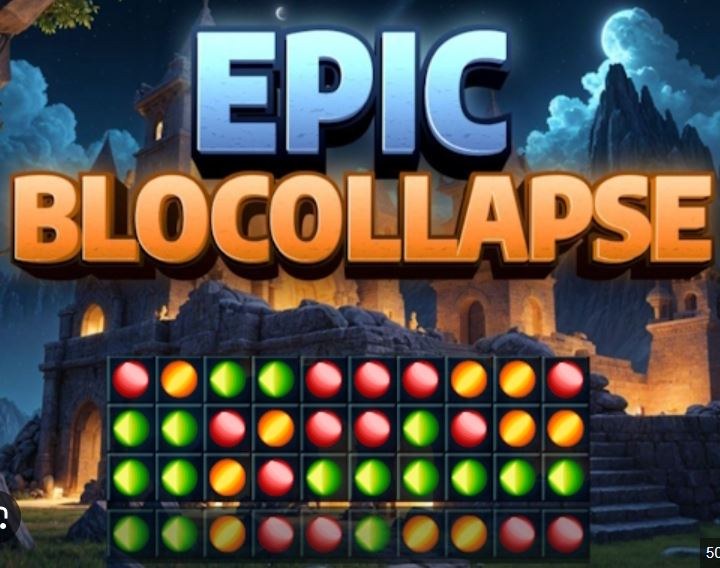
I fired up Epic Blocollapse expecting another match-three thing with a bomb in the corner, and instead the first thirty seconds felt weirdly quiet. You get a grid of chunky blocks, most of them stacked two or three layers deep, and a single fuse icon blinking in the middle of the screen. No tutorial pop-up. No sparkle trails pointing where to tap. Just this low humming sound and the knowledge that if you don't find the right block fast, the whole screen's going to flash white and you're back to the title.
The first block I tapped was wrong. Not dramatically wrong — just the kind of wrong that eats ten seconds and leaves you staring at a cluster of grayed-out squares, realizing you've already cornered yourself. What surprised me was how physical it felt. The blocks don't just disappear; they crumble with this satisfying little shake, and adjacent pieces shift to fill the gap. You can almost feel the weight redistributing. By the one-minute mark I'd failed three times and was genuinely annoyed, but in that specific way that makes you hit "play again" before you've even processed the loss.
What the Loop Actually Is, and What You're Optimizing For
On the surface it's a blast-removal puzzle: tap blocks to clear them, trigger chain reactions when possible, don't let the fuse hit zero. But after about fifteen minutes of runs I realized the real loop is spatial triage. The board isn't random clutter — every block occupies a position that matters for what it supports, what it's blocking, and what it might reveal two layers down.
You're not really optimizing for score, even though there's a counter in the corner. You're optimizing for clean sightlines. The moment you can see three or four moves ahead without the board geometry fighting you, the difficulty drops by half. The problem is that the game keeps introducing stacked blocks (the "collapse" part of the name isn't decorative) and those stacks hide critical single-layer pieces you need to keep the chain alive. I started thinking of it less like a bomb game and more like a demolition puzzle where the fuse is just the timer that forces you to commit.
Chain reactions are where the satisfaction lives. When you clear a block and the one above it drops into the blast radius of something you tapped three seconds earlier, there's this delayed payoff that feels earned. But chasing chains blindly is what killed most of my early runs. The game doesn't reward fancy combos if you've ignored a stack in the corner that's about to become the only tap-able block left.
Mistakes That End Runs Early, and Why They're So Common
I kept a mental list of the ways I died in the first twenty attempts, and a few patterns kept repeating. The biggest one was edge neglect. The grid edges feel safe because they have fewer neighbors, but that also means fewer ways to trigger a chain if you get stuck. I'd clear the center aggressively, feel good about my progress, and then realize the leftmost column was three layers deep with no adjacent blocks to help. By the time I noticed, the fuse was too short to dig out.
Another trap was what I started calling "greedy tapping" — hitting every block that lights up as tappable without checking what's underneath. The game highlights available blocks, but it doesn't tell you which ones are load-bearing. I collapsed entire sections of the board accidentally because I removed a block that was supporting two layers above it, and suddenly half the grid was inaccessible gray rubble. That's not a bug; it's the core tension. You have to read the stacking visually, and the game gives you just enough time to get it wrong.
The third mistake was ignoring the fuse recharge mechanic. Every successful chain adds a sliver back to the fuse, and I didn't clock that until maybe my tenth run. I was playing like the timer only ever decreased, which made me panic-tap and make worse decisions. Once I realized I could stretch a run by planning small chains specifically to buy time, the whole rhythm changed. But the game never explains this explicitly — you just have to watch the fuse bar twitch upward after a combo and put two and two together.
The Difficulty Curve No One Mentions
Epic Blocollapse doesn't have a gentle ramp. The first few boards feel almost tutorial-light, then around what I'd guess is the fourth or fifth layout, the game starts introducing blocks that require two taps to clear. These are brutal because they break your tapping rhythm. You tap once, the block cracks, and you have to tap again — but in that half-second pause, the fuse keeps burning and your brain has already moved on to the next target. I lost several runs just forgetting which blocks were half-cracked, leaving them stranded while I chased something shinier.
There's also a color system I didn't fully grasp until I'd been playing for a while. Blocks have subtle tint variations — not in a way that screams "match the colors," but more like a visual hint about which pieces are structurally related. Blue-tinted blocks tend to be part of the same layer group, while warmer tones often indicate support pieces. It's not a hard rule, but once I started paying attention to the tints, my stack-reading got faster. The game never spells this out, and I'm still not sure if it's intentional design or just a happy accident of the art style.
Phone vs Desktop: The Controls Feel Different
I played on both phone and desktop browser, and the experience shifts in ways worth mentioning. On a phone, tapping is direct and fast — you can blaze through early boards with thumb taps, and the haptic-style vibration (if your browser supports it) adds to that physical demolition feel. But on smaller screens, the blocks are more cramped, and I mis-tapped often enough to lose runs. There's no undo button, so a fat-fingered tap on the wrong block can collapse a section you were saving.
On desktop with a mouse, the precision is better, but the clicking feels slower. You lose that rapid-fire rhythm you get on touchscreens, and I found myself overthinking moves because the mouse cursor made me more deliberate. The trade-off is that I survived longer on desktop simply because I made fewer accidental taps. If you're struggling with the later boards, switching to a bigger screen with a mouse might help, but it does change the tempo. I wouldn't call either version superior — just different flavors of the same tension.
A Short Practice Plan If You're Stuck
After banging my head against the same board layouts for a while, I settled into a practice routine that helped more than just grinding attempts. It's not a speedrun strat, but it made the game feel less punishing.
First, spend five minutes doing "no-fuse runs." Just open a board and ignore the timer completely. Let it explode. The point is to train your eyes to read the stack layers without pressure. Look at how blocks shift when you remove a piece from the bottom, middle, and top of a stack. Notice which collapses cascade and which just leave dead gray space. Do this three or four times until you can predict a collapse before you tap.
Second, force yourself to clear every board from the edges inward for five runs. You'll fail most of them because the fuse is merciless, but the constraint teaches you to respect the perimeter blocks. You'll start noticing how edge pieces connect to the center in ways you miss when you're tunnel-visioned on the middle of the grid.
Third, practice "chain farming" — deliberately set up small two- or three-block chains even when they're not the most efficient clear. The goal is to get comfortable with the fuse recharge timing. Once you internalize how much time a chain buys you, panic-tapping drops off naturally because you know you have a lifeline.
I did this for about twenty minutes total and came back to my regular runs noticeably sharper. Not world-beater sharp, but I was reaching boards I hadn't seen before and the losses felt like my fault rather than the game being cheap.
What the Game Doesn't Tell You (and Probably Should)
There's no in-game help menu, so a few things only emerged through repetition. Cracked blocks can still support weight above them — the crack is just visual, not structural. I assumed a damaged block was weaker and avoided tapping near it, but the game treats it as fully intact until the second tap. That cost me several careful setups where I tiptoed around blocks I could have used normally.
Also, the fuse speed isn't constant. It accelerates slightly when you're down to the last few seconds, which I only noticed because I started counting beats during a particularly tense board. It's not a huge jump, but enough to make those final desperate taps feel even more frantic. Knowing this ahead of time helps you budget the last quarter of the fuse differently — you can't rely on the same rhythm you used at the start of the board.
The game also seems to prioritize chain animations over your next tap input for a split second. If you're tapping rapidly during a chain, sometimes your input gets eaten because the game is still resolving the previous collapse. Slowing down just slightly during big chain moments actually made me faster overall because I stopped wasting taps that didn't register.
Who This Is For, Honestly
Epic Blocollapse isn't going to be everyone's thing. If you want a relaxing puzzle game you can zone out to, this is not that. The fuse creates a low-grade anxiety that persists even when you're doing well, and the lack of undo means every tap is a commitment. But if you like spatial puzzles where the challenge comes from reading geometry under pressure, it scratches an itch that a lot of browser games miss.
It reminds me of those physical puzzle boxes where you have to slide panels in a specific order — except someone set a timer on it and the panels keep stacking higher. The free browser format means there's zero friction to try it; you can be in a run within seconds of loading the page. Just don't expect the game to hold your hand, because it very pointedly does not.