
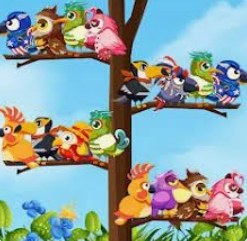
What Happens the Moment You Tap In I opened Bird Sort Main expecting the usual color-matching calm, but the first minute threw me. The birds stare at you from their branches, feathers puffed, and the branch layout isn't
What Happens the Moment You Tap In
I opened Bird Sort Main expecting the usual color-matching calm, but the first minute threw me. The birds stare at you from their branches, feathers puffed, and the branch layout isn't the simple two-perch setup you see in screenshots. One branch already has three birds stacked, another holds a single grumpy toucan, and the empty ones sit at weird angles that make you second-guess where to tap first. The timer doesn't exist, which is a relief, but the move counter does. I burned four moves just shuffling a blue jay back and forth before I realized there's a rhythm to how the game wants you to think.
The physics feel light. Birds hop with a little bounce, and if you place one on the wrong branch, the rejection sound is a soft chirp rather than a buzz. It's polite. But the politeness hides a puzzle that gets sticky fast, and by stage 18 I was undoing moves constantly, not because I didn't see the solution, but because I'd trapped myself three moves earlier without noticing.
How the Sorting Loop Actually Works
You have branches, you have birds, and the rule is simple: you can only place a bird onto an empty branch or onto a bird of the same color. A completed set of identical birds flies away, freeing up that branch. The game calls itself a sort puzzle, but "sort" only tells half the story. The real optimization isn't about matching colors quickly — it's about branch management. Every occupied branch is a resource you can't use for something else, and the moment you treat a branch as just a holding spot, you've started losing.
What surprised me after twenty minutes of play is how much the puzzle punishes depth. If you stack three different-colored birds on one branch because you're trying to clear another, you've now created a column that can only accept a match for the top bird. The two underneath are frozen until the top one leaves. This sounds obvious, but in practice, your brain wants to consolidate. You see five branches with scattered single birds and think, "I'll group these." That instinct is the trap. The game wants you to keep birds as spread out as possible until a full set is ready to chain-complete.
You're also managing the invisible queue: which birds are coming next. Unlike some sorting games where all pieces are visible from the start, Bird Sort Main reveals the full layout upfront. Nothing is hidden. That means every single bird's position is a puzzle piece you can study before touching anything. I started pausing for ten seconds at the start of each stage just to trace potential routes for the rarest color on screen. Usually, that's the one that'll wreck you if you move it carelessly.
The Early-Game Mistake That Kills Runs
Most stages I failed, I failed because I moved a bird to "get it out of the way" without checking whether I was blocking its only possible future match. Here's a concrete example: on stage 12, there's a red cardinal sitting alone on the leftmost branch, and two more reds buried under a yellow and a blue on opposite sides of the screen. My instinct was to move the lone red onto an empty branch so I could use its original branch for shuffling. But by doing that, I placed the red where it could only receive one of the two buried reds — the other buried red was now unreachable without moving the yellow or blue first, both of which needed their own matches I hadn't set up yet. I locked myself out of a clean solve and had to undo five moves to fix it.
The lesson: before you relocate any bird, mentally trace every other bird of that same color and ask whether your target branch can physically receive all of them in sequence. If the answer is "no" or "only if I make other moves first that I haven't prepared," leave the bird where it is. Even if its current spot is inconvenient, an inconvenient but reachable bird is better than a conveniently placed bird that orphans its siblings.
Why Empty Branches Are More Valuable Than You Think
I started counting empty branches obsessively around stage 20. The game gives you a generous number early on, then slowly tightens the ratio. An empty branch is the only place you can put a bird when you're trying to dig out another bird from underneath a stack. It's also the only place you can start building a fresh color set when all other branches are occupied by incomplete groups. If you waste an empty branch by dropping a random toucan on it just because you didn't know where else to put it, you've spent a wildcard that won't come back until a full set flies away.
Good play, I found, treats empty branches like a currency. Spend them only when you're actively constructing a match chain or when you have a clear plan to free the branch again within two moves. If you have three empty branches and a messy board, resist the urge to fill them. The mess is often solvable without using all your empties, and keeping one in reserve gives you an escape hatch when you inevitably misclick or realize mid-sequence that your plan has a flaw.
Color Prioritization That Actually Helps
Not all bird colors are equally dangerous. In most stages, one or two colors appear only twice or three times total, while others appear four or five times. The rare colors are your priority — not because they're harder to match (they're actually easier since there are fewer pieces to coordinate), but because if you accidentally block a rare color's only viable path, you might not have enough pieces left to fix the mistake. A common color with five birds gives you flexibility; a rare color with two birds gives you none.
I started scanning each new stage for the color with the fewest birds and solving for it first. Once that color's set is complete and flown away, the board simplifies dramatically. The remaining birds are usually more plentiful and can handle a little inefficiency. This approach flipped my win rate on stages I'd previously found frustrating, especially the mid-teens where the game starts mixing three-bird sets with five-bird sets on the same board.
The Undo Button Is a Learning Tool, Not a Cheat
Bird Sort Main gives you unlimited undos, and I used them aggressively. Not to cheat my way to a perfect score, but to understand why a move was wrong. When I'd make a sequence of three moves and suddenly realize I was trapped, I wouldn't just undo the last move — I'd undo all three, then replay them slowly, watching for the exact moment the trap formed. Almost always, it was the first move that set the problem in motion, not the third.
This habit taught me to recognize "trap moves" before I make them. A trap move looks perfectly safe: you're placing a bird onto a matching color, freeing up space, advancing the board state. But if that placement reduces your future options for a different color, it's a trap. The undo button let me build pattern recognition without punishment. I recommend using it not as a crutch but as a deliberate study tool for the first forty stages or so. After that, the patterns start to feel familiar and you'll need it less.
Phone vs Desktop: What Changes
I played on both a phone browser and a desktop browser. On desktop, the larger screen makes it easier to see all branches at once without scrolling, which matters because you want to hold the full board in your peripheral vision when planning moves. The mouse gives you precise control, and I made fewer misclicks. On phone, the branches are stacked vertically, so you'll scroll a bit depending on the stage. Dragging birds with a thumb is satisfying — the haptic-like bounce when a bird snaps into place feels tactile even without actual haptics — but I occasionally dropped a bird onto the wrong branch because my finger covered the target area.
The game is perfectly playable on both. If you're stuck on a hard stage, try switching to desktop temporarily. The wider view genuinely helped me spot color connections I'd missed on the smaller screen. It's not a difficulty difference, just a visibility one. Since it's free in browser, you can switch devices without losing progress (assuming your browser saves it locally, which mine did).
Stages Where the Usual Advice Breaks Down
Around stage 30, the game introduces layouts where some branches start with two birds of the same color already stacked, but with a different color sandwiched between them and their third match elsewhere. The standard advice of "keep birds spread out" still holds, but now you have to factor in partial stacks. A branch with two matching birds and a third waiting elsewhere is a ticking clock: you need to clear the third bird's path to that branch without burying it under unrelated moves. I lost a few runs by treating these partial stacks as "already solved" and ignoring them, only to realize later that the third bird was now trapped under two others I'd carelessly placed.
In these situations, I found it helpful to work backwards from the partial stack. Look at the third bird, note everything blocking it, and solve those blockages first before touching anything else. It's counterintuitive because the partial stack looks like progress, but leaving it unfinished while you tidy up other colors is how you walk into an unwinnable board.
A Practice Plan That Builds Good Instincts
If you're hitting a wall, here's a short practice routine that sharpened my play in about twenty minutes of focused effort. It's not about grinding — it's about training your eyes to see the board differently.
First, pick any stage you've already completed. Replay it with a self-imposed rule: you cannot use the undo button. The pressure of permanent moves forces you to plan further ahead, and since you already know the stage is solvable, the stakes feel low. Do this for three stages in a row. You'll notice your hesitation before moves gets longer and more productive.
Second, take a stage you're stuck on and don't make a single move for two full minutes. Just stare at the board and trace every possible path for the two rarest colors. Say the paths out loud if that helps. "This blue goes here, then this blue goes here, then they fly away." If any path requires a move you can't make yet, note that blockage and figure out what needs to happen first. Most of my breakthroughs came during these staring sessions, not during active play.
Third, play five stages where your only goal is to preserve at least one empty branch at all times. Even if it means making slower progress. This drill rewires the hoarding instinct into something useful. After five stages, you'll start seeing empty branches as tools rather than just vacant space.
Fourth, intentionally lose a stage. Mess it up on purpose. Stack birds badly, block your own paths, fill every empty branch. Watch how the board state degrades and identify the exact moment it becomes unsalvageable. Knowing what failure looks like in slow motion makes you better at spotting warning signs in real play.
None of this takes long. The whole set fits comfortably into a lunch break, and the skills transfer to every subsequent stage. I noticed improvement within the first two drills, especially in my ability to resist the urge to "just move something" when I felt stuck.
A Few Things the Game Doesn't Tell You
There's no tutorial beyond the first two stages, which are trivially easy and don't teach the deeper skills. That's fine — the game expects you to learn by failing, and the gentle chirp rejection sound keeps frustration low. But I would've liked a visual indicator for birds that are currently blocked from all possible matches. Sometimes a bird looks available but isn't, and you only discover that by trying to move it to every branch and getting rejected each time. A faint glow or desaturation on trapped birds would help, but since that doesn't exist, you have to manually check each bird's viability, especially after a series of moves changes the board.
The stages don't have a difficulty curve so much as a difficulty staircase. You'll breeze through six stages, then hit one that takes ten minutes of undo-heavy experimentation. That's not bad design — it's the game forcing you to learn a new concept. When you hit a wall, the concept is usually something about branch economy or color rarity that you've been able to ignore until now. Pause and figure out what new thing the stage is teaching rather than trying to brute-force it.
When to Walk Away and Come Back
I hit stage 34 and couldn't solve it for fifteen minutes straight. Every approach led to a dead end. I closed the browser tab, did something else for an hour, and when I came back, I solved it on my second try. The puzzle hadn't changed — my brain had just stopped repeating the same flawed sequence. Bird Sort Main rewards fresh eyes more than persistence. If you're undoing the same three moves repeatedly, you're not learning; you're just rehearsing a mistake. Close the game. The birds will wait.