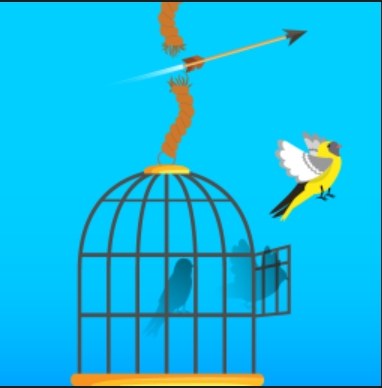
Free Birds is a browser-based endless flyer where you guide a bird through obstacles with simple tap or click controls. It suits players who enjoy reflex-testing physics games and quick, repeatable sessions. Expect a minimal presentation focused purely on timing, pattern recognition, and beating your personal best.
Free Birds is a browser game that puts you in control of a flight path, and while the catalogue entry for it is light on specifics, that is not a barrier to getting airborne. The name tells you the core fantasy: you are guiding a bird, and the likely goal is to travel as far as you can without crashing. This is a common and beloved structure in the free-to-play browser space, so we can talk honestly about how to approach it, what to watch for, and how to improve your first few attempts without pretending we have insider knowledge of every mechanic.
What Free Birds Probably Asks of You
When a game is simply labelled "New" and offers no detailed description, the safest assumption is that it follows the physics-and-timing school of endless flyers. You tap or click to flap, you release to descend, and you try to thread your bird through gaps in obstacles. The "free" in the title suggests a sense of liberation, but also implies you are not locked to a rail or an auto-runner. You have agency over your altitude and forward momentum, which means your biggest enemy is usually your own twitchy thumb.
Because the game is browser-based, there is likely no install required and no long tutorial. You will probably be thrown straight into a short flight, asked to survive a modest distance, and then given a score. That score is your feedback loop. The bird will move forward at a set pace, and your job is to keep it alive long enough to see new scenery or beat your personal best. Do not expect a story. Expect a test of reflexes, patience, and pattern recognition.
The Core Loop: Flap, Glide, Repeat
In most games of this type, the loop is brutally simple. The bird is always moving sideways. Gravity pulls it down. A single action gives it a burst of upward velocity. The tension comes from the fact that holding that action down does not make you climb forever. If you hold the button, you might just stall or flip. If you tap too late, you clip a pipe, a branch, or a wall. If you tap too early, you rise into a ceiling that is not visible until you are already there.
What you are optimizing for is not distance in a straight line. You are optimizing for stable altitude. The bird will naturally sink when you are not flapping, so you want to find a rhythm where you are flapping just enough to stay level, then adjusting for incoming obstacles. The difference between a good player and a beginner is not reaction speed. It is the ability to predict where the bird will be two seconds from now, not where it is on your screen at this exact moment.
Think of each flap as a small investment. Too many flaps and you overshoot into danger above. Too few and you sink into the ground below. The bird is not a plane with a throttle. It is a pendulum with wings. Your early runs should be spent learning how much altitude one tap gives you, and how quickly gravity reclaims that altitude after you stop tapping.
Mistakes That End Runs Early
Most first flights end not because the game is unfair, but because of a few predictable errors. Here are the concrete ones to watch for.
Panic tapping. The moment an obstacle appears, your instinct will be to mash the button. That is wrong. Mashing creates a high, unstable arc that is much harder to control than a single well-timed tap. If you find yourself tapping three or four times in quick succession, stop. Let the bird fall a little, then do one clean tap. A calm single tap is almost always better than a frantic double tap.
Looking at the bird instead of the path. New players stare at their feathered avatar, checking whether it is safe. That is backwards. The bird will always be there. What you need to watch is the space ahead. Look at the gap between obstacles, not at the obstacle itself. Your peripheral vision will handle the bird's position if you are looking at where you need to go. Train your eyes to sit about a third of the screen ahead of the bird, and you will react twice as fast.
Overcorrecting after a near miss. You scrape past a pipe or a ledge and your heart jumps. You then immediately pull up hard to get away from it. That overcorrection pushes you into the next obstacle. The correct response is to hold your line. If you survived the last gap, the next one is probably designed to be reachable from your current altitude. Do not undo a good save with a bad panic move.
Ignoring the rhythm of the level. Free Birds, like many endless flyers, likely uses repeating patterns or a steady difficulty curve. If you die at the same spot three times in a row, you are not failing on reaction. You are failing on anticipation. Memorize that section. Count how many flaps it takes to clear it. The game is not random. It is a sequence, and sequences can be learned.
Device Notes: Phone and Desktop Are Different Animals
Because Free Birds is playable in a browser, you might try it on both a phone and a desktop computer. Do not assume the experience is identical. On a phone, you are tapping a touchscreen with a finger that covers part of the screen. That finger can obscure an incoming obstacle. On a desktop, you are clicking a mouse or pressing a key, and your cursor is usually off to the side, giving you a cleaner view of the action.
If you play on a phone, hold the device with your non-dominant hand and tap with your dominant thumb, but keep your thumb low. Do not tap in the center of the screen. Tap near the bottom edge so your hand does not block the flight corridor. Also, be aware of screen lag. Some phone browsers introduce a few milliseconds of input delay, which can feel like the game is ignoring you. If you notice this, switch to desktop for a fairer test of your skills.
On desktop, use a mouse click if you have a steady wrist, or a keyboard key if you prefer a constant input position. There is no universal best option. The key is consistency. Pick one input method and stick with it for at least ten runs. Changing between mouse and keyboard mid-session ruins your muscle memory.
A Short, Practical Practice Plan
You will not master Free Birds in five minutes, but you can improve dramatically in a single sitting if you practice with intention. Here is a ten-minute routine that works for most physics-based flyers.
First two minutes: ignore obstacles. Just flap. Let the bird fly. Do not try to score. Your only job is to learn the feel of the controls. Ask yourself: how high does a single tap go? How fast does the bird fall when you stop? Is there a sweet spot where the bird seems to hover if you tap at a steady rate? Answer these questions before you try to survive.
Next three minutes: fly low. Deliberately keep the bird near the bottom of the screen. This is uncomfortable because you feel closer to death, but it teaches you two things. First, it shows you how much clearance you actually have. Second, it forces you to use small, precise taps instead of big panic flaps. If you can fly low and steady, you can fly anywhere.
Next three minutes: fly high. Now push the bird up near the top. Notice how the controls feel different up there. Does the bird stall? Does it move faster? Many flyers have hidden physics changes at different altitudes. Learning the upper register prepares you for sections where you have no choice but to climb.
Final two minutes: restart immediately after death. Do not watch the death screen. Do not stare at your score. Just restart and get back into the rhythm. This trains your mental reset. The fastest players die a hundred times and never feel frustrated because they treat each run as a fresh puzzle, not a personal failure.
What to Actually Aim For on Your First Flights
On your very first run, your only goal is to see what happens when you crash. Do not try to set a record. Crash early, crash quickly, and learn the boundary conditions. If there is ground, find out if you can skim it. If there is a ceiling, find out if you can bonk it. The game will not punish you for curiosity, and every boundary you discover is one less unknown for your next attempt.
On your second and third runs, start counting. Count how many taps it takes to clear a specific obstacle. Count how long you can glide without tapping before you start to sink. These numbers are your personal control map. They will stay consistent across runs, so write them down or just repeat them in your head. A bird that you can predict is a bird that you can pilot.
By run ten, you should be looking for patterns. Does the game alternate between low gaps and high gaps? Are there rest sections where you can catch your breath? Does the background change as you progress, hinting at new challenges? These are the questions that turn a casual player into a competent one. You are not just flapping. You are reading the game's language.
Free Birds is free to play in your browser, which means there is zero cost to repetition. That is your greatest advantage. A player on a console might have to wait for loading screens. You do not. You can die, restart, and be back in the air in under three seconds. Use that speed. Treat every crash as a data point, not a defeat.
The bird does not care about your score. It cares about the next flap. That is the mindset you need. Focus on the immediate moment, make one good decision at a time, and the distance will take care of itself. Your first flights will be short. Your next ten will be longer. And the run after that? That is where you stop thinking about surviving and start thinking about flying.