I opened Find Difference 2024 expecting a quick brain-teaser, the kind of thing you tab over to while waiting for an email. The first thirty seconds surprised me. Instead of the usual side-by-side photo spread, I was dro
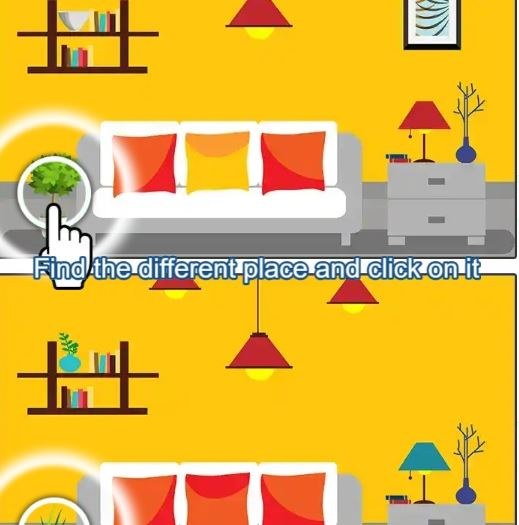
I opened Find Difference 2024 expecting a quick brain-teaser, the kind of thing you tab over to while waiting for an email. The first thirty seconds surprised me. Instead of the usual side-by-side photo spread, I was dropped into a single cluttered living room scene with a ticking clock and a vague instruction to "spot what's wrong." The timer wasn't just for scoring—it was genuinely pushing me, the way a friend tapping their watch might. One of the first anomalies was a lamp cord that plugged into a banana instead of the wall. It was silly, but my brain had glossed right over it because the banana was yellow and the wallpaper behind it was beige. That's the game in a nutshell: your own pattern recognition working against you.
What You're Actually Doing Here
If you've played any spot-the-difference title in a browser, you know the basic rhythm. Two images, find five or seven changes, tap them, move on. Find Difference 2024 doesn't stray far from that formula, but it rebalances the pressure. You're not just spotting differences between two static frames. Often you're comparing one "correct" room against a subtly mangled version of itself. Sometimes the difference is a missing object. Other times it's a logical break, like a clock with thirteen numbers. The loop tightens as you go: early levels give you a generous 90 seconds. By level ten, you might have 45 seconds and seven increasingly sneaky alterations to find.
You're optimizing for speed, sure, but also for a kind of visual skepticism. The game rewards you for not trusting anything that looks "close enough." I found myself scanning in a pattern—left to right, top to bottom—but the most devious changes punish that habit. A pillow on a couch might be the same shape and color as its twin, but its shadow falls the wrong direction. Your eye sees "pillow, check, next" and the timer keeps bleeding. The real skill isn't eyesight; it's learning to pause on things that seem unremarkable.
The Loop Tightens Faster Than You'd Think
You get a star rating per level, which is standard. But the jump from two stars to three is where the game shows its teeth. A single mistaken tap—clicking on something you think is different but isn't—costs you a chunk of time. In later levels, one wrong guess can make a three-star run impossible. There's no penalty strike system beyond the time loss, but the time loss is savage. The game also tracks your streak of perfect levels, which matters more to your final score than you'd guess. I threw away a ten-level streak on a level where a book spine was just slightly more worn than its counterpart. I tapped it, the game buzzed, and five seconds evaporated. I finished the level but with two stars and a reset streak. That's the moment the game stops being casual.
What keeps it from feeling unfair is that the differences, once revealed, almost always make sense. Rarely did I see a change that felt like a developer trolling me. A crooked picture frame, a different number of fish in a tank, a plant that's suddenly plastic instead of real—these are rooted in the scene's logic. The game trusts you to notice when something is off, not just when something is "missing." That's a subtle but important distinction from older games in the genre.
Mistakes That Will Tank Your Run
I lost more runs to impatience than to bad eyes. Here's what actually tripped me up over a few sessions:
- Glancing instead of scanning. The background objects in this game aren't just filler. A rolling pin in a kitchen drawer might be the different item, but if you're only checking the obvious stuff—furniture, wall art—you'll miss it. I started forcing myself to look at every drawer, every shelf, every shadow under a table. That habit alone saved me from three-staring the first eight levels and then faceplanting on nine.
- Misjudging color similarities. The art style uses a muted, slightly washed palette. A blue mug against a blue tile backsplash can be nearly invisible. I learned to squint slightly, which reduces color detail and makes shape mismatches pop more. It sounds ridiculous, but it works.
- Trusting the "almost identical" object. There's a level with two framed photos on a mantelpiece. At a glance, they're the same: same frame, same photo subject, same size. The difference? One photo is slightly desaturated. The change is on the object, not the object itself. If you see two things that feel like deliberate mirrors of each other, zoom in mentally.
- Rushing the first tap. The timer starts, you feel the adrenaline, you click the first thing that catches your eye. Half the time, it's a false positive. The game doesn't punish you with a game-over, but as I mentioned, the time penalty compounds. I began using the first five seconds just to let my eyes settle. Counterintuitive, but my accuracy jumped.
Phone vs Desktop: Your Mileage May Vary
I played on both a laptop with a trackpad and a mid-size phone screen. The differences are worth noting because they change how you approach the game entirely.
On desktop, the larger screen gives you the full scene without scrolling. You can see the entire room at once, which helps with peripheral spotting. The cursor is precise, and the hitboxes for tapping differences felt fair. I never had a correct tap not register. The downside is that the bigger screen can lull you into lazy scanning. There's so much visual information that your eyes wander more.
On a phone, the scene is compressed. You might need to pinch-zoom or hold the screen closer to your face, especially for details like text on book spines or small kitchen utensils. The advantage is forced focus—you see a smaller chunk of the image at any given moment, which makes anomalies stand out more. The disadvantage is real: I mis-tapped several times just due to finger size, and the game counted those as wrong guesses. If you're chasing high scores, desktop is objectively better. For casual play on a bus or couch, phone works fine, but expect your star ratings to dip slightly.
There's no mobile-specific UI jank that I noticed. The ads between levels are there, as expected for a free browser game, but they're skippable after a few seconds and don't interrupt the flow too aggressively.
Who This Game Actually Suits
Let's be direct. Find Difference 2024 is not a game for someone who wants pure relaxation. The timer and the streak system create a low-grade tension that I felt even when I told myself I was just "messing around." It suits a few specific types of players pretty well.
First, if you're the kind of person who actually enjoys proofreading or detail work, this scratches that itch. The satisfaction of catching a tiny logical flaw—a teacup handle on the wrong side, a window that reflects a landscape not present in the room—is real and repeatable. Second, if you have short, unpredictable pockets of free time, the level structure works. Most levels take between one and three minutes. You can finish a handful during a coffee break and feel like you did something. Third, if you get bored of pure hidden-object games and want something slightly more cerebral without being a puzzle box, this hits a nice middle ground.
It's less ideal if you want a narrative, or if you dislike any kind of countdown pressure. There's no story, no characters, no progression beyond unlocking new scene packs. The game doesn't pretend to be more than a sharp observation drill. Also, if your vision isn't great for small detail work, you might find the later levels more frustrating than fun. The developers don't include an accessibility mode for larger contrast or a relaxed timer. That's a gap worth knowing about before you invest time.
A Short Practice Plan If You Want to Improve
I spent about twenty minutes total across a few sessions, and my approach improved noticeably after I stopped treating it like a casual swipe-fest. If you want to get consistently high star ratings, here's a simple routine I fell into that helped:
First five levels (warm-up). Play these without caring about stars. Just look at the scenes and say out loud what you think might be off, even if you're alone. Verbalizing forces you to process what you're actually seeing. I know it sounds odd, but it slowed my eyes down in a good way.
Middle levels (focus on pattern breaking). By level six or seven, start consciously scanning right to left instead of left to right. Most of us have a natural left-to-right reading habit, and the game's designers know this. Differences often hide in the lower right quadrant because our eyes get there last and with the least attention. I found several clutch differences in that zone after switching my scan direction.
Later levels (mental checklist). Around level twelve and up, I started running a quick mental list: shadows, reflections, text, faces, food items. These categories account for a disproportionate number of changes. A mirror that doesn't reflect the room correctly, a clock with the wrong time, a piece of fruit that's the wrong color—these are Find Difference 2024's signature moves. If I checked those categories before randomly tapping, my accuracy stayed high.
End of session. Replay your worst level from that day. The levels don't randomize differences, so you'll remember a few changes, but the goal is to see if you can spot the ones you missed earlier without the timer panic. Over a few days, you'll start recognizing the art style's tells, and your initial playthroughs will get faster.
Find Difference 2024 doesn't reinvent the genre, and it doesn't try to. It's a tighter, slightly more punishing version of a familiar formula, and for the right person—someone who likes being wrong for interesting reasons—it's a solid free browser pick. Just be prepared to lose a few rounds to a banana.