
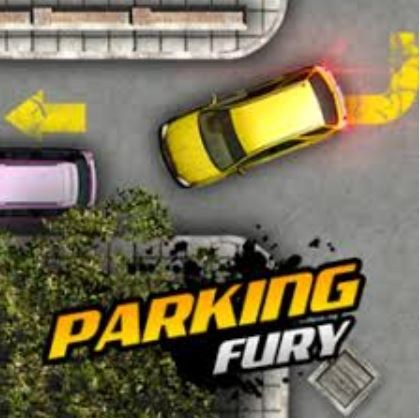
First Minute Behind the Wheel You tap the arrow and the sedan lurches forward. Immediately you realize the turning radius is tighter than you expected. The first parking spot in Parking Fury 2 sits maybe three car-length
First Minute Behind the Wheel
You tap the arrow and the sedan lurches forward. Immediately you realize the turning radius is tighter than you expected. The first parking spot in Parking Fury 2 sits maybe three car-lengths away, angled between a pickup truck and a concrete planter. I nudged the nose in at what felt like a generous 45 degrees, straightened out, and still clipped the planter's edge with my rear bumper. Restart. No dramatic music, no countdown — just a quiet reset and the same car waiting in the same starting position, almost passive-aggressive about it.
That quiet restart loop defines the first minute. You're not fighting the controls — they're simple, arrow-based, responsive enough — but you're fighting your own depth perception. The top-down perspective flattens everything. A gap that looked generous from the starting position suddenly shrinks when you're halfway into it and realize you misjudged how far that orange barrier actually extends. You'll probably fail the first level twice before your brain calibrates to what the camera is actually showing you. That's normal. The game doesn't tut-tut you for it.
What the Loop Actually Wants From You
On the surface, Parking Fury 2 presents itself as a straightforward task: get the car into the glowing rectangular slot without touching anything painted red, orange, or striped. But the loop isn't really about parking. It's about path commitment. Every level is a miniature geometry puzzle where the solution exists in how early you decide on your approach angle and whether you have the nerve to stick with it through the middle phase when things look sketchy.
You're optimizing for clean entry. Not speed — there's no timer ticking down. Not points — the game doesn't score you. The only feedback is pass/fail, and "pass" feels satisfying in a way that's hard to pin down until you notice what a clean park actually requires. You need to visualize the car's pivot point, which sits somewhere around the rear axle, and understand that your front end swings wider than you think. Once that clicks, you start seeing each parking spot not as a destination but as a channel you need to align with early, sometimes two or three car-lengths before you reach the opening.
The level variety keeps this from getting repetitive. Early stages give you wide suburban lots with a single obstacle. By the mid-teens you're threading a minivan between shipping containers with maybe eighteen inches of clearance on either side. Some layouts force you to reverse in. Others have you parallel parking along a curb with cars bookending the spot so tightly you'll swear the level designer was trolling you personally. They probably were.
Mistakes That End Runs Before They Start
I tracked my own failures across about thirty levels and noticed patterns. The most common killer isn't the final adjustment — it's the initial approach angle. Players (myself included) tend to start turning too late, which forces a sharp correction at the entrance. That correction eats up lateral space you don't have, and suddenly your front corner is kissing a bollard. The fix feels wrong at first: begin your turn earlier than your gut says, even if it means the car looks like it's aiming at the wrong spot initially. The arc will bring you in line.
Another silent run-ender is treating reverse like a panic button. Parking Fury 2 gives you a reverse gear and it's tempting to shimmy back and forth when you've misjudged. But the game's collision detection is unforgiving about compound mistakes. A three-point turn in a tight space often creates more contact points than just committing to a slightly imperfect forward entry. If you're going to reverse, do it once and do it decisively, usually to set up a completely fresh approach from further back. Half-hearted back-and-forth wiggles are how you tap a cone you forgot was behind you.
Over-focusing on the front bumper while ignoring the rear swing is the third big one. When you're staring at the nose of the car trying to clear a pole, it's easy to forget that the back end is describing a wider arc in the opposite direction. I lost count of how many times I cleared the front obstacle perfectly only to hear that soft crunch sound because my rear quarter panel swept into something I'd stopped paying attention to. You have to mentally track both ends simultaneously, which is genuinely harder than it sounds in top-down view.
Phone vs Desktop: Different Games, Same Name
I played on both and the experience diverges more than you'd expect for a browser game. On desktop with keyboard arrows, you get discrete input — tap the key, the car turns a fixed increment. This makes precision adjustments feel surgical. You can feather the left arrow three quick taps and know exactly how many degrees you just rotated. The downside is that continuous motion suffers. Long sweeping turns require you to hold the key and release at exactly the right moment, which introduces a tiny reaction-time tax that will occasionally cost you a clean run.
On a phone, the on-screen buttons invert the tradeoffs. Touch controls feel mushier for fine adjustments — your thumb drifts, you overshoot by a few pixels, suddenly you're three degrees off your intended line. But fluid turns are easier because you can roll your thumb pressure more naturally. I found myself preferring phone for levels that required long arcing approaches and desktop for the surgical precision of tight parallel parking. Neither is strictly better, but if a level is frustrating you on one device, try the other. The same stage can feel totally different.
One hardware-agnostic tip: the hitboxes are tighter than the visual models suggest. The car's collision boundary extends slightly beyond the sprite, especially at the corners. You'll occasionally fail a parking attempt where it looked like you had clearance. You didn't. The game is consistent about this, so once you learn the true boundary, you can trust it. But those first few phantom collisions will gaslight you into thinking the game is broken. It's not. You're just wider than you look.
A Practice Plan That Won't Make You Hate Everything
If you want to actually get good at Parking Fury 2 without rage-quitting, structure your practice around failure analysis rather than volume. Here's what worked for me after I stopped trying to brute-force levels:
Spend your first five minutes on a level you've already beaten. Not to celebrate — to dissect. Replay it three times. On the first replay, park as fast as possible. On the second, park as slowly as you can without stopping, paying attention to where the car's pivot point travels. On the third, try to park using only forward motion — no reverse. This teaches you what the level actually demands versus what your panic-brain added. You'll notice that many levels have a "natural line" that feels wrong initially but works perfectly once you commit. Those are the lines you want to train yourself to spot on first sight in new levels.
When you hit a wall on a new level — and you will, probably around the levels with the police cars and the staggered concrete barriers — stop after three consecutive failures. Seriously. Stand up, look away, come back in two minutes. The frustration spiral in a precision game like this is real, and it makes your inputs sloppier, which creates more failures, which deepens the spiral. Three attempts, forced break, then a fresh run where you verbalize your plan out loud before touching the arrow keys. "I'm going to pull past the spot, cut hard left at the fire hydrant, then reverse straight in." Saying it forces you to form a plan rather than reacting frame-by-frame. The difference in success rate is noticeable within ten minutes of doing this.
For the later levels where you're parking larger vehicles — the truck and the bus appear eventually — practice on earlier levels with those same vehicles if the game lets you select them. The pivot point shifts backward as the vehicle gets longer, and you need to recalibrate your sense of when to start turning. A bus doesn't behave like a sedan with a stretched texture. It behaves like a completely different geometry problem. Give yourself permission to be bad at it for a while.
Final practice note that sounds obvious but isn't: use the entire starting area. Levels don't penalize you for driving far away from the parking spot before beginning your approach. Sometimes the cleanest line starts from twenty feet behind where you spawned, and the game expects you to figure that out. New players tend to drive directly at the spot from where they begin, which is rarely the optimal angle. Pull back, circle wide, treat the empty space as a resource. It's there for a reason.
The Appeal That Sneaks Up On You
Parking Fury 2 doesn't announce itself as anything special. The graphics are functional, the sound design is minimal, and the premise sounds like a DMV training module. But somewhere around level eight or nine, when you nail a reverse park in one smooth motion that you visualized before executing, the game reveals its quiet hook. It's the same satisfaction as untangling a knot or fitting an oddly-shaped piece into a jigsaw puzzle — spatial reasoning rewarded with a little dopamine hit and a new level to solve.
The free browser format serves it well. There's no friction to starting, no account to create, no tutorial to sit through. You open the page and you're parking within seconds. That immediacy makes it dangerous in the best way — you'll tell yourself "just one more level" six times before you realize twenty minutes evaporated. The difficulty curve is lumpy rather than smooth, with occasional spikes that feel unfair until you solve them and realize they were teaching you something specific. Those moments of retrospective clarity are where the game earns its replay value.
If you're the type who enjoys process optimization more than spectacle, Parking Fury 2 will get its hooks in. It's not flashy. It doesn't need to be. It just keeps handing you small, solvable spatial problems and trusting you to figure out the geometry on your own terms. Most browser games try to distract you from their simplicity with upgrades or story snippets. This one leans into the simplicity and makes it precise enough to matter.