
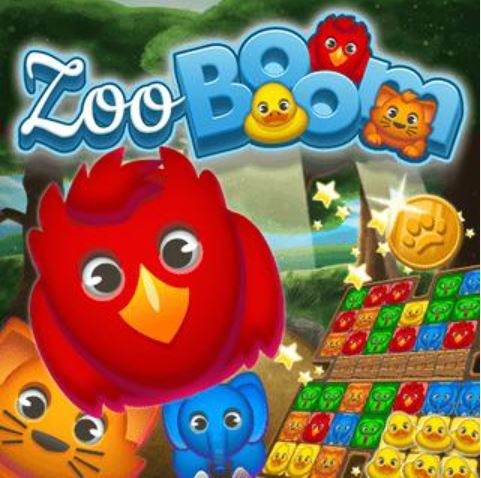
I fired up Zoo Boom expecting a gentle match-and-pop thing with cartoon animals, and the first minute completely wrecked that. You're staring at a grid of colorful animal faces, sure, but there's a fuse burning across th
I fired up Zoo Boom expecting a gentle match-and-pop thing with cartoon animals, and the first minute completely wrecked that. You're staring at a grid of colorful animal faces, sure, but there's a fuse burning across the top of the screen and the whole thing feels like someone crossed a bomb-defusal manual with a zoo brochure. The music is oddly cheerful for how fast my heart was beating. My first move was a panicked tap on three identical parrots, and the resulting chain reaction cleared half the board before I understood what I'd done. That's when I realized this isn't a casual matcher — it's a race to build combos that cascade so violently you clear the stage before the timer even registers you were nervous.
The Loop That Keeps You Tapping
Zoo Boom drops you into a grid packed with animal tiles, and your only job is to tap groups of two or more matching critters to remove them. Groups of two feel stingy but sometimes they're the only move. Groups of three or more are where things start humming. The real magic, though, isn't in the tap itself — it's in what falls down afterward. When tiles disappear, everything above them drops, and if the new arrangement creates another match, that match pops automatically. Then more tiles fall. Then another match. You can clear an entire board from one smart initial tap if gravity is feeling generous.
What you're actually optimizing for isn't score or even clearing the board. It's time. Every level has a goal: rescue a certain number of each animal type before the fuse burns out. The fuse isn't a gentle suggestion. It's a thick orange bar shrinking across the top, and when it hits zero, the bomb icon flashes and the run ends. No second chances, no watch-an-ad revival on the levels I played. Just a restart button and a quiet moment of self-reflection.
Because the timer is the real enemy, efficiency matters more than big numbers. A massive 15-tile group feels satisfying, but if it doesn't trigger a cascade that feeds your goal animals, you've burned seconds on spectacle. I learned this the hard way on a level that wanted twelve zebras and eight lions. I spent my first ten seconds building a gorgeous monkey cluster off to the side, popped it, and watched the resulting cascade deliver exactly zero zebras. The fuse didn't care about my combo aesthetics.
Which Combos Actually Earn Their Keep
After about twenty rounds, I started noticing which move types reliably pushed me toward the goal instead of just making the board look busy. The combo that paid off most often was what I started calling the "column clear." You find a tall vertical stack of the same animal — four or five identical tiles in a single column — and you pop the bottom two or three. This drops the upper tiles down into the empty space, and if the column above them is even slightly dense, the new arrangement almost always creates a secondary match somewhere in the same column. Since the tiles are falling straight down, the physics are predictable. You're not hoping for a diagonal miracle; you're just letting gravity do tidy work in a narrow lane.
Equally reliable but harder to spot: the "crossfade." This happens when you have two different animal groups touching at a corner, and removing one group causes the other to slide diagonally into a match. These are satisfying in a way that feels almost like puzzle-solving rather than luck. On a jungle-themed level with tight corridors between rock tiles, crossfades were the only reason I cleared the lion quota. I'd pop a small monkey group wedged between two lion clusters, and the lions would slide together like magnets. You can't force these, but you can train your eye to see them before you tap anything else.
The combo that surprised me with its inconsistency was the giant blob tap. You know the one: a huge shapeless mass of seven or eight identical animals sprawled across the middle of the board. Popping it feels powerful, and the score pop-up is big and flashy. But because the shape is irregular, the resulting collapse is chaotic. Tiles fall in from all sides at different speeds, and while you do often get a cascade, it's rarely focused on the animals you actually need. I tracked this loosely across ten levels, and giant blob taps advanced my goal progress less than half the time. They're fun. They're not efficient. Use them when the board is cluttered and you need to reset the layout, not when the fuse is down to a sliver.
The Mistakes That End Runs Before You Blink
My worst runs shared a few patterns, and once I named them, I stopped making them quite so often. The biggest killer was tapping the first obvious match I saw. In early levels, the board is sparse and the timer is generous, so speed-tapping works fine. By level eight or nine, the board is denser, the quotas are higher, and the fuse burns faster. If you tap the first pair of elephants you see without scanning for a three-elephant cluster two rows down, you've robbed yourself of a bigger initial pop that would have fed a cascade. I started forcing myself to pause for two full seconds at the start of every level, just scanning top to bottom for the largest group of my goal animal. Two seconds feels like an eternity when a fuse is burning, but it saved me more runs than it cost.
Another pattern: ignoring animals that aren't in the quota. This sounds counterintuitive. Why would you clear animals you don't need? But those off-quota tiles are blocking the board. If you only tap lions and zebras, the monkeys and parrots pile up in awkward columns that prevent anything from falling into place. I found that clearing a small group of off-quota animals early — especially if they're sitting directly above a dense cluster of goal animals — often triggered the cascade I actually needed. The key is to clear them when they're in the way, not when they're just sitting harmlessly in a corner. Context matters.
The third mistake was tunnel vision on a single column. I'd spot a promising vertical stack of zebras and just keep tapping zebras in that column, ignoring the rest of the board. Meanwhile, lions were piling up on the left and the fuse was burning. By the time I looked up, I'd cleared the zebra quota but had no path to the lions because the board was a mess of scattered singles. The fix was simple: after every two taps, force your eyes to the quota display at the top of the screen. It shows exactly how many of each animal you still need. If zebras are done, stop touching zebras. I know that sounds obvious, but in the rhythm of tapping, it's weirdly easy to keep clearing what's comfortable.
Phone vs Desktop: It Actually Matters Here
I played Zoo Boom on both a phone and a laptop, and the experience shifted in ways that affected my combo success rate. On a phone, the tiles are smaller, and my thumb occasionally tapped the wrong animal if two groups were close together. This is especially dangerous when you're going fast near the end of a fuse and you accidentally pop a single pair instead of the five-stack next to it. I lost at least three runs to fat-finger taps on a phone screen. The upside is that phone play feels more immediate — the game loads fast in a mobile browser, and the vertical orientation suits the grid perfectly. If you're on a phone, I'd recommend using your index finger instead of your thumb for precision, especially on levels with tight tile clusters.
On desktop, the precision is better. A mouse click is unambiguous. You can also see the whole board at once without scrolling, which matters because Zoo Boom sometimes spawns tiles near the edges that are easy to miss on a smaller screen. The downside on desktop is that the game feels slightly less urgent, and that can lull you into overthinking. I caught myself planning three-move sequences on desktop, which is a terrible idea because the board state changes completely after the first cascade. By the time I'd planned my second move, the tiles I was targeting had already vanished. Desktop rewards a looser, more reactive play style — scan, tap the best available group, watch the cascade, reassess. Don't strategize beyond the next tap.
One practical note: the game runs cleanly in a browser on both platforms, no downloads or weird permissions. I tested it in Chrome and Firefox, and the only difference I noticed was that the fuse animation felt slightly smoother on Chrome. Not a dealbreaker either way.
Reading the Board Before You Touch It
After enough runs, I developed a quick pre-tap checklist that helped me spot high-value combos faster. First, I look at the quota animals and find the largest cluster of each one on the board. I don't tap yet — I just note where they are. Second, I check if any of those clusters are directly underneath a column of off-quota animals. If they are, that off-quota column is my first tap, because clearing it will drop the goal animals down and likely trigger a match. Third, I glance at the edges of the board. Zoo Boom sometimes tucks goal animals into the corners where they're easy to overlook, and a corner cluster can be the key to finishing a quota without scrambling.
This whole scan takes maybe three seconds. It feels slow at first, but it's faster than restarting the level four times because you kept tapping the wrong things. The game doesn't reward pure speed. It rewards speed built on a quick, accurate read of the current board state. The best players I watched (I pulled up a few gameplay videos after getting stuck on a particularly mean jungle level) all did the same thing: a brief pause, a deliberate first tap that triggered a chain, and then a fluid series of taps as the cascade unfolded. They weren't faster than me. They were just tapping the right things in the right order.
A Practice Plan That Won't Make You Hate the Game
If you're struggling to clear levels consistently, here's a short practice routine I used to get more reliable. It's not a grind — it's more about changing how you see the board.
First, play three levels where you only tap groups of three or more. No pairs. This forces you to scan for larger clusters and ignore the tempting little duos that waste time. You'll probably fail a level or two because the board runs out of triples, and that's fine. The point is training your eye to see big groups first.
Second, play three levels where you deliberately clear one off-quota animal early, before you touch any goal animals. Pick an off-quota animal that's sitting above a dense area. Watch what happens. Some levels this will backfire and you'll wish you hadn't wasted the tap. But on others, the cascade will be so clean that you'll wonder why you ever played any other way.
Third, play one level where you narrate your taps out loud. "I'm tapping these three lions because they'll drop the zebras above them. Now I'm clearing these parrots because they're blocking the left column." This sounds ridiculous, but it stopped me from tapping on autopilot. When you have to justify each move to an empty room, you catch yourself before making the lazy tap that would have ended the run.
After a few cycles of this, the patterns start to feel natural. You'll find yourself spotting column clears and crossfades without consciously looking for them, and the fuse will feel less like a threat and more like background noise. Zoo Boom is generous with its early levels and quietly brutal later on, but the difficulty curve is fair if you're paying attention to the right things. The game isn't asking for lightning reflexes. It's asking you to see the board clearly and trust gravity to do the rest.