First Minute: Tangled Hooks and a Calm That Sneaks Up On You I opened Rope Color Sort 3d expecting the usual frantic puzzle vibe, and the first thing that hit me was how quiet it felt. The ropes drop into view with this
First Minute: Tangled Hooks and a Calm That Sneaks Up On You
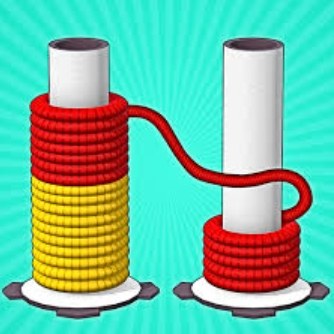
I opened Rope Color Sort 3d expecting the usual frantic puzzle vibe, and the first thing that hit me was how quiet it felt. The ropes drop into view with this soft little physics wobble, and there's no timer ticking in my face. You get a handful of hooks or pegs—usually three to five—and each one has a messy stack of colored rope rings looped around it. The goal sounds simple: move rings one at a time until every hook holds a single color. But you can only place a ring onto a hook if the top ring already there matches its color, or if the hook is empty. That rule alone turns the first thirty seconds into a tiny strategy panic. I found myself staring at a red ring trapped under two blues, mentally tracing three moves ahead, and then messing it up anyway because I moved too fast. It's the kind of calm that tricks you into thinking you're in control, right up until you realize you've boxed yourself into a corner.
What You're Actually Optimizing For (It's Not Just Sorting)
The obvious goal is clearing all the ropes by color, and yes, that's what the level-complete screen celebrates. But after fifteen minutes of playing, I noticed I'd stopped caring about speed and started caring about move economy. Every time you lift a ring and set it down somewhere, that's one move. The game doesn't punish you with a star rating or a loud buzzer, but you'll feel a quiet sting when you realize you've used twelve moves to solve something that probably could have taken seven. The real juice here is in finding those elegant sequences where a single empty hook becomes a temporary parking spot for three different colors in a row, each one unlocking the next. You start seeing the hooks less as destinations and more as tools. That empty peg isn't just empty—it's your only lifeline when you've got a green ring buried under two yellows and no green hook in sight. The satisfaction curve is weird: it's not flashy, but when you nail a five-move cascade that untangles a mess you thought was hopeless, there's a genuine little click of "oh, nice" in your brain.
The Loop That Keeps You Saying "One More"
Rope Color Sort 3d doesn't reinvent the sorting puzzle wheel. If you've played any water sort or ball sort game in the last few years, the skeleton is familiar. What makes this one stick is the physicality. The ropes aren't just flat icons—they have thickness, they sway a tiny bit when you grab them, and the rings slide off with a subtle resistance that makes each move feel tactile. You tap a ring on one hook, then tap where you want it to go, and the animation does this quick little zip across the screen. There's no drag-and-drop, which I appreciated on my phone because my thumb wasn't covering half the puzzle. The core loop is: stare at the tangled ropes, spot a legal move, make it, reassess. Every successful placement reveals the next ring down, which changes the whole board state. Sometimes a move you thought was safe suddenly exposes a color you have nowhere to put, and that's where the game gets its teeth. Levels don't escalate in a straight line either. One moment you're breezing through a four-hook setup with six colors, and the next you're staring at six hooks, eight colors, and two empty pegs that feel like they're taunting you.
There's no energy system from what I could tell, and no forced ads between every level. I got a short video ad maybe every four or five completions, which feels fair for a free browser game. You can also undo your last move with a button that's always visible, and there's a "add one empty hook" option if you're really stuck, though I tried to avoid using it because it felt like admitting defeat. The undo alone saved me from restarting levels at least a dozen times. I did notice that the undo only goes back one step, so if you make two bad moves in a row without realizing, you're still out of luck. That's a design choice I respect—it forces you to stay present instead of mindlessly tapping.
Mistakes That End Your Run Early (And How I Made All of Them)
The most common trap, and the one I fell into repeatedly in my first ten minutes, is what I started calling "color greed." You see a hook with three red rings stacked perfectly, and you have a red ring sitting on top of a blue hook. The instinct is to immediately move that red ring to its matching stack. But if that blue hook only had one red ring on top and three blues underneath, you've just blocked yourself from ever moving those blues unless you can clear the reds first. I learned to ask: what does this move unlock, and what does it lock away? Sometimes leaving a ring where it is for two more turns opens up a much cleaner path.
Another classic blunder is filling your only empty hook too early. That empty peg is sacred. I treated it like a spare hand in a card game. You use it to hold a ring temporarily while you rearrange other stacks, and the moment you commit a color there without a plan, you've lost your flexibility. I restarted a level three times in a row because I kept parking a yellow ring on the empty hook just to get it out of the way, only to realize thirty seconds later that I needed that empty spot for a green ring that was now completely trapped. The third mistake is less obvious but just as deadly: not scanning the full board before moving. The game doesn't highlight legal moves or give you hints unless you specifically press a button, so you have to manually check every hook. I'd get tunnel vision on two hooks and miss that a third hook actually had a matching color sitting right there, which would have solved my problem in one move instead of four.
Phone vs Desktop: One Clear Winner
I played Rope Color Sort 3d on both my phone and my laptop, and the experience splits pretty hard. On a phone, the tap-to-select, tap-to-place controls feel natural. Your thumb does all the work, the hooks are large enough to hit accurately, and the vertical screen orientation means you can play one-handed while waiting for coffee. The rope physics and ring animations look crisp on a smaller screen, and the colors are saturated enough that I never confused a purple for a blue, even in bright sunlight. On desktop, the game runs in a browser window, and you're clicking with a mouse. It works fine, but the magic of that tactile rope-sway feeling gets a little lost when you're detached from the screen. The bigger issue is that the layout doesn't always scale gracefully. On my 13-inch screen, the hooks sat in a row across the top with a lot of empty space below, and the rings felt smaller relative to the cursor. It's perfectly playable, but if you have the choice, this is a phone-first game through and through. I'd only play on desktop if I had a touchscreen laptop or was really committed to using a mouse and didn't mind the slightly floatier feel.
Who This Is Actually For
This isn't a game for people who want constant dopamine hits or flashy explosions. Rope Color Sort 3d works best as a palate cleanser between tasks, or as something to do with your hands while listening to a podcast. The lack of a timer means you can put it down mid-level and pick it up an hour later without penalty. I found myself reaching for it during five-minute gaps—waiting for a file to download, standing in line, that kind of thing. If you're the type who gets genuinely annoyed when a puzzle game adds timers or punishes you for experimenting, you'll appreciate how hands-off this one is. The difficulty comes from the puzzle design itself, not from artificial pressure. That said, if you need a narrative or a sense of progression beyond "level 12, level 13, level 14," you might bounce off after a while. There are no unlockable rope skins or achievements that I could find, and the background is a static gradient that doesn't change. The game knows what it is and doesn't pretend otherwise.
A Short Practice Plan If You Want to Stop Restarting Levels
After losing to the same level structure a few times, I started applying a little routine that cut my restart rate way down. It's nothing revolutionary, but it helped me stop making the same boneheaded moves. Here's what I settled into:
- Scan every hook before touching anything. I literally count the colors out loud or in my head. Red has three on hook one, two on hook four, one buried on hook two. Knowing where every instance of a color lives prevents that "oh no, I forgot about that one" moment.
- Identify which color is closest to being fully stacked. If I see four green rings all on one hook with just one stray green elsewhere, that's my priority. I build my early moves around getting that stray home.
- Protect at least one empty hook at all costs. I treat filling the last empty peg as a late-game move, not an early-game convenience. If I have two empties, I might use one as a buffer, but I try to keep one completely clear until I can see the end sequence.
- Before moving a ring off a stack, peek at what's underneath. If moving a yellow ring exposes a blue ring, and I have nowhere to put blue, I pause. That yellow ring might be better off staying put until I create a blue destination.
- Practice undoing aggressively. The undo button isn't a failure—it's a learning tool. I started using it to test moves: place a ring, see what reveals, and if it's a dead end, undo immediately. That taught me more about level structure in five minutes than careful planning did in twenty.
After a few days of poking at this game in spare moments, I've settled into a rhythm. I don't know that I'll remember Rope Color Sort 3d as a groundbreaking puzzle experience, but it's the kind of free browser game that does exactly what it promises without getting in its own way. The rope aesthetic is charming enough to stand out in a sea of identical sorting games, and the lack of aggressive monetization makes it easy to recommend for anyone who just wants a quiet brain teaser. If you've got a phone and five minutes to kill, it's worth a spin.