
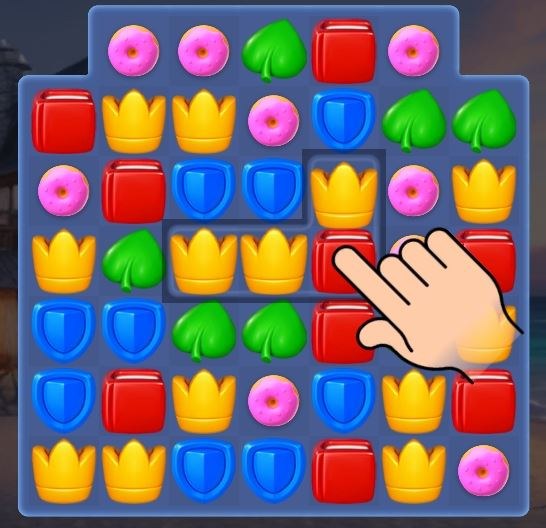
I fired up Buildingahouse not expecting much—just another match-3 with a construction theme slapped on. The first thirty seconds felt like that too. Bright tiles, a grid, the usual swapping mechanic. But then I noticed t
I fired up Buildingahouse not expecting much—just another match-3 with a construction theme slapped on. The first thirty seconds felt like that too. Bright tiles, a grid, the usual swapping mechanic. But then I noticed the blueprint outline sitting at the top of the screen, half-filled, and a little counter ticking down moves. By the end of my first game I'd built exactly two walls and a doorframe before I ran out of moves and the board locked up. I stared at it, annoyed. It looked so simple, but I'd already blown it.
That's the trick this game plays. It lulls you into casual-match mode, then about four levels in, it pulls the rug. You're not just clearing tiles for points. You're gathering specific materials—wood planks, bricks, glass panes, roof tiles—and each piece needs to hit a quota before the move counter hits zero. Miss one material by even two units and the whole house stalls. No partial credit. The early levels train you to match freely, but the hard levels demand you plan like a foreman who also happens to be a tile-swapping wizard.
How the Loop Actually Works (and What You're Really Optimizing For)
Most match-3 games reward cascading combos and high scores. Buildingahouse does too, but the score is secondary. Your real job is material extraction. Each level gives you a blueprint with required amounts: say, 14 wood, 9 bricks, 6 glass. The board spawns resource tiles among the normal colored ones. Match those resource tiles and they fly up into your inventory. Match normal tiles and you just waste a turn, though you might set up a better board.
The tension comes from move efficiency. You don't get infinite shuffles. Every swap that doesn't collect a needed resource pushes you closer to failure. On hard levels—I'd say starting around level 12 or 15, depending on how quickly you adapt—the quotas get tight. You'll need 20+ of a material and the board only spawns it in awkward corners, often locked behind ice blocks or chained tiles that require multiple matches to free. I found myself doing quick mental math: "I need seven more bricks, I have nine moves left, there are two brick tiles on screen and neither is adjacent to a match." That's when the panic sets in.
What you're optimizing for isn't score. It's board state. You want to keep resource tiles flowing toward the bottom or middle where you can reach them. You want to avoid dead columns where no vertical matches are possible. And you absolutely want to preserve special tiles—the line-clear rockets, the area bombs—for breaking obstacles that guard the materials you're short on. Wasting a bomb on a cluster of normal tiles feels satisfying for a second, then you realize you needed that bomb to crack open the glass tiles trapped behind a double-locked crate in the top left. I learned that the hard way, multiple times.
The Mistakes That End Runs Early
After about an hour of bouncing between level 17 and level 21, I started noticing patterns in my failures. Not the "oh, bad luck" kind—the "I did this to myself" kind. Here's what actually killed my runs, consistently.
Ignoring the material tracker at the top. This sounds obvious, but in the heat of a match-3, your eyes drift to the middle of the board where the colors are. The blueprint sits at the top edge, quiet and unassuming. I'd finish what felt like a great cascade, glance up, and realize I'd collected twelve wood—twice what I needed—and exactly one brick, with five moves left. The game doesn't stop you from over-collecting. Those extra wood matches were wasted turns. Now I check the tracker every three moves, minimum. If a material is already full, I treat its tiles as obstacles to match around, not prizes to grab.
Matching from the bottom too reflexively. In many match-3 games, matching near the bottom causes the most tile displacement and chain reactions. That's still true here, but displacement can bury resource tiles you need. I lost a level where I needed glass because I kept matching at the bottom, and every cascade pushed the glass tiles upward into the top row where they sat frozen behind a row of locks I couldn't reach. Now I match more carefully in the middle third of the board if I see scarce resources drifting upward. Sometimes a quiet horizontal match near the top saves a run.
Hoarding power-ups for the "perfect" moment. Buildingahouse gives you a hammer item occasionally—lets you smash a single tile—and rockets or bombs from large matches. I used to save them, thinking I'd need them more later. Then I'd hit zero moves with two hammers unused. The perfect moment on hard levels is usually right now, when a critical resource tile is one swap away from being freed but you can't make the match naturally. Use the hammer. Crack the lock. The relief of having that brick in your inventory is worth more than a hypothetical future emergency that might not even involve bricks.
Not counting locked tiles as real obstacles. Some levels introduce chain links, ice, or wooden crates that take multiple adjacent matches to clear. I'd treat them like background decoration and focus on the free tiles. Then with eight moves left I'd suddenly need five glass, and all the glass was locked behind two layers of ice in a column I hadn't touched all game. You can't ignore obstacles and hope. By the time you need what's behind them, you won't have enough moves to break through. I now identify which obstacles guard my priority materials within the first three moves and start chipping away immediately, even if it means passing up a juicy four-match elsewhere.
Phone vs Desktop: It Actually Matters Here
I played Buildingahouse on both my phone (iPhone, Safari) and a laptop (Chrome, trackpad). The game runs fine in either browser—no download, no account, just click and play. But the experience differs in ways that affect hard-level performance.
On desktop, I had more precision. The larger screen let me see the entire board without scrolling, which matters when you're tracking six material types and scanning for matches. I could also hover my cursor over tiles to double-check what was locked or chained without accidentally committing to a swap. On hard levels where one wrong move can cascade into disaster, that hover ability saved me multiple times. The trackpad took some getting used to—occasionally I'd drag a tile too far and swap the wrong direction—but after ten minutes I adjusted.
On mobile, the touch controls feel more natural for quick swapping. I was faster, and on levels with generous move counts that speed helped. But on tight levels, I fat-fingered swaps at least three times, once ruining a board where I had a bomb perfectly lined up. The smaller screen also made it harder to spot glass tiles, which are pale blue and blend into the background on some levels. I found myself squinting. I'd recommend desktop for the truly difficult levels where every move counts, and mobile for casual replay of earlier levels when you just want to zone out and match bricks.
One weird note: the game doesn't seem to have a sound toggle that's obvious, so on mobile I ended up muting my phone because the match sounds got repetitive. On desktop I just lowered the browser tab volume. Not a dealbreaker, but worth knowing if you're playing in a waiting room.
A Practice Plan That Actually Builds Skill
If you're stuck on a hard level—and you will be, probably somewhere in the late teens or early twenties—bashing your head against the same board over and over doesn't help much. The tile layout is semi-random each time you restart, which means luck plays a role, but your habits matter more. Here's the practice approach I settled on after losing level 19 maybe fourteen times.
First, replay an earlier level you already beat, but with a restriction. Pick a level from the 5–10 range where the quotas are forgiving. Play it again, but forbid yourself from making any match that doesn't collect a material. No "setting up the board" moves. No cascades for fun. Just cold, mechanical resource gathering. This retrains your brain to scan for resource tiles first and colored tiles second. Do this twice. It takes five minutes and feels weirdly stressful even though the level is easy.
Second, play your stuck level three times without trying to win. I know that sounds ridiculous, but bear with me. On the first attempt, just study the board for a full minute before making any move. Identify which materials are going to be scarce based on how many tiles of that type are visible and where they're placed. On the second attempt, focus exclusively on clearing obstacles for the first ten moves, ignoring quotas entirely. See how much progress you can make on freeing locked resource tiles. On the third attempt, play normally but pause every five moves to check the blueprint tracker. You'll start noticing patterns: maybe glass always spawns in the top two rows, maybe brick tiles cluster on the left. That knowledge is more valuable than any single lucky cascade.
Third, steal a trick from puzzle-game speedrunners: over-prioritize the scarcest material. If the blueprint needs 10 wood, 10 brick, and 20 glass, glass is your bottleneck. Every move that can collect glass should collect glass, even if it means ignoring a shiny four-match that would give you a rocket. Rockets are great, but rockets don't fill the glass quota. I started treating the scarcest material as the real objective and everything else as a side quest. My win rate on hard levels jumped noticeably after that mental shift.
One last thing: the game does not punish you for replaying levels. There's no energy system, no timer, no limited lives. You can restart a level thirty times in a row and the game just quietly resets the board. That freedom is rare in free browser match-3s, and it's the main reason I stuck with Buildingahouse through the frustrating parts. The only thing I'm spending is my own patience, and that's on me.
I still haven't finished every level—I'm stuck somewhere in the mid-20s now, a level that wants an absurd amount of roof tiles and keeps spawning them behind triple-locked crates—but I'm closer than I thought I'd get. The game doesn't change dramatically as it goes. No weird new mechanics or sudden genre shifts. It just tightens the screws. Smaller move counts, higher quotas, nastier obstacle placement. If you can handle that tightening without losing your cool, you'll build a lot of houses. If you can't, you'll have a half-finished blueprint and a board full of matches you wish you hadn't made. Either way, it's free in your browser, and I've definitely spent worse afternoons.