The first pour in Ball Sort Master feels almost too easy. You tap one glass tube, watch the top blob of color lift, and drop it into another tube. The liquid settles with a satisfying little wobble. For about forty-five
The first pour in Ball Sort Master feels almost too easy. You tap one glass tube, watch the top blob of color lift, and drop it into another tube. The liquid settles with a satisfying little wobble. For about forty-five seconds, you think you've stumbled into the most relaxing puzzle game ever made. Then you hit your first dead-end around level four, stare at four tubes full of mixed-up green, purple, and orange blobs, and realize you have absolutely no idea what you just did wrong. That moment — the quiet panic when no empty tube exists and every move feels like making things worse — is the actual game introducing itself. The gentle colors and soft animations are a disguise. Underneath is a sorting puzzle that punishes mindless tapping with surprising speed.
What You're Actually Trying to Optimize
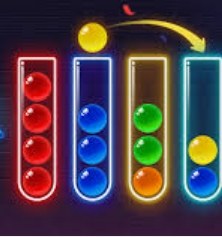
The loop is simple on paper. You get a set of glass vials, each holding four colored balls stacked on top of each other. Some tubes sit empty. Your job is to get every color grouped into its own tube, so you end up with several full tubes of solid color and the same number of empty tubes you started with. The only rule: you can only place a ball on top of a matching color or into an empty tube. That's it. No timers, no scores, no move counters pressuring you. The optimization is entirely internal — you're fighting your own impulse to make moves just because they're available.
I started treating each puzzle like a game of freeing up oxygen. The resource you're actually managing isn't balls. It's empty tubes. Every empty tube represents freedom. It's a temporary parking spot, a way to unstack a color you don't need yet so you can reach the one underneath. Beginners burn through empty tubes early, filling them with whatever color happens to be on top of the most annoying stack. That's the fast track to getting stuck. The smarter play is treating empty tubes like they're made of glass themselves — use them sparingly, and always with a plan to clear them again within two or three moves. If you fill your last empty tube and still have mixed stacks, you've probably already lost.
The Sorting Logic That Clicks After Twenty Minutes
There's a rhythm to how the game teaches you. Around level ten, the puzzles stop being solvable through reactive tapping. You start needing to look at the board for ten or fifteen seconds before touching anything. The key shift is moving from "what can I do right now" to "what am I working toward." Each tube of four balls has a natural destination color — the one at the bottom. If you've got a tube with blue at the base and red, yellow, red stacked above it, the goal isn't to sort all three colors at once. It's to clear the top three balls so blue becomes the active surface, then to find or create a tube that's ready to receive blue.
This sounds obvious written out. In practice, your brain wants to chase the most complete-looking move. You'll see a tube with two matching colors on top and immediately want to move them somewhere together. But if that destination tube only has one empty slot left, you've just trapped yourself. The move felt productive, but it consumed capacity you might have needed for a color that's actually closer to being finished. I lost three runs in a row around level sixteen before I realized I was prioritizing pretty-looking stacks over functional ones. A messy tube with one exposed green and three hidden blues is often more useful than a neat tube with two greens on top, because the messy one is closer to becoming a dedicated blue tube once you clear that single green obstacle.
Concrete Mistakes That End Runs Early
Let me list the specific ways I watched my own puzzles collapse. These aren't theoretical — they're the exact moments where I'd stare at the board and realize I'd have to restart the level.
First: filling your last empty tube with a color you have no immediate plan to move again. This is the classic beginner error, and I still do it when I'm tired or distracted. You see an empty tube, you see a color blocking something you want, and you dump it in without checking whether any other tube can accept that color next turn. Now your parking spot is occupied, and the blocking color is sitting isolated with nowhere to go. The only fix is to undo the move or restart.
Second: completing a color too early. This sounds counterintuitive, but finishing a tube of four matching balls removes that tube from play as a mixing space. A completed tube is functionally dead — you can't add anything to it. If you complete a color while you still have complicated stacks to untangle, you've reduced your available work space. I now deliberately leave one slot open on almost-finished colors until the very end. That partial tube acts as a staging area where I can accept one more ball of that color while I shuffle other things around.
Third: ignoring the two-move lookahead. Ball Sort Master is not a game where you can think one move at a time. Every move creates a new top surface on the source tube and reduces capacity on the destination tube. Before I drop a ball, I now ask myself: what becomes exposed underneath, and do I have a home for it? If the answer is "I don't know," I don't make the move. Hesitation is a strategy here, not indecision.
Fourth: the sunk-cost spiral. You'll have a board where you've made eight or ten moves and things look almost sorted, but there's one stubborn mixed tube left and no empty vials. The instinct is to keep shuffling, hoping a path appears. In my experience, if you can't see the solution within thirty seconds of scanning, the fastest way forward is to restart the level and play the opening differently. The game doesn't penalize restarts. There's no streak to protect. Swallowing your pride and hitting restart on level seventeen will save you five minutes of futile tapping.
What Undo Actually Teaches You
Ball Sort Master includes an undo button, and I've got complicated feelings about it. On one hand, it's a generous feature that lets you experiment without commitment. On the other, relying on undo can mask bad habits. I caught myself using undo as a crutch around level twenty-two — making speculative moves, seeing if they worked out, and rewinding when they didn't. That approach kept me moving forward, but I wasn't actually learning the board-reading skills the game was trying to build. When I hit a level where my usual undo-heavy approach stopped working, I had to unlearn the laziness I'd developed.
My current rule: I allow myself three undos per level. If I need more than that, I restart and try to solve it clean. The three-undo limit forces me to treat each move as consequential while still leaving room for the occasional "oh wait, that was dumb" correction. It's a self-imposed constraint, but it's made me a much stronger player. Your mileage may vary — some people will prefer the pure puzzle experience of never touching undo, and I respect that. But the feature exists, and using it mindfully is better than pretending it doesn't.
Device Feel: Phone Versus Desktop
I played Ball Sort Master on both a phone browser and a laptop with a trackpad, and the experiences are genuinely different. On a phone held vertically, the tubes sit in two rows of about five each, and tapping feels immediate and physical. The animations are quick enough that you can chain moves without waiting, but the smaller screen means you're doing more mental mapping. You can't see all the tubes with equal clarity at once, especially if you're on a smaller device. I found myself physically tilting the phone sometimes to remind myself what was in the bottom of a particular tube.
On desktop, the wider layout spreads the tubes out, and I could take in the full board state without scanning. This made planning easier, but the click-to-move interaction felt slightly less satisfying than tapping. There's also a tiny lag on some browsers where the ball drop animation takes a beat longer than expected, which can trick you into clicking again too soon. Neither version is broken — this is a browser game that works fine wherever you play it — but I found I made fewer careless errors on desktop purely because I could see the whole puzzle. On phone, I was faster but sloppier. If you're struggling with a particular level, try switching devices before you assume you're bad at the game. The layout difference might be all that's holding you back.
The Visual and Audio Landscape
Ball Sort Master doesn't do much, and that's a compliment. The background is a flat gradient, the tubes are simple glass cylinders, and the balls are glossy spheres in a handful of distinct colors. There's no theme, no characters, no narrative wrapper about being an alchemist or a potion brewer. The game trusts that sorting colored balls into tubes is inherently satisfying, and it's right. The color palette is chosen carefully — no two colors are similar enough to confuse, even on a dimmed screen. The orange is properly orange, the purple is unmistakably purple, and the blue and green are far apart in tone.
Sound is minimal. You get a soft plink when a ball lands, a slightly different tone when you complete a tube, and that's about it. There's no music loop, which means you can play in a quiet room without reaching for a mute button. I appreciate games that don't assume I want an audio experience. The silence, or near-silence, reinforces the calm-strategy mood the game is going for. It's a puzzle you play while thinking, not while being entertained.
A Practice Plan That Actually Builds Skill
If you want to improve rather than just progress, here's a short structured approach I worked out after about an hour of play. It's not a grind — it's more like focused practice that makes later levels feel easier instead of harder.
First, spend ten minutes on levels one through eight without using undo at all. These early puzzles are simple enough that you can solve them clean if you slow down. The goal isn't to beat them — you already know you can. The goal is to practice scanning the full board before your first move. On each level, identify which tube will become which color's final home. Say it out loud if you're alone. "This tube is going to be all green. This one will be yellow." Then solve. Doing this explicitly builds the habit of assigning destinations early, which is the skill that keeps you alive past level twenty.
Second, take three mid-game levels you've already beaten — somewhere around fifteen to twenty — and replay them with a specific constraint: never let your empty tube count drop below one. This forces you to treat empty tubes as precious and to plan refills. You'll discover moves you missed the first time through, alternative paths that keep your options open longer. This drill changed how I see the board. I stopped thinking of empty tubes as storage and started thinking of them as a rotating door — something goes in, something comes out almost immediately.
Third, find a level that's currently stumping you and play it five times in a row, restarting each time after six moves regardless of how well it's going. The six-move limit prevents you from drifting into dead ends and forces you to experiment with different opening sequences. You'll be surprised how often the first three moves determine whether the puzzle is solvable at all. After five restarts, you'll have a much clearer picture of which opening moves create flexibility and which ones paint you into a corner.
That's it. Ten minutes of clean early play, three constrained replays, and five short experiments on your current wall. The whole practice session takes about twenty minutes and leaves you sharper than an hour of mindless progression would.
Who This Game Is Actually For
Ball Sort Master isn't for everyone, and I think it's worth being honest about that. If you need escalating action, narrative stakes, or a sense of forward momentum beyond a level number ticking up, you might bounce off after fifteen minutes. The game is repetitive by design. It's a single mechanic explored across dozens of slightly harder variations. That's the appeal for the right player, but it can feel thin if you're looking for variety.
The people who will love this are the ones who enjoy untangling knots. Literal knots, like headphone cables, or abstract ones, like scheduling conflicts. There's a deep satisfaction in taking something chaotic and reducing it to order through a series of small, logical moves. Ball Sort Master scratches that itch cleanly and without fuss. It's also a genuinely good game for anxious moments. The lack of time pressure, the soft sounds, the undo safety net — it's built to be calming even when the puzzles get hard. I played several levels while on hold with a utility company, and it kept me from spiraling into phone-menu rage. That's not nothing.
The free browser format matters here too. This isn't a game you need to download, update, or commit to. You open a tab, you sort some balls, you close the tab. It respects your time and your device storage equally. For a certain kind of player — maybe you, reading this — that low-friction access is exactly what makes it stick in your daily rotation.