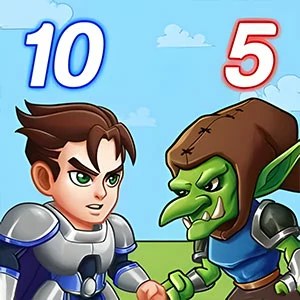
Hero Tower Wars is a browser puzzle game where you move a hero, defeat enemies, grow stronger, and defend your tower while collecting treasures. It suits players who like planning moves ahead, not fast reflexes.
Hero Tower Wars sits in the Puzzle category, and its own instructions describe a four-step loop: move your hero using your brain, defeat all enemies, increase your strength, and defend your tower. The description adds a collection goal — gather all the treasures and become the ultimate hero. That is the whole of what the catalogue gives us. It does not detail controls, level counts, characters, or progression systems, so treat anything beyond those four steps as a reasonable guess rather than fact.
What that description does tell you is useful. This is a game that asks you to think before you move, not one that rewards fast reflexes. If you like puzzles where each decision has a cost, the setup is aimed at you. If you want pure action or a tower defense game where you mostly place turrets and watch, the wording points elsewhere.
What the instructions actually promise
The four steps are worth reading closely because they suggest an order of priorities. First, movement is framed as a thinking task, which implies limited or meaningful moves rather than free roaming. Second, the goal is to defeat all enemies, so clearing the board matters. Third, you increase your strength, which suggests growth is part of the plan rather than an afterthought. Fourth, you defend your tower, which means something is at risk while you work.
Notice what is not there. There is no mention of real-time combat, no controller layout, no stated number of stages, and no description of how heroes are unlocked. The catalogue also does not say whether the tower is yours alone or shared with enemies. If those details matter to your purchase decision, the supplied notes will not settle them.
The automated check that accompanied this listing confirmed the game loaded on a desktop device in a browser, with a load time of roughly eight seconds. It did not record any control information. So we can say the game opens in a browser on desktop; we cannot say how you move the hero. That gap is worth knowing before you commit an evening to it.
How the loop likely works, and what you are optimizing
Reading the four steps together, the loop looks like this: you plan a move, you resolve an encounter with an enemy, you gain strength, and you keep your tower standing. The optimizer in that loop is not speed. It is the ratio between the strength you gain and the risk you take to get it. The description mentions collecting all treasures, which suggests optional gains scattered around the board. Those are probably where the interesting decisions live — the treasure that is easy to reach versus the one that pulls you away from defending.
If that reading is right, the game rewards players who treat each move as a budget. You spend a move to gain strength, or to clear an enemy, or to defend. You rarely get all three at once. That is a puzzle-shaped problem, and it fits the Puzzle category better than a pure tower defense label would.
What you cannot confirm from the notes is whether moves are turn-based, whether enemies act on a timer, or whether the tower has a health value. Those are the details that decide whether the game feels like a chess problem or a light strategy skirmish. The catalogue does not say, so plan to find out in the first few minutes rather than assuming.
Mistakes that end runs early
Because the mechanics are not documented, these are genre-based cautions rather than tested findings. Still, they follow from the four steps the description lays out.
- Chasing every treasure first. The instructions put defending your tower fourth, which implies it is easy to neglect. If you spend early moves collecting, you may be doing so while your tower is exposed.
- Fighting enemies before building strength. Step three sits before step four for a reason, perhaps. Walking into fights at base strength is the classic way to lose ground you cannot recover.
- Moving without a plan. The first instruction is to use your brain to move. If movement is limited, a wasted step is a real cost, not a minor detour.
- Treating it as a reflex game. Nothing in the description suggests twitch play. If you approach it like an action title, you may misread the pacing and rush decisions that wanted thought.
- Ignoring the tower until it is threatened. Defense is listed as a task, not a background condition. Assume it needs active attention.
One more caution: the eight-second load time on desktop is not unusual for a browser game, but it is not instant either. If you are the kind of player who bounces after three seconds of a loading screen, give it a moment before deciding.
Phone versus desktop
The only device evidence we have is a desktop browser load. There is no recorded information about touch controls, mobile layout, or performance on phones. That means I cannot tell you whether Hero Tower Wars plays well on a phone, whether the interface scales, or whether the controls suit a touchscreen.
What I can say is that puzzle games built around deliberate moves often translate reasonably to touch, because you are not relying on precision timing. But that is a general observation about the genre, not a claim about this game. If mobile play matters to you, the honest answer is that the catalogue does not confirm it, and you should check before relying on it.
On desktop, the confirmed detail is simply that it loads in a browser. Free browser play is the natural format here, and it means you can try the opening minutes without installing anything.
Who this suits, and who it does not
Hero Tower Wars looks like a good fit if you enjoy planning a few moves ahead, if you like the tension between grabbing a reward and holding your ground, and if you are happy with a puzzle pace rather than an action pace. The combination of movement, combat, growth, and defense in one loop suggests a game that asks you to balance priorities rather than master a single skill.
It is probably a poor fit if you want a traditional tower defense game built around placing and upgrading static defenses. The description centers on a hero who moves, fights, and grows. That is a different shape of game. It is also a poor fit if you need confirmed mobile support or detailed control information before you start, because the catalogue does not provide either.
If you are unsure, the low commitment of browser play makes the decision easy. Spend ten minutes on the first stretch and see whether the move-by-move thinking clicks. That tells you more than any description can.
A short practice plan
You do not need a long routine for a game this size. A simple approach works better than a complicated one.
- First session, five to ten minutes: focus only on learning how movement works. Do not try to win. Note whether moves are limited and whether enemies respond immediately.
- Second session: pick one treasure and one enemy and see how gaining strength changes the fight. This tests whether step three actually matters in practice.
- Third session: deliberately neglect your tower for a few moves to learn what happens when it is threatened. Understanding the failure state is more useful than avoiding it.
- Then: play a full attempt with the four steps in mind, treating defense as a standing cost rather than a final chore.
Keep notes if the game gives you a lot to track. Puzzle games with multiple objectives reward a written plan more than memory.
The honest verdict
Whether Hero Tower Wars is right for you comes down to one question: do you want to think about each move, or do you want to react? The catalogue describes a game built around the first. It asks you to move with intent, fight to clear the board, grow stronger, and keep your tower standing while you collect what is scattered around.
What the catalogue does not give you is the fine print — controls, level structure, mobile support, or how defense is actually handled. Those gaps are real, and I will not fill them with guesses dressed up as facts. Use the confirmed details to decide whether the concept appeals, then use a short browser session to check the rest. That is the fairest way to judge a game whose description is this brief.