First Minute on the Clock I opened Spot Differs expecting the usual side-by-side image comparison, but the timer in the corner immediately changed my posture. The first screen showed a messy kid's bedroom with toys scatt
First Minute on the Clock
I opened Spot Differs expecting the usual side-by-side image comparison, but the timer in the corner immediately changed my posture. The first screen showed a messy kid's bedroom with toys scattered across the floor, and I could tell within ten seconds this wasn't going to be a lazy Sunday activity. The differences aren't hidden in shadows or blurred edges—they're right there, but the images are packed with so many colorful objects that your eyes kind of glaze over. I missed a floating balloon that literally wasn't in the second picture and felt genuinely silly. The music is bouncy and inoffensive, the kind that loops cleanly without making you want to mute the tab, which is a small blessing when you're staring at cartoon penguins for three minutes straight.
What struck me most was how quickly the initial calm gave way to a low-grade panic. You get a generous countdown, sure, but the penalty for wrong taps is immediate. I jabbed at a lamp that looked slightly different and lost five seconds. That's when I realized this isn't really a spot-the-difference game in the leisurely sense. It's more like a visual scavenger hunt where the clock is the real opponent.
The Loop You're Actually Playing
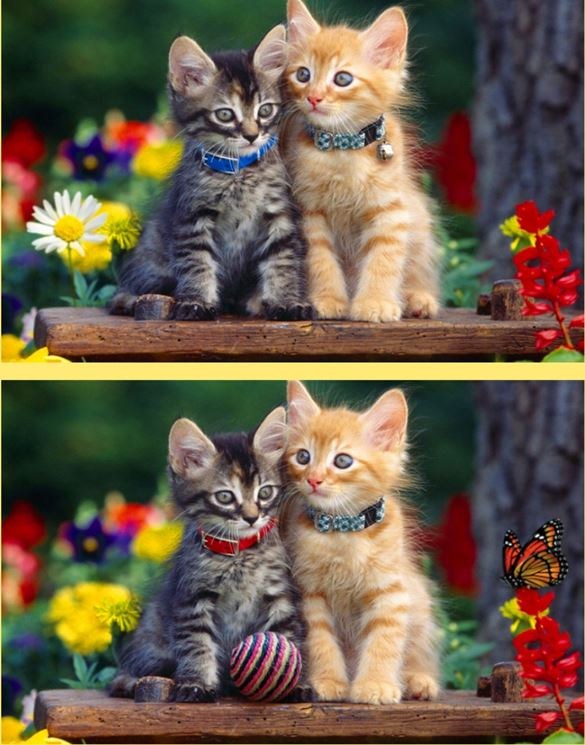
Spot Differs follows a structure most people will recognize from mobile puzzle games, but it runs cleanly in a browser without any downloads or account setup. Each level presents two nearly identical illustrations, and you tap the spots on the bottom image where something is missing, recolored, or shifted. Find all differences before time runs out, and you move to the next scene. Sounds simple, and for the first handful of levels, it is.
What you're really optimizing for isn't just completion—it's speed and accuracy in combination. The game tracks your score based on how much time remains and how few mistakes you make. A perfect run with half the clock left feels genuinely satisfying. A sloppy finish where you scrape by with three seconds and two penalties gets you to the next level but leaves a nagging feeling that you didn't really earn it. I found myself replaying early levels not for fun but because I knew I could shave eight seconds off my time, and that compulsion is the engine underneath the whole experience.
The difficulty ramps up in a way that feels designed rather than accidental. Early scenes are wide-open with distinct objects. Later levels introduce mirrored layouts, repeating patterns, and color palettes that blend together. By level twelve or so, I was squinting at identical rows of books on a shelf, trying to spot which spine was a slightly different shade of blue. That's the wall where casual players will either lock in or tap out.
Mistakes That Will End Your Run Early
I lost more runs than I'd like to admit before I started noticing patterns in my own failures. The most common error, and the one that cost me the most time, was what I'd call confident mis-tapping. You spot something out of place, your finger moves before your brain confirms it, and you click a region that's actually identical. The penalty animation plays, the timer deducts seconds, and now you're rattled. That rattled state leads to more mis-taps, and suddenly a level you could have cleared comfortably becomes a scramble.
Another trap is fixation on a single quadrant. The images are often busy in all four corners, and I'd catch myself staring at the bottom-right area while three obvious differences sat untouched on the left side. The game doesn't give you a hint system—at least not in the version I played—so there's no safety net for tunnel vision. You have to train yourself to sweep methodically, even when the timer is ticking down and your instincts are screaming at you to keep digging in the spot where you already found one difference.
Then there's the scale problem. Some differences involve objects that are genuinely small: a missing button on a coat, an extra leaf on a distant tree, a window that's one pixel taller than its twin. On a phone screen, these are brutal. I'll get into device specifics in a moment, but the short version is that playing on a smaller display adds a layer of difficulty that has nothing to do with observation skills and everything to do with whether you can physically see the detail.
Last mistake worth mentioning: playing tired. I tested this game at night after a long day, and my error rate tripled. The cognitive load isn't enormous, but it requires sustained attention, and when your focus wavers, you start clicking the same wrong spot twice in a row because your brain refuses to accept that the vase really is identical in both images.
Phone vs Desktop: A Bigger Divide Than Expected
I played Spot Differs on both a laptop with a trackpad and a mid-size phone, and the experiences were different enough that it feels worth spelling out. On desktop, you have a larger canvas and the precision of a mouse cursor. Differences that involve fine details—stitching on a pillow, reflections in a window—are actually solvable because you can see them clearly. The downside is that moving your cursor across a wide screen takes fractions of a second longer than tapping directly on a phone, and in the later levels where every moment counts, that micro-delay adds up.
On mobile, the images scale down, and the touch targets for some differences become frustratingly small. I had multiple instances where I was certain I'd spotted a missing item, tapped the exact spot, and the game registered it as a mis-tap because my finger covered the very detail I was trying to select. Zooming isn't an option, or if it is, I couldn't find it. The advantage on phone is speed: you can scan with your eyes and tap with your thumb in a rhythm that feels almost musical when you're in the zone. For kids or casual players who just want to mess around, phone is probably the more natural fit. For anyone trying to clear the harder levels without pulling their hair out, desktop gives you a real edge.
Both versions loaded quickly in a browser with no noticeable lag, which matters because stuttering during a timed puzzle would be a dealbreaker. I didn't test on a tablet, but I'd guess that's the sweet spot: enough screen real estate to see small details, plus the direct touch input that makes the game feel responsive.
Who This Game Actually Suits
Spot Differs sits in a strange middle ground. The art style is cheerful and child-friendly: animals, playgrounds, colorful kitchens, undersea scenes. A six-year-old could absolutely play the first few levels and feel accomplished. But the difficulty curve doesn't stay in kid territory for long. By the midpoint, you need patience and a systematic approach that younger children might not have. I'd say the core audience is probably older kids—think eight to twelve—and adults who want a short mental warm-up that doesn't demand too much emotional investment.
If you're someone who plays hidden object games or enjoys jigsaw puzzles, the appeal is obvious. The game scratches the same itch but in smaller, timed doses. It's also a solid choice for parents looking for something to hand a child that isn't filled with ads or microtransactions, since the free browser version I played had neither. I can't speak to whether there's a paid ad-free version elsewhere, but the web build was clean.
Competitive types will find a score-chasing loop here, even though there's no leaderboard. The internal motivation to beat your own times is surprisingly sticky. I caught myself muttering "I can do that faster" more than once, which is either a testament to the game's design or a sign that I need to get outside more.
A Short Practice Plan That Actually Helps
After fumbling through a dozen levels and replaying several, I developed a small routine that improved my consistency. It's nothing revolutionary, but it worked, so I'll share it in case you hit the same walls I did.
First, spend your first three seconds on every level doing nothing but letting your eyes go slightly unfocused. Counterintuitive, I know, especially with a timer ticking. But the impulse is to start tapping immediately, and that's how you miss the big, obvious differences. Let the two images blur together for a moment, and the discrepancies often pop out as visual static. I found this especially useful on levels with complex backgrounds.
Second, adopt a scanning pattern and stick to it. I settled on left-to-right, top-to-bottom, like reading a page. Every time I abandoned the pattern because I got excited about a difference I'd spotted in the corner of my eye, I'd end up losing track of where I'd already checked. The pattern feels slow at first, but it prevents the frantic darting that leads to missed details and penalty taps.
Third, practice on the first five levels until you can clear them perfectly with at least half the time remaining. These early scenes are simple enough that you can build speed without the stress of tiny, camouflaged differences. Once the scanning rhythm becomes automatic, the harder levels feel less overwhelming because your eyes know how to move efficiently even when the content gets dense.
Fourth, if you're on mobile, use a stylus or the tip of your pinky instead of your thumb. It sounds ridiculous, but I tried it and my accuracy improved noticeably. Your thumb covers too much of the screen, and on those small-detail differences, you need to see exactly where you're tapping.
Finally, take actual breaks. I know it's a browser game and the temptation is to say "just one more level," but my performance tanked after about twenty minutes of continuous play. Step away for five minutes, let your eyes rest, and come back. The differences that seemed impossible before will often jump out immediately on a fresh look.
What the Game Doesn't Tell You
Spot Differs doesn't have a tutorial beyond the most basic instruction, and a few things only became clear through trial and error. The penalty for mis-tapping isn't just a time deduction—it also seems to briefly lock your input, meaning you can't immediately tap again on the correct spot. That half-second lockout feels like an eternity when the clock is low. Knowing this changes how you play: it's better to pause for a beat and confirm a difference than to fire off three quick taps and hope one lands.
The differences themselves fall into a few predictable categories once you've seen enough levels. Objects that are present in one image and absent in the other are the most common. Color changes come next: a red balloon becomes blue, a green shirt turns yellow. Size differences appear occasionally, where an item is scaled slightly larger or smaller. Rotation or mirroring is rare but shows up in later stages. Once I internalized these categories, I stopped looking for more exotic changes that don't exist, which saved mental energy.
There's no story connecting the levels, no progression narrative beyond a level number ticking upward. For some people, that will feel aimless. For others, it's liberating—you're here to find differences and beat your time, full stop. The game doesn't pretend to be anything else, and I respect that clarity.
If you're looking for a free browser puzzle that you can play in short bursts without signing up for anything, Spot Differs does exactly what it says on the tin. It won't change your life, but it might sharpen your eyes and give you fifteen minutes of focused calm in a day that needs it.