First Minute on the Map You load in and it’s just stars and a curved path. No cutscene, no lore dump. I placed my first basic turret near a bend and watched a few blocky enemy ships drift in. The firing sound is a soft p
First Minute on the Map
You load in and it’s just stars and a curved path. No cutscene, no lore dump. I placed my first basic turret near a bend and watched a few blocky enemy ships drift in. The firing sound is a soft pew-pew, not obnoxious. By wave three I already had a second tower up and was feeling that small dopamine nudge when the last ship in a wave pops before reaching the exit. The interface is mostly icons—you figure it out by tapping. If you’ve played any tower defense before, the first minute feels like slipping on a familiar jacket. If you haven’t, you’ll still get it within the first two waves.
What You’re Actually Optimizing For
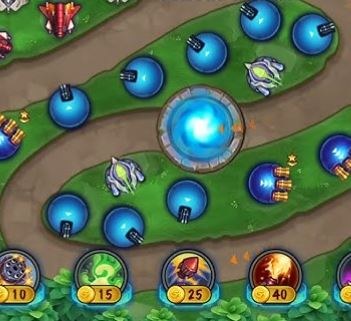
The loop in Tower Defense Galaxy isn’t about perfect mazing or pixel-perfect placement. Paths are fixed. You can only build on designated nodes along the route. That shifts the whole puzzle from "where do I make the maze" to "which spots give me the most overlapping fire for the longest time." You’re optimizing for coverage density. A turret on a straightaway has less value than one at a corner where it hits ships on two sides. I kept placing towers on long straights early and regretting it by wave 12.
You earn credits per kill, plus a small bonus at wave clear. Upgrades are per-tower and get expensive fast. The real resource you’re managing is attention. You can’t be everywhere. I found myself staring at the health bars of the beefier ships while a fast little scout slipped past on the other side. The game punishes tunnel vision gently—you lose one life, not the whole run—but a few leaks in a row and you’re done.
The tower types are standard: fast shooter, slow heavy hitter, a beam that slows, and a splash damage option. I won’t pretend there’s a wild twist here. The complexity comes from upgrade timing. Do you make your main damage dealer level three, or spread levels across three towers? I tried both. Spreading kept me alive longer in the mid-waves because I had fewer leaks, but I hit a wall around wave 25 where the big ships just shrugged off everything. Going tall on one tower worked better if I babysat it with the slow beam.
Casual Doesn’t Mean Brain-Off
I played this during lunch breaks for a few days. Sessions can be short—a full run to wave 30 takes maybe 12 to 15 minutes if you don’t pause. You can pause anytime by just switching tabs or locking your phone, which I appreciated. The game remembers where you were. But "casual" here means low time commitment, not low stakes. The difficulty curve has teeth after wave 18 or so. I lost three runs in a row at wave 22 before I changed my approach.
The simple priority system the headline mentions is real. You’re constantly deciding: upgrade existing tower or buy a new one? Target the front of the pack or the biggest threat? Place your next tower to cover a leak point or to layer damage where you’re already strong? There’s no wrong answer universally, but there are wrong answers for specific wave compositions. Learning to read the wave preview bar at the top—which shows tiny icons of what’s coming—became my main edge.
Mistakes That Ended My Runs Early
I made a handful of avoidable errors repeatedly. Here’s what actually killed me, not in theory:
- Ignoring the wave preview. The bar shows ship types for the next wave. Fast scouts look different from heavy cruisers. I kept building more single-target damage right before a swarm wave and getting overrun. Check the bar before you spend.
- Upgrading too early. A level two basic turret costs about as much as two level one turrets. Two turrets cover more ground. I upgraded my first tower to level three by wave 10 and had a single strong point while the rest of the path was naked. Leaks everywhere.
- Forgetting the slow beam exists. I treated it as optional for too long. It’s not optional. By wave 15, without at least one slow tower near the middle of the path, the fast movers will slip through. The slow beam’s damage is pitiful but it buys your damage dealers time. I started placing one by wave 8 every run and my survival rate jumped.
- Clumping towers too close. Coverage overlap is good, but three towers all hitting the same short stretch means everything after that stretch is undefended. I now space my damage dealers so their ranges just barely overlap, creating a long kill zone instead of a short hot spot.
- Selling towers in a panic. You can sell for a partial refund. I did this once mid-wave when a big ship was about to leak. I sold a backline tower to fund an upgrade at the front. The big ship died but the next wave spawned with scouts that walked right through the gap I created. Felt clever for about ten seconds.
Phone vs Desktop Notes
I tested this on both. On a phone browser, the tap targets are a little small. Dragging to place a tower sometimes missed and I’d accidentally select a different node. Not a dealbreaker, but I lost one run because I placed a slow tower one node too far back and couldn’t afford to sell and replace. On desktop with a mouse, it’s smoother. The hover tooltips actually appear, which on mobile require a long press I didn’t discover until day two. If you’re going to play seriously, desktop gives you slightly better precision. But for a quick session on the couch, phone works fine once you adjust to the tap sensitivity.
One weird thing: the upgrade buttons on mobile sit near the bottom of the screen. I kept brushing them with my palm when reaching to place towers at the bottom of the map. Minor annoyance. No such issue on desktop.
A Short Practice Plan That Worked for Me
After losing a bunch, I stopped trying to beat the whole thing and ran a focused practice routine for about 20 minutes. It helped more than I expected. Here’s what I did:
Run one (5 minutes): Play only to wave 10. Goal is to not leak a single ship. This forced me to learn the early wave patterns and figure out the minimum spend to hold the line. I realized I was overbuilding early and starving myself for the mid-game.
Run two (8 minutes): Play to wave 18 with exactly four towers, no more. Upgrade them as needed. This taught me which tower combos handle mixed waves. The slow beam plus two basic shooters and one splash turret became my go-to core.
Run three (full attempt): Take what I learned and push as far as possible. First time I did this, I hit wave 28. Previously my best was 22. The practice runs gave me a cleaner early game and I arrived at the hard waves with more credits and better tower placement.
I also started pausing at the start of each wave after wave 15 to scan the preview bar and ask: "What’s the threat here—speed or health?" If speed, I checked my slow coverage. If health, I checked my single-target damage. That tiny pause habit cut my mid-game leaks way down.
What the Game Doesn’t Tell You
The catalogue description was unavailable when I wrote this, so everything here is from playing the game itself. There’s no tutorial beyond the first wave tooltip. A few things I had to learn by failing: you can target specific ships by tapping them, which I didn’t know for my first three runs. Towers default to "first in range" targeting, but switching to "strongest" on your heavy hitter makes a real difference against mixed waves. There’s also a speed-up button hidden in the corner—double arrow icon. I played at normal speed for way too long. Speed-up is safe for the first 15 waves; after that, I keep it on normal so I can react to leaks.
The game works in any modern browser, no download, no login. It’s the kind of free HTML5 game you can pull up in a tab and play while waiting for something else. I didn’t hit any paywalls or ad interruptions during my sessions, which is worth noting because that’s not always the case with browser games in this genre.
Who This Is For
If you want deep tower customization, branching upgrade trees, or story-driven campaigns, this isn’t that. Tower Defense Galaxy is a straightforward, single-map survival game. The fun is in refining your build order and seeing how far you can push. It scratches the same itch as optimizing a spreadsheet, but with little explosions. I found myself thinking about it between sessions—"what if I tried two slow towers instead of one?"—which is a good sign for a game this simple.
It’s best in short bursts. I wouldn’t marathon it, but as a ten-minute daily challenge, it holds up. The simple priorities angle is accurate: you’re making the same few decisions over and over, but the context shifts enough that they stay interesting. My advice is to treat early losses as data, not failure. The game is designed to be replayed, and the runs are short enough that restarting doesn’t sting.