
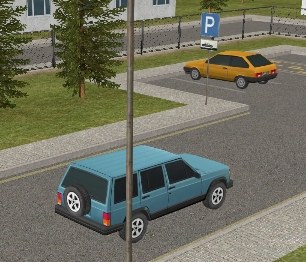
I fired up Parking Slot expecting something relaxing and maybe a little boring. The first minute told me I was wrong. You're dropped into a top-down lot with a handful of marked spaces, and cars start rolling in one afte
I fired up Parking Slot expecting something relaxing and maybe a little boring. The first minute told me I was wrong. You're dropped into a top-down lot with a handful of marked spaces, and cars start rolling in one after another. The early seconds feel gentle — a sedan here, an SUV there — and you think, "Okay, I'll just tap them into the nearest open rectangle." Then the timer between arrivals shortens, a truck shows up sideways, and suddenly you've got three vehicles idling while you try to remember where the compact-only spot was. That shift from calm to controlled panic is the game's real hook.
What You're Actually Managing
The core loop isn't just about filling empty spaces. You're optimizing a constant flow against limited geometry. Every car that enters has a size and a patience meter. Ignore one too long and it honks, then leaves, which eats into your daily revenue target. Hit the target and you unlock the next lot, which introduces tighter layouts, pillars, or one-way lanes. Miss it and you replay the day.
What I found myself obsessing over wasn't the individual parks but the rhythm of clearing the queue. A car parked perfectly in three seconds feels fine, but chaining four quick parks without a single vehicle honking — that's where the score multiplier lives. The game nudges you toward combos by flashing a subtle streak counter near the top. You'll notice it resets if you hesitate or pick the wrong spot size. My best runs happened when I stopped treating each car as a solo puzzle and started seeing the lot as a breathing system I was conducting.
How the Combo System Actually Works
The combo logic isn't explained anywhere obvious, so I pieced it together through trial and error. A combo triggers when you park consecutive cars without a gap that trips the "waiting too long" warning. The multiplier climbs slowly at first — 1.2x, then 1.5x — but after about six or seven clean parks, it jumps to 2x and stays there as long as you don't break the chain.
Breaking the chain happens in three specific ways. First, letting any car reach the red zone on its patience bar. Second, parking a vehicle in a spot that doesn't match its size category — the game treats a compact in a large slot as a valid park but it kills your streak silently, which I learned the hard way. Third, and this one's sneakier, moving a car into a spot and then immediately moving it again because you realized you blocked a better angle. The undo counts as a pause, and the combo drops.
The payoff for maintaining a long chain isn't just points. High combos fill a bonus meter that triggers a temporary "clearance" state where for about ten seconds, every spot becomes universal — any car fits anywhere. That's your window to bulldoze through a backlog of mismatched vehicles and stabilize the lot. I started treating combos less like a score flex and more like a survival tool.
Mistakes That Torch Your Run Early
I lost more runs to bad opening decisions than to late-game chaos. The first mistake is over-prioritizing easy parks. The initial wave always includes one or two compact cars. If you slot them into the large spaces right at the entrance, you've just condemned yourself to a mid-wave crunch when the SUVs arrive and your remaining spots are all compact-sized. You'll watch a perfectly good large vehicle honk and peel out while two empty big rectangles sit behind tiny cars you can't move.
A related error is parking vehicles flush against the entry lane. The lot layouts in mid-tier levels often have a central corridor that doubles as the main artery for incoming traffic. Park a sedan too close to that artery's edge and later cars clip it, slowing their pathfinding. They'll crawl, their patience drains faster than you expect, and your combo shatters because the game treats the slowdown as your fault for creating the obstruction.
The third mistake is ignoring the day's special condition. Around level five or six, the game starts adding modifiers — things like "only electric vehicles earn tips" or "motorcycles arrive in pairs." I skimmed these at first and promptly failed a day where half the lot was cordoned off for "resurfacing." You have to read the tiny text at the day's start and adjust your spot allocation before the first car appears. No amount of combo skill saves you if you've already doomed your spatial layout.
One more specific failure point: the tow truck. On levels with a tow icon in the corner, you can call it once per day to remove a badly parked car. I used to save it for emergencies, but the smarter play is using it proactively around wave three or four when your lot is half-full and you spot a compact car squatting in a large spot that you know you'll need in sixty seconds. Yank it early, replant it correctly, and your combo survives intact. Wait until the SUV is already honking and the tow truck's slow arrival animation will cost you the streak anyway.
Phone vs Desktop — It Matters Here
I played on both a mid-range Android phone and a laptop with a trackpad, and the experience splits in ways worth noting. On phone, the touch-and-drag parking feels immediate and satisfying. You tap a car, drag a path to the spot, and release. The gesture is fast enough that you can chain parks at the speed the game wants for high combos. The trade-off is visibility. On smaller screens, the lot boundaries get cramped, and I misjudged spot sizes more than once because my thumb obscured the corner of a parking rectangle.
On desktop, the mouse gives you precision and a full overview of the lot. I found it easier to plan three or four moves ahead because I could see every spot's designation without zooming or squinting. The downside is speed. Dragging with a mouse introduces a tiny input lag — not from the game, but from the physical motion of moving a cursor across a wider screen. In the late waves where quarter-seconds matter for combo maintenance, I dropped streaks on desktop that I would have saved on phone. If you're chasing leaderboard scores, I'd recommend phone with a stylus or just a very clean thumb technique. If you're learning layouts and want to study the flow, desktop is more forgiving.
A Practice Plan That Actually Builds Skill
After about fifteen minutes of flailing, I settled into a practice approach that made the game click. Instead of grinding the same day over and over, I ran a short deliberate cycle that looked like this:
First five minutes: Replay day one, but with a self-imposed rule. Park every car in the farthest available spot of the correct size. This feels inefficient and wrong, but it forces you to learn the lot's full footprint instead of defaulting to the nearest rectangle. You'll notice which corners the camera loves to hide and which lanes become bottlenecks when traffic doubles. After three runs of this, you've internalized the geometry without the pressure of later modifiers.
Next five minutes: Pick a day you've already cleared and replay it with the goal of never letting the combo counter drop below 1.5x. This means you're not optimizing for the daily revenue target — you're optimizing for streak continuity. If a car is about to honk but the only open spot is the wrong size, park it anyway and accept the streak break, then immediately analyze what you could have done thirty seconds earlier to avoid that bind. Usually the answer is that you parked a medium car too deep in a corner when you should have left it near the exit for a quick reshuffle later.
Final five minutes: Attempt a new day blind, but pause after the first wave to sketch a rough mental map. Which spots are large? Which are compact? Is there a pillar creating a blind turn? Assign a rough zone in your head — "large vehicles go to the left row, compacts to the right pocket" — and stick to it unless a special condition forces a pivot. The mental map fades fast under pressure, but the act of pausing to build it trains you to read new layouts faster on subsequent attempts.
This twenty-minute cycle gave me more genuine improvement than an hour of reactive play. The combo system rewards preparation more than reflexes, and the practice plan leans into that truth.
When the Game Gets Mean (and Fun)
Around level eight, the lot introduces angled parking and a one-way entry lane that loops counterclockwise. Cars now approach from two directions, and the patience meters drain at different rates depending on vehicle type. Electric cars, I noticed, have a slightly longer fuse, while delivery vans start honking almost immediately. The game doesn't announce these differences — you feel them through failure.
This is where the combo system truly earns its place. A 2x multiplier during the clearance state I mentioned earlier becomes your only reliable way to process a wave of mixed-direction traffic without losing a vehicle. I started hoarding my first big combo specifically for the moment when the entry lane switches direction mid-wave. If you trigger clearance right as the flow reverses, you can park anything anywhere for ten seconds, which is exactly enough time to slot four or five cars that would otherwise require a full lot reorganization. Missing that window means watching two vans and a motorcycle leave in quick succession, tanking your revenue and forcing a replay.
The game never stops being a parking puzzle, but the combo layer transforms it into something closer to a time-management rhythm game. You're not just placing cars — you're keeping a beat, and the beat gets faster and more syncopated as the levels climb.
What the Game Doesn't Tell You
A few hidden mechanics emerged during my longer sessions. The lot has a "flow rating" that the game tracks silently. Park cars in a way that creates clear inbound paths for new arrivals and the rating stays green. Create a tangle where vehicles have to snake around each other and it drops to yellow or red. A red flow rating speeds up patience drain across all waiting cars, which means a single bad park can cascade into three honking vehicles in under ten seconds. The flow rating never appears as a visible bar, but you'll hear a subtle audio cue — a low hum that gets throatier when the lot is clogged. I started using that hum as my early warning system.
Also, the daily revenue target isn't a fixed number the way it appears. The game adjusts it slightly based on your previous day's performance. Crush a day with a perfect combo and the next day's target creeps up. Struggle and barely scrape by, and the target softens. It's a gentle dynamic difficulty that keeps the pressure consistent without feeling punitive. I appreciated this once I noticed it, because it meant I wasn't being punished for experimentation on off-days.
Should You Play It?
Parking Slot is free in your browser and asks for nothing but your attention. It's not a game that dazzles with graphics or story — the cars are colored rectangles, the lots are gray grids, and the interface is functional to the point of being stark. But the combo loop is tight in a way that rewards repeated runs, and the difficulty curve respects your time. I came for a five-minute distraction and stayed because I wanted to see if I could hold a 2x chain through an entire day with angled spots and motorcycle pairs. I could, eventually, and the satisfaction was disproportionate to the visual simplicity.
Play it on phone if you want speed, on desktop if you want clarity, and spend your first few runs learning the lot's bones before you chase high scores. The game won't hold your hand, but it also won't waste your time.