
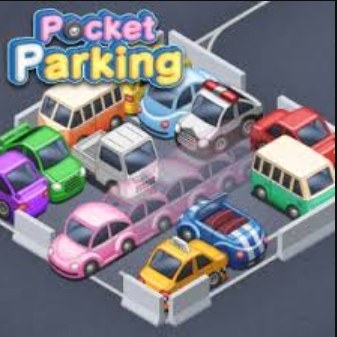
I opened Pocket Parking and immediately tapped the first level, expecting one of those breezy “slide the car into the rectangle” puzzles you see everywhere. The opening seconds were humbling. My little sedan clipped a bo
I opened Pocket Parking and immediately tapped the first level, expecting one of those breezy “slide the car into the rectangle” puzzles you see everywhere. The opening seconds were humbling. My little sedan clipped a bollard, oversteered into a lamp post, and ended up wedged diagonally across two spaces while a timer I hadn’t noticed ticked down. The game doesn’t tutorialize much — it drops you onto a cramped city lot and says, essentially, figure it out. That initial fumbling made the eventual clean park feel genuinely earned, and it hooked me for a solid twenty-minute session I hadn’t planned on taking.
What you’re actually doing (and why it’s stickier than it looks)
Pocket Parking isn’t a driving game. It’s a spatial-reasoning puzzle wearing car physics like a costume. Each level gives you a top-down parking scenario — parallel spot, angled bay, tight garage corner — and you control a vehicle using on-screen directional arrows or a virtual steering wheel, depending on your settings. The goal is simple: park inside the glowing outline without hitting anything. But the execution lives in the friction between your inputs and the car’s momentum. Turn in too early on a parallel park and you’ll scrape the bumper of the car ahead. Overcorrect on a three-point turn and suddenly you’re perpendicular to the space with the rear wheels kissing a concrete planter.
The loop tightens around a star rating system. Finish quickly and without collisions for three stars. Tap something — even lightly — and you’re capped at two. Exceed the time limit (which varies per stage) and you might scrape by with one star or a “retry” screen. Stars gate later levels, so if you’re the type who likes to unlock everything, you’ll need to revisit early stages for cleaner runs. There’s no currency, no upgrades, no garage to customize. The game bets entirely on its mechanics feeling satisfying to master, and for the most part, that bet pays off.
What surprised me is how much of the gameplay is about pre-visualization. The top-down view gives you full information — you can see every obstacle, every car, every stripe of paint — so the puzzle is never about hidden information. It’s about execution under gentle time pressure. I found myself pausing with my thumb hovering over the reverse arrow, mentally tracing the arc the vehicle needed to make. That moment of planning, followed by the slow, deliberate crawl into position, scratches the same itch as lining up a perfect shot in a physics puzzler.
Mechanics that matter: momentum, pivot points, and the camera
The physics aren’t simulation-grade, but they’re consistent enough to learn. Cars have a bit of weight — they don’t stop instantly when you lift your finger, especially on the faster “roll” levels where the parking brake might as well be greased. The turning radius varies slightly between vehicle types. Compact hatchbacks pivot tighter than the sedan, and the box truck in later levels is an exercise in patience. If you’re coming from a game with arcade-y instant rotation, the half-second of drift will throw you off. I lost at least four early runs because I expected the car to rotate around its center axis the moment I tapped left. Instead, the front end swings while the rear wheels lag, which means you need to start your turn a car-length earlier than your instinct says.
The camera deserves a mention because it’s both helpful and occasionally obstructive. The default view is a fixed overhead angle that shows the entire parking area. On most levels this works fine — you can see the space, the approach angle, and the obstacles all at once. But on stages with overhead coverings (parking garages with ceilings, awnings, trees with canopy shadows), the camera doesn’t always let you zoom or tilt. I had a moment on level 17 where a decorative tree’s foliage blocked my view of the rear bumper just as I was easing into a tight spot. I guessed the clearance, guessed wrong, and earned a two-star finish. The workaround is to use the car’s shadow as a depth cue. The shadow sits on the pavement and doesn’t get occluded, so you can judge position relative to painted lines even when the car body disappears under visual clutter.
Mistakes that end runs early (and how I stopped making most of them)
After replaying the first dozen stages multiple times to claw back stars, I noticed patterns in my failures. The single biggest run-ender was what I call “commitment panic.” You pull up alongside a parallel spot, check your angle, and everything looks fine. But the moment you start reversing, doubt creeps in. You adjust the wheel mid-maneuver — just a tap — and suddenly the car is on a collision course with the curb. The fix, counterintuitively, is to trust the setup. If your initial positioning is correct, the car will slot in with minimal steering input. The time pressure makes you want to micro-correct, but the physics punish twitchy inputs far more than they punish a slightly suboptimal line taken smoothly.
Another frequent mistake: ignoring the approach phase entirely. Some levels start you a fair distance from the spot, and there’s a temptation to floor it toward the target area, then figure out alignment once you’re close. This works on the easiest stages but backfires as soon as obstacles appear near the parking space entry. I developed a habit of using the first three seconds of each level just to trace the intended path with my eyes — start point, first pivot, second pivot, final alignment. It sounds obvious, but the timer’s presence made me skip this step repeatedly until I forced myself to do it. On levels where the timer is generous, those three seconds of planning saved me ten seconds of correcting.
The third mistake is specific to angled-bay levels. When pulling into a diagonal spot, it’s natural to approach from the center of the aisle and cut the turn. But the game’s collision detection on the front corners is unforgiving. Even a slight overlap with the adjacent car’s rear panel counts as a hit. I learned to swing wide — almost uncomfortably wide — before turning in. You use more of the aisle than seems necessary, but the entry angle ends up shallower, and the front bumper clears the neighboring vehicle with room to spare. On tight lots where swinging wide isn’t possible, I found that approaching in reverse (backing into the diagonal bay) gives better visibility of the rear corners and makes the angle more forgiving.
Sticky stages worth a specific mention
Not every level is created equal. Most follow a gentle difficulty curve, but a few spike unexpectedly. Level 24 sticks in my memory because it combines a narrow parallel spot with a time limit that felt about five seconds too tight. The spot sits between a delivery truck and a low wall, and the approach road is barely wider than the car’s turning circle. After six attempts, I realized the intended solution was a two-part reverse entry: back past the spot at a shallow angle, then cut the wheel hard once the rear axle clears the truck’s bumper. It’s a real-world parallel parking technique that I’d read about but never actually used, and seeing it work in a browser game was genuinely satisfying.
Level 31 introduces a multi-point turn in a dead-end alley, and it’s the first stage where I had to think about the car’s front and rear overhangs separately. The pivot point sits between the wheels, so the ends swing wider than the center. I scraped the front bumper on a dumpster three times before I realized I needed to treat the car less like a rectangle and more like two triangles hinged at the middle. Once that clicked, the level opened up.
If you hit a wall, the game doesn’t offer hints or skip options — at least not in the version I played. That’s a double-edged sword. It preserves the purity of the puzzle, but it also means you can get stuck with no recourse except trial and error. I respect the design choice even as I wished for a “show me the intended line” button on one particularly stubborn garage level.
Phone versus desktop: a tangible difference
I tested Pocket Parking on both a mid-range Android phone and a desktop browser with a keyboard. The experience diverges more than I expected. On mobile, the default control scheme is a pair of on-screen arrow buttons for forward/reverse and left/right steering. The buttons are large enough to hit reliably, but they lack tactile feedback, which matters when you’re trying to make a fractional steering adjustment at low speed. I found my thumb sliding slightly off the virtual D-pad zone on longer sessions, resulting in a missed input at the worst possible moment. Tapping the screen edges works better if you can train your muscle memory, but that took me a good ten minutes of fumbling.
On desktop with arrow keys, the precision improves noticeably. Tapping a physical key gives a discrete, repeatable input that’s easier to time. The downside is that keyboard steering is binary — you’re either turning full-lock or not turning at all, with no gradient. The mobile virtual wheel offers analog-ish control if you enable it in settings, but I found it too twitchy on a smaller screen. For stages requiring delicate angle adjustments (like the multi-point alley turns), the keyboard’s binary nature forces you to pulse the steering key rapidly, which works but feels inelegant. My best times came on desktop, but my cleanest parking jobs — the ones where the car ended up perfectly centered in the lines — happened on mobile with the virtual wheel and a lot of patience.
One practical note: if you’re playing on a phone, turn off screen rotation lock. The game renders in landscape by default on most devices, and having the UI flip mid-level because you tilted your phone is a guaranteed way to botch a run. I learned this the hard way on level 9 while parallel parking next to a fire hydrant.
A short practice plan that actually helped me improve
After my first fifteen minutes of chaotic three-star chasing, I stepped back and approached the game more methodically. The following routine isn’t a speedrun strategy — it’s a way to build the underlying skills so that later levels feel less punishing.
Start with the first five levels, but ignore the timer entirely. Your only goal is to park the car perfectly centered in the space — equal gaps on both sides, wheels straight, bumper not kissing the line. Do this three times per level. The repetition builds a feel for the car’s turning radius and momentum without the clock distorting your decisions. It’s boring, but the boredom is the point; you’re encoding the physics into muscle memory so you don’t have to think about them when the timer is ticking.
Next, pick one parallel-parking level and one angled-bay level from the early set. Time yourself on five consecutive attempts for each, writing down your times and collision count. The goal isn’t to beat your best time every run — it’s to reduce the variance. If your times are 12 seconds, 18 seconds, 9 seconds, 22 seconds, you’re relying on luck. If they’re 11, 10, 12, 11, 10, you’re consistent. Consistency matters more than raw speed because consistent lines are adjustable lines. You can tighten a consistent approach; you can’t tighten chaos.
Finally, for any level that gives you trouble, spend two minutes just driving around the lot without attempting to park. Circle the obstacles, reverse into corners, test how close you can get to walls without triggering a collision. This maps the actual hitboxes, which occasionally extend slightly beyond the visible geometry. I discovered on a garage level that a concrete pillar’s collision box was about a tire-width wider than the pillar’s visual model. Knowing that saved me from a string of mysterious crashes.
Pocket Parking won’t blow you away with production values — the car models are basic, the environments are functional, and the sound design is minimal. But the core loop is honest. It gives you a clear goal, consistent rules, and a scoring system that rewards precision without punishing experimentation too harshly. It’s the kind of game that fits into a coffee break but rewards longer sessions if you’re chasing three-star perfection. I came in expecting a throwaway time-killer and left with a genuine appreciation for how much nuance lives inside a simple parking mechanic. If you’re looking for a free browser game that respects your attention without demanding it, this one’s worth a spot in your bookmarks.