
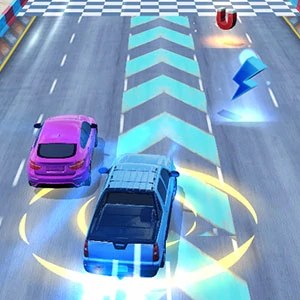
Rush Hour is a browser action game about racing through peak traffic, dodging and dashing to the finish. It suits players who stay calm under pressure and read gaps ahead rather than react late.
Rush Hour is an action game with a simple pitch: race through peak traffic, dodge and dash to the finish. That is the whole of what the catalogue tells us, and it is worth taking seriously. A game built on dodging and dashing through congestion is a game about decisions made quickly, under pressure, with the cost of a wrong one paid immediately. The strategy guide below works from that description rather than from any claimed playthrough. It separates what the catalogue confirms from what genre experience suggests, and it focuses on staying calm when the screen is busy.
What the description establishes, and what it leaves open
The supplied description gives us three verbs: race, dodge, dash. It gives us a setting: peak traffic. It gives us a goal: the finish. It does not give us a control scheme, a level list, a timer, a scoring system, or a difficulty curve. We should not pretend otherwise. If you go looking for a definitive list of Rush Hour levels or a confirmed button layout, the catalogue will not supply one.
What the description does imply is worth noting. "Peak traffic" suggests a crowded field of moving obstacles rather than a sparse track. "Dodge and dash" suggests two distinct movement ideas, one about avoidance and one about speed, and the pairing hints that they are not the same action. "Race" suggests forward progress against something, whether a clock or simply the finish line itself.
The automated check recorded the game loading successfully on a desktop device, with a load time of roughly nine seconds. That is a real data point, and a useful one: it means the first thing to plan for is a short wait before play begins, not an instant start. The check did not record controls, so treat any control description as something you confirm on screen rather than something this article can assert.
How the loop likely works, and what you are optimizing for
Genre-based reasoning suggests a loop that looks like this: you move forward through traffic, you read the gaps ahead, you commit to a dodge or a dash, and you either continue or you collide. Repeat until the finish. The optimisation target is not raw speed. It is the number of clean decisions you can string together without a collision resetting your progress.
That framing matters because it changes how you should think about the dash. A dash is almost certainly the fastest way to close distance, and it is also the action most likely to put you somewhere you did not fully plan for. The calm approach is to treat the dash as a tool for confirmed gaps, not as a default movement mode. If you dash into uncertainty, you are outsourcing the outcome to luck.
There is a second optimisation target worth naming: reading time. In a traffic game, the screen is full of things that are not relevant to you right now. The skill is filtering. You want to be looking two or three positions ahead rather than at the vehicle immediately in front of you, because the gap you need to hit is usually created by something further up the road. This is a genre-level suggestion, not a claim about Rush Hour's specific implementation, but it holds across most games built on this description.
Mistakes that end runs early
These are the concrete failure patterns that tend to appear in dodge-and-dash games. Apply them as a checklist when a run goes badly.
- Dashing into an unconfirmed gap. The most common run-ender. You see space, you commit, and the space closes before you arrive. Confirm the gap is still open at the moment you press the dash.
- Reacting instead of anticipating. If you are dodging only when a collision is imminent, you have already left it too late. Look further ahead.
- Hugging one edge of the road. Sticking to a single lane or side feels safe and quietly removes your options. Drift toward the middle of the available space so you can move in either direction.
- Treating the dash as a panic button. Pressing dash the instant things get crowded tends to accelerate you into the problem rather than out of it.
- Ignoring the finish orientation. Racing means there is a direction of progress. Losing track of which way "forward" is while dodging is a quiet way to waste seconds.
- Restarting too fast. After a bad run, the instinct is to immediately go again. One breath before you restart is usually worth more than the second you save.
Staying calm when the screen gets busy
The headline angle here is calm, and it is not a soft suggestion. In a traffic action game, tension narrows your attention. You start looking only at the threat closest to you, your inputs get twitchy, and you stop planning. The result is a run that ends in exactly the situation you were trying to avoid.
A practical countermeasure: pick one thing to look at. Not the whole screen, not every vehicle, just the next meaningful gap. When you notice your eyes darting, bring them back to that single point. This is a focusing trick, not a game-specific mechanic, but it is the kind of habit that keeps a run stable.
Another: separate dodge from dash mentally. When you are dodging, your job is positioning. When you are dashing, your job is commitment. Trying to do both at once produces the half-dodge, half-dash input that ends runs. Decide which one the situation calls for before you act.
Finally, accept the reset. If the game sends you back after a collision, that is information, not punishment. Note what you misread, then move on. Carrying frustration into the next attempt is the surest way to repeat the mistake.
Desktop and phone notes
The automated check confirms Rush Hour loads in a desktop browser. It took about nine seconds, which is long enough that you should expect a brief pause and not assume the page has failed. Give it a moment before you start clicking around.
For phone play, the catalogue does not confirm a mobile version or touch controls, so treat that as unverified. If you do try it on a phone, expect the usual trade-offs: a smaller field of view makes reading ahead harder, and touch input is less precise than a keyboard or mouse. Neither is disqualifying, but both argue for a more conservative approach. Dodge earlier, dash less, and give yourself more margin than you would on desktop.
Whichever device you use, free browser play means there is nothing to install and nothing to configure before you start. That also means there is no barrier to a quick retry, which is useful for practice and slightly dangerous for patience.
A short practice plan
You do not need a long session to improve. Four short passes, each with one focus, will do more than an hour of unfocused attempts.
Pass one: no dashing. Move through traffic using dodges only. The goal is not to finish quickly, it is to learn how the traffic behaves and how much room you actually have. If the game allows a slow run, take it.
Pass two: look ahead. Same movement, but consciously fix your gaze two or three positions up the road. Notice how much earlier you see gaps forming. This is the single most transferable skill in the genre.
Pass three: deliberate dashes. Now use the dash, but only into gaps you have already confirmed. Count your dashes and note how many ended cleanly. The ratio is your real progress metric.
Pass four: full pace. Combine everything. If a run ends early, do not restart instantly. Identify which of the mistakes above caused it, then go again.
Keep sessions short. Three or four attempts per pass is plenty. The point is to build the reading habit, not to grind. Rush Hour's description promises a race through peak traffic, and races reward composure more than they reward reflexes. Play the gaps, not the panic.