
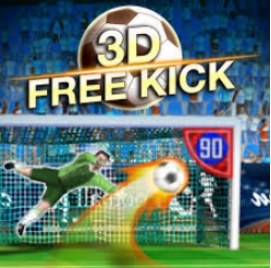
Freekick Football 3D strips soccer down to the dead-ball moment, challenging you to bend shots past a wall and keeper. It suits players who enjoy precision-based, single-skill gameplay over full matches. Master placement, curve, and small adjustments to score consistently on any device.
Freekick Football 3D: Dialing In Your Aim on Any Screen
Freekick Football 3D is exactly what the title promises. You stand behind the ball, the wall lines up, and the keeper shifts on his line. The game strips football down to the dead-ball moment, which means your entire session hinges on one skill: putting the ball where the keeper isn’t. The catalogue notes are thin, but the genre is well-worn, so we can talk honestly about what works, what doesn’t, and how to stop wasting attempts on the crossbar.
The Core Loop Is Simpler Than It Looks
Every free-kick game, including this one, asks the same question: can you bend a shot around a human wall and past a keeper who moves late? You are not dribbling, passing, or chasing possession. You are optimizing a single strike. The loop is pick your target, set your power, adjust your curve, and shoot. Then you watch the replay, see where the ball ended up, and adjust your next attempt.
What you are actually optimizing for is placement over power. A rocket into the top corner looks great, but a slower, well-placed shot into the side netting scores just as often. The keeper in these games tends to react to the ball’s trajectory rather than your body shape, so a shot that changes direction late is almost always more effective than a straight blast. Curve is your friend. Swerve the ball around the wall, not through it.
You are also managing the wall. The wall blocks a big chunk of the goal, and shooting straight through it usually means a block. You need to either go over the wall or around it. Going over requires more power and a lower trajectory arc, which brings the keeper into play. Going around means you need sharper curve and a wider starting angle. Both are viable, but you should pick one approach per kick rather than guessing mid-run-up.
The Mistakes That End Runs Early
Most failed attempts in this genre come from a handful of repeatable errors. The first is aiming at the obvious spot. You see the keeper leaning left, so you shoot right. That is fine, but the keeper recovers quickly in many of these games. Aim for the corner, not just the side of the goal. If you shoot to the middle-right, the keeper will often get a hand to it. If you shoot at the post itself, you force the keeper to make a save that is physically unlikely.
The second mistake is ignoring the wall’s jump timing. The wall will jump when you strike the ball. If you shoot low and through the middle, the wall blocks it. If you shoot high and over the wall, you risk skying it. The sweet spot is a shot that starts low enough to dip under the jump but with enough curl to bend around the edge. That means you need to start your aim wider than feels natural. Aim at the outside of the wall, not at the goal directly. The curve will bring it back in.
The third mistake is overcorrecting after a miss. You miss wide left, so you drag your aim far right, and now you miss wide right. The games use a consistent physics model. If you missed by a meter, adjust by a meter, not by three. Watch the replay. The ball’s path is usually shown after the kick. Note where the ball actually crossed the line relative to the post, then nudge your aim accordingly. Small adjustments, not big swings, are what get you consistent.
The fourth mistake is holding the power too long. In most free-kick games, power is a bar that fills and then drops. If you hold for max power every time, you lose control. The ball will sail over the bar or dip too late. Find the power that lets you clear the wall but still dip under the crossbar. That is usually around 70 to 80 percent of the bar, but you should test it on your first kick of each session. Every game has a slightly different power curve, and Freekick Football 3D is no exception.
Phone vs. Desktop: Different Hands, Same Physics
The controls differ depending on where you play, and that changes how you aim. On a phone, you are likely using touch and swipe. You drag on the ball, pull back to set power, and swipe in a direction to add curve. The key on mobile is to use your thumb’s natural arc. Swiping in a straight line is fine, but adding a slight curve to your swipe adds spin to the ball. That is a hidden trick in many touch-based kickers. You do not need to be precise with a mouse; you need to be smooth with your finger.
On mobile, your finger covers part of the screen. That is a real issue. If you are aiming at the top-right corner, your thumb is blocking your view of the ball and the near post. Adjust your grip. Hold the phone lower, or use your off-hand to tilt the screen slightly so you can see the target. Also, on a smaller screen, the goal looks smaller than it is. The keeper takes up a larger visual share. Do not panic and shoot at the center just because the goal seems crowded. Use the full width of the goal, even if it looks tight on a 6-inch display.
On desktop, you have a mouse or trackpad. This gives you finer control over the aim point. You can hover the cursor exactly on the post’s inside edge and hold it there. The problem is that fine control can lead to overthinking. You will spend five seconds trying to get the aim pixel-perfect, then rush the power because you are taking too long. Do not do that. Set your aim in two seconds, then focus on the power and curve. On desktop, the curve is usually applied by moving the mouse left or right during the strike, or by holding a separate key. Test the controls once, then commit to a rhythm.
One big difference is stability. On a phone, you can tilt the device slightly to adjust your view, which some players find intuitive. On desktop, you are locked to a fixed camera angle, so you have to read the geometry of the pitch from a static view. That is not harder, just different. Spend your first three kicks on desktop just learning where the posts are relative to the wall. On mobile, your first three kicks should be about figuring out how much swipe equals how much curve.
A Short Practice Plan That Actually Works
You do not need to grind for an hour to get good at this. Ten minutes of focused practice will beat forty minutes of random shooting. Here is a simple routine you can run through in any session.
Start with no wall and no keeper, if the game allows that mode. If not, just take your first three kicks aiming at the exact center of the goal. That sounds boring, but it calibrates your power. You want to hit the center of the net with a clean strike. Note how the ball flies. If it dips too much, reduce power. If it stays flat, increase power slightly. Get the ball to hit the net at chest height, not bouncing before the line.
Next, move to the corners. Aim at the top-left, then top-right, then bottom-left, then bottom-right. Do not add curve yet. Just straight shots. This tells you how much the aim point actually affects the ball’s final position. Many games have a slight aim assist that pulls the ball toward the center, so your top-corner aim might actually land closer to the middle than you expect. Adjust for that.
Now add the wall. Take five kicks trying to bend the ball around the right edge of the wall. Aim wide, add curve, and watch where the ball ends up. Then do the same on the left. The goal is to find the minimum curve needed to clear the wall while still keeping the ball on target. That is your bread-and-butter shot. Once you have that, you can start aiming for the corners with curve on, and you will see the keeper struggle to react.
Finally, practice the late-dip shot. This is where you aim high, over the wall, but use enough power that the ball dips at the last second. This is harder on mobile because your swipe speed affects both power and curve. On desktop, it is easier to control. This shot is not necessary, but it is satisfying. It also forces you to read the keeper’s position. If the keeper is cheating to one side, the late-dip shot into the opposite corner is nearly unstoppable.
End your practice session with three free kicks in a row. Do not restart if you miss. Just take the next kick as it comes. This trains you to reset mentally after a miss, which is the real skill in a game that is only about one kick at a time.
The bottom line is that Freekick Football 3D rewards patience and repetition, not raw power. Learn the power curve, trust the curve on the ball, and make small adjustments after every miss. Whether you are swiping on a phone or clicking on a desktop, the physics are consistent. The only variable is your own hand. And that is a variable you can train.