
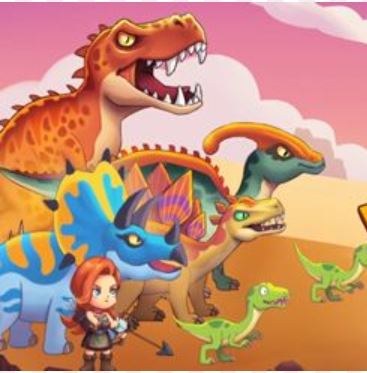
I fired up Merge Dinosaurs expecting a chill idle game where you drop cute cartoon dinos onto a grid and watch numbers go up. The first 60 seconds are exactly that—you drag two identical eggs together, they pop into a sl
I fired up Merge Dinosaurs expecting a chill idle game where you drop cute cartoon dinos onto a grid and watch numbers go up. The first 60 seconds are exactly that—you drag two identical eggs together, they pop into a slightly bigger hatchling, and the game gives you a satisfying little chime. It’s tactile in a way that feels good on a touchscreen or with a mouse. Then around the three-minute mark I realized I’d already boxed myself into a corner and had no space left to make anything useful. That’s when it clicked: this is not a casual sandbox. It’s a spatial puzzle that punishes you for treating it like a sticker book.
The Real Loop Isn't Just Matching
On the surface you’re merging prehistoric creatures to climb an evolution chain—egg, baby, juvenile, adult, and eventually something massive that takes up four tiles and looks vaguely like a T-Rex with extra spikes. Every merge frees up grid space and gives you a slightly higher-value dino that earns more coins per second or produces a special resource. The coins buy more eggs from a shop that restocks on a timer. Standard merge-game stuff.
But the thing you’re actually optimizing for isn’t the biggest dinosaur. It’s board density. Every tile you fill with a half-finished combo is a tile that can’t generate anything, and the game keeps feeding you new eggs whether you’re ready for them or not. You get eggs from the shop, from free daily chests, from watching optional ads, and sometimes just because the game decides to be generous. If you don’t have a plan for where each new item lands, you end up with what I call confetti board—a grid full of unmatched pairs spread so far apart you can’t merge them without a massive reorganization that costs you time and coins.
What separates a functional run from a doomed one is how you manage the space between merges. The game gives you a limited board (it starts small and expands as you level up, but expansions come slowly). You’re always working with less room than you want. Good players treat every unmerged dino as a temporary loan against future space. Bad players—and I was one for my first several attempts—hoard things because they “might need them later.” That instinct is a trap.
Combos Are About Setup, Not Speed
The word "combo" in Merge Dinosaurs doesn’t mean a flashy chain reaction where five things pop at once and fireworks go off. There’s no multiplier counter ticking up on the side of the screen. Combos here are quieter: they’re the sequence of merges you can pull off in a single reorganization without wasting moves or spawning new items in awkward spots.
A real combo starts with a cluster. You want three or more identical dinos sitting adjacent or within one tile of each other so that you can merge them all in quick succession, ideally freeing up a 2x2 or 3x2 rectangle of clean space. That rectangle becomes your staging area for the next wave of eggs. If you pull off the sequence cleanly, the newly merged higher-tier dino drops into the space you just cleared, and you don’t have to shuffle half the board to make room for it.
The highest-value move I’ve found is what I think of as the five-merge redirect. In most merge games, merging three items gives you one upgraded item and merging five gives you two. Merge Dinosaurs follows that rule. The two-for-one payoff is obviously better mathematically, but the spatial benefit is even bigger. When you five-merge, the two resulting dinos usually appear adjacent to each other, which sets you up for another merge later without moving anything. It’s a combo that plants the seed for the next combo. I started prioritizing five-merges not because I wanted efficiency but because I wanted the board to feel less scrambled ten minutes later.
Mistakes That End Runs Early
I killed at least three promising boards before I figured out what I was doing wrong. Here’s the list of things I wish someone had told me.
Buying eggs without a destination. The shop refreshes and it’s tempting to grab everything you can afford, especially when you see a dino you’re one merge away from completing. But every egg you buy lands in a random empty tile—or, if the board is full, it queues up off-screen and drops the moment you clear a space. I bought a batch of four eggs once, merged two things to make room, and watched all four drop into the exact spots I needed for a different combo. I spent the next five minutes digging myself out.
Merging the wrong thing just to make space. When the board is tight, you’ll be tempted to merge three low-value dinos that aren’t part of your current plan just to free up a tile. This feels productive in the moment, but it upgrades those dinos into a larger creature that takes up more room, and you’ve burned a merge that could have been part of a five-set later. I’ve done this, then looked at my board thirty seconds later and realized I now have a juvenile dino sitting exactly where I needed to place two eggs for a much better merge. The board punishes impatience.
Ignoring the spawn logic. New items don’t always drop randomly. The game seems to favor open spaces near the center or near recently merged items—I can’t prove the algorithm, but after a dozen runs I’m confident it’s not purely random. If you leave a tempting empty patch in the middle of your board, that’s where the next egg will land, and it’ll break up whatever cluster you were building around it. I started keeping my open spaces along the edges so new spawns don’t disrupt my merge lanes.
Overvaluing the biggest dinosaur on screen. That massive spiky T-Rex thing looks impressive and its coin generation is nice, but it’s also a four-tile anchor that can’t be merged further until you get another one of the same tier, which might take twenty minutes. In the meantime it’s eating up a 2x2 block you could use for three or four smaller merges. I’ve had runs where selling or ignoring a high-tier dino was the correct play because it was clogging the board. That felt wrong emotionally but right strategically.
What High-Value Moves Actually Look Like
After enough failed runs I started recognizing patterns that reliably lead to a clean mid-game board. One is the corner nursery. Pick one corner—I usually use the bottom-left—and dedicate it to your lowest-tier eggs and hatchlings. Let them accumulate there in a loose cluster without merging them until you have at least five of a kind. While they’re sitting there they’re not interfering with the rest of your board, and when you finally pull the trigger on a five-merge you clear multiple tiles at once and get two upgraded dinos that you can immediately walk to your staging area.
Another high-value pattern is the merge-and-scoot. When you merge two dinos and the resulting creature lands in a spot you don’t like, you can often immediately merge it with a neighbor of the same type if you’ve positioned things well. This moves the upgraded dino again, and sometimes you can chain three of these in a row so the final product ends up exactly where you want it without ever taking a “move” in the traditional sense. It feels like nudging a puzzle piece across the board with physics exploits.
The single most satisfying move I pulled off involved a five-merge of juvenile triceratops-like dinos that spawned two adults into a row I’d cleared in advance. Those two adults were sitting next to a third adult I’d placed there earlier, so they immediately formed a new merge set. I merged those three, got a higher-tier dino, and that dino landed on a tile that completed a different pair sitting one row up. Three merges, maybe five seconds, and I cleared something like eight tiles of clutter. That’s the combo high the game is actually selling—not VFX explosions but the feeling of a plan coming together perfectly.
Phone vs Desktop: It Matters More Than You’d Think
I played Merge Dinosaurs on both my phone and a desktop browser. The game is clearly designed for touch first. On a phone, dragging dinos feels natural and the hitboxes are generous—you can be a little sloppy with your finger and the game still knows which egg you meant to grab. The portrait orientation on mobile also gives you a nice tall board that suits the vertical flow of most merge strategies.
On desktop with a mouse, the experience is slightly clunkier. You have to click and hold to drag, and if your mouse skips at all you might drop a dino one tile off from where you intended. I misclicked several merges on desktop that I never would have botched on a phone. The wider landscape view on desktop shows you more of the board at once, which is genuinely useful for planning, but the tradeoff is precision. If you have the choice, I’d recommend phone for serious runs and desktop for experimenting with layouts where you want the overview.
One thing that’s consistent across both: the game runs smoothly in a browser with no downloads or installs. It’s free, it loads fast, and the ad breaks are there but not aggressive enough to make me quit. The occasional rewarded ad for extra coins or a special egg is actually worth it if you’re trying to recover a messy board.
A Practice Plan That Actually Builds Good Habits
If you’re brand new to Merge Dinosaurs and want to skip the phase where you restart every fifteen minutes in frustration, here’s a short practice routine I used that helped me stop making the same mistakes.
First session: don’t try to win or get a high-level dino. Just focus on keeping the board at least 20% empty at all times. That means merging or selling anything that’s taking up space without a plan. If you feel the urge to hoard, sell a low-value item just to prove to yourself that the world doesn’t end. This session is about unlearning the collector instinct.
Second session: commit to only performing five-merges. No three-merges allowed unless you’re literally out of board space and about to lose. This will feel slow and awkward, and you’ll have moments where you’re staring at three identical dinos begging to be merged. Resist. The point is to train your eye to see clusters of five and to learn how long you can afford to wait. By the end of this session you’ll have a much better sense of timing.
Third session: pick one merge chain and try to push it as high as possible while ignoring everything else. Sell dinos from other chains if you have to. This is deliberately unbalanced, but it teaches you how much board space a single high-tier creature demands and whether the payoff is worth it. Spoiler: usually it’s not, but you need to feel that for yourself.
After those three practice runs, go back to playing normally. You’ll notice you’re automatically leaving breathing room, eyeing five-sets before three-sets, and questioning whether that cool-looking big dino is actually helping or just posing for a screenshot. The game stops feeling like a frantic juggling act and starts feeling like a slow, deliberate optimization puzzle. That shift in mindset is the real progression system—more than any level-up or unlockable creature.
Merge Dinosaurs doesn’t explain any of this. The tutorial teaches you how to drag and drop, then waves goodbye. The depth is there if you go looking for it, hidden in the spatial constraints and the subtle incentives the board design creates. It’s the kind of game that rewards you for paying attention to the things most players ignore: empty space, drop patterns, and the quiet math of waiting for a fifth egg.