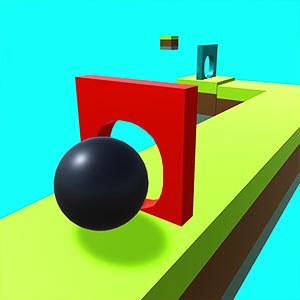
Through It is a one-button puzzle platformer where a block moves forward automatically and you click to switch between square, triangle and rectangle to fit through archways. It suits players chasing a high skill ceiling.
Through It is a puzzle platform game that leans hard on timing. The catalogue calls it "extremely challenging," and the setup is as simple as it sounds: a block moves forward on its own, and you have to reshape it to fit through archway openings. There is no jump button and no direction control to manage. Your only input is the left mouse button.
That single-input design is what makes the game worth a close look for anyone chasing a higher skill ceiling. When a game strips away everything except one verb, the difficulty shifts entirely. You are not learning a control scheme. You are learning a rhythm, and then you are learning to hold that rhythm when the gates start coming faster.
What the game actually asks of you
According to the catalogue description, your block changes shape each time you click the left mouse button. The shapes available are a square, a triangle and a rectangle. The block moves automatically, so forward progress never stops. The only thing you control is which shape you are wearing when you reach an archway.
To clear a gate, your current shape has to match the shape of the opening. Get it wrong and the block does not fit through. That is the whole loop: see the gate, know the shape it wants, click until you are that shape, arrive correctly aligned.
Notice what is missing from that description. There is no mention of a timer, a score, lives, or checkpoints. The catalogue does not tell us what happens after a failed pass, so I will not guess. What it does tell us is that the challenge is structural: the game is built around fitting a block through a series of gates, and the pressure comes from the fact that you are always moving toward the next one.
The real thing you are optimizing
Most puzzle games reward figuring out a solution. Through It rewards preparing a solution before you need it. Because the block moves on its own, you cannot stop to think at the gate. The thinking has to happen while you are still travelling.
That means the skill you are actually building is not shape recognition in isolation. It is shape recognition under forward motion. You look ahead, identify the next opening, count how many clicks separate your current shape from the required one, and execute those clicks early enough that the change completes before arrival.
Advanced play, then, is mostly about converting a reaction into a plan. A beginner sees a gate and clicks. A stronger player sees a gate, checks the click count, and clicks before the gate is close. The difference is small on paper and large in practice, because every click you defer is a click you have to make while the block is already at the archway.
There is a useful side effect to this approach. Once you are planning a gate or two ahead, you stop treating each archway as a separate problem. The sequence becomes a pattern, and patterns are faster to read than individual obstacles.
Mistakes that end runs early
None of these are exotic. They are the ordinary errors that a one-button game punishes because there is no second channel to correct with.
- Clicking at the gate instead of before it. The block does not wait for you. If your first click happens when the archway is already in front of you, you have spent your entire margin. Start the change earlier than feels necessary.
- Losing count of the shape order. The block cycles through square, triangle and rectangle. If you are not tracking where you are in that cycle, you will overshoot and have to come back around, which costs clicks you may not have.
- Watching the block instead of the road. Your eyes want to follow the object you control. But the block's position is not information you need. The next opening is. Train your gaze forward.
- Panic-clicking after a near miss. A single extra click leaves you in the wrong shape for the following gate. One rushed correction often becomes two errors.
- Assuming a gate you cleared tells you anything about the next one. Each archway has its own opening. Reading the pattern of gates as a whole is more useful than celebrating the last pass.
That last point deserves emphasis. In a game built on a repeating cycle of three shapes, the temptation is to assume the gates follow a matching rhythm. The catalogue does not say they do. Treat every opening as new information rather than an expected continuation.
Reading the cycle instead of memorizing it
With three shapes and one button, the state space is tiny. That is good news. You do not need to memorize anything, because the full set of possibilities fits comfortably in working memory. What you need is a reliable way to answer one question fast: how many clicks from here to there?
Because the cycle is fixed and short, the answer is never more than two clicks. From any shape, you are at most two presses away from any other. That is a genuinely useful fact for advanced play, because it caps the size of the problem. You are never solving something complicated at speed. You are solving something trivial at speed, which is a different skill and one that responds well to repetition.
Practically, this means your decision at each gate has three possible answers, and you should be able to produce the right one without conscious arithmetic. If you find yourself counting on your fingers mid-run, that is the thing to drill. The counting should collapse into recognition.
Desktop is the setup the game was checked on
The automated check for this title was run on desktop, where the game loaded successfully. That is worth stating plainly because the control scheme is mouse-based. The catalogue describes changing shape with the left mouse button, so a mouse is the natural input.
If you are playing on a phone or tablet, the catalogue does not describe a touch control scheme, and I will not invent one. The only confirmed input is the left mouse button, and the only confirmed test environment is desktop. Treat desktop as the known-good setup and go from there.
One more note from the check: load time was around 8.3 seconds. That is not a gameplay concern, but it does mean the first thing you do should not be a scored attempt. Let the game finish loading before you start reading gates.
A short practice plan
You do not need a long regimen for a game with one input. You need a few focused passes, each with a single objective.
Pass one: watch, don't win. Play a run with the explicit goal of looking one gate ahead at all times. Do not worry about clearing everything. If you catch yourself staring at the block, reset your gaze forward. This pass is about where your attention lives.
Pass two: count out loud. Say the click count before you press. "Two." "One." "Zero." The goal is to make the distance between current shape and required shape explicit rather than intuitive. It will feel slow. That is fine. You are building the habit that later becomes automatic.
Pass three: early clicks only. For this pass, commit to changing shape as soon as you can identify the next gate, even if it feels premature. The point is to find out how much lead time you actually have. If you are consistently arriving early and waiting, you have found your margin.
Pass four: full runs, no commentary. Drop the verbal counting and the deliberate early clicking. Just play. This is where you find out whether the previous passes stuck or whether you fall back into clicking at the gate.
Repeat the cycle if you need to. The whole thing takes less time than reading this article, and the game is playable free in a browser, so there is no cost to running it again.
What separates a clean run from a scrappy one
In a game with this little surface area, the difference between a good player and a great one is not knowledge. Everyone who has played for ten minutes knows the three shapes and knows that a click changes them. The difference is composure under automatic movement.
The block is going to keep going whether you are ready or not. Higher-skill play in Through It means being ready before it matters, keeping your eyes on the archways rather than the block, and treating each gate as fresh information. Get those three habits in place and the extreme difficulty the catalogue advertises becomes a matter of execution rather than surprise.